
 Written by
Daniel van Hek
Search Clicks·July 28, 2026
12 min read
Written by
Daniel van Hek
Search Clicks·July 28, 2026
12 min read
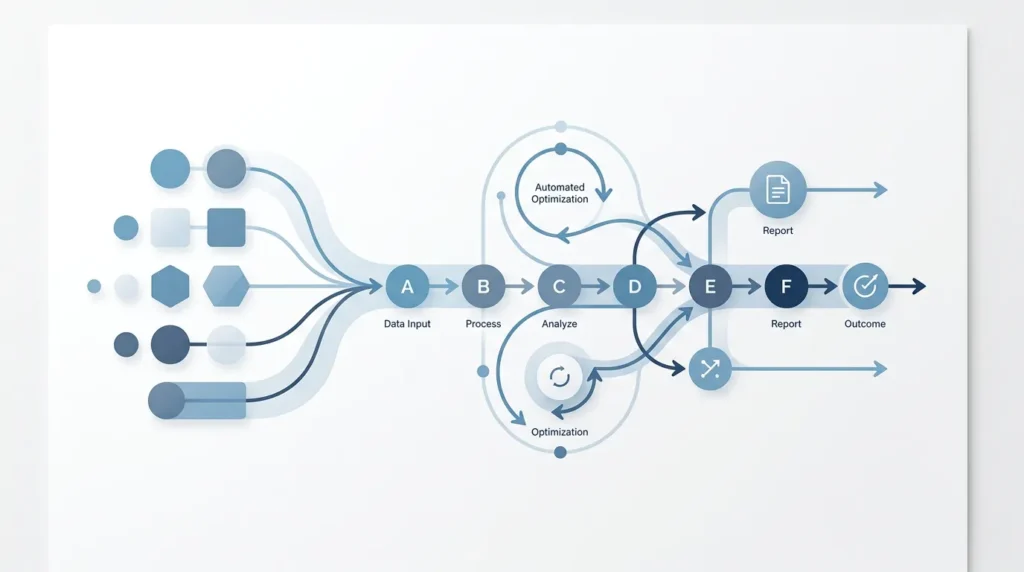
Imagine your team doing the same tasks every week, but without the typing on the keyboard and without those review rounds. That is what automation means in practice: you remove repetition and friction from your processes, so people have time left for work that really requires decisions.
In this article, we treat automation as a hub: you’ll learn what you can automate, what results you can realistically expect, which types of tools you’ll come across, and, above all, how to get started without the project turning into a months-long search for “the perfect solution”. We keep it concrete, with trade-offs you want to understand from the start. (Because yes, automation is not a magic button. It is a lever.)
Automation is the smarter organization of work so that part of the process runs by itself, with minimal human intervention. That can involve tasks, such as processing a form. But it can also involve an entire chain: from a request to a confirmation, registration and follow-up action.
In practice, you see two forms that we often come across:
An important detail that many teams only learn later: automation works best when the process is stable. If the input is different every time, “automatic” quickly becomes “manual correction”. And then part of the gain disappears. You can combine automation with checks, but then the question shifts to which controls make sense and who makes the decision.
If we look at the bigger picture, there is also a fact worth remembering when setting expectations: research shows that not every task can be automated 100 percent, but that a large share of work in organizations consists of activities that are at least partly automatable. McKinsey, for example, reports that about 30 percent of activities in 60 percent of occupations could technically be automated. At the same time, you also see that nearly all activities are fully automatable in only a small share of occupations. This helps you choose your scope honestly: aim for parts, not the full miracle. (mckinsey.com)
If you think “we don’t have time for automation”, chances are you haven’t chosen the right processes yet. We always start with a simple approach: look for work that (1) happens often, (2) has rules, (3) requires little creativity, and (4) can be measured in time or errors.
These are the most common areas where automation gives quick results in our experience. Not because it is sexy, but because it is often repetitive and data-driven.
There are three “returns” we usually see first. Sometimes in the same month, sometimes in two to three months. But if you choose the right use case, you will see improvement either way.
The NIST Center of MEP (Manufacturing Extension Partnership) emphasizes in its materials that automation is not only about saving labor, but also about broader benefits such as process stability and better alignment with your business needs. (nist.gov)
And one more important thing: automation almost always comes with a trade-off. Often that trade-off is not “time” but “change”. Your team has to learn how exceptions are handled, who owns the process, and how you safeguard quality when work moves faster.
Let’s go straight to the core. Automation only becomes valuable when you treat it as an improvement journey, not as a tool selection exercise. Tools matter, but strategy is the reason it keeps working.
We never start with a list of twenty automation ideas. We want one process you can measure. Think about:
Why this works: you can only judge whether automation adds value if you know what happened before. Otherwise you are optimizing by instinct. And instinct is fine for coffee, not for processes.
Before you automate, break the process down into a few building blocks. We ask questions like:
You do not need a perfect process map right away. But you do need to know where the decisions happen and where the work gets “messy”.
A common mistake is trying to make “everything automatic”. That leads to odd outcomes and extra correction work. A better approach:
This is the point where we often see automation suddenly become “workable”. Your team feels in control, while the standard workload still keeps moving.
Quality is not a spreadsheet afterwards. It belongs inside your automation. Think of validation rules, logging and simple checks.
This reduces an important risk. Automation without quality leads to “producing the wrong things faster”. Nobody wants that, except maybe a chaotic satirical sitcom.
Your first version does not have to be finished. It has to be usable. We recommend starting with a pilot, learning during the run, and only then expanding.
Why this works: processes change, data changes, and user expectations change. If you only start adjusting after months, the chance of stakeholders dropping out is bigger. Fast iterations make the project better and less stressful.
In the market, you roughly see four tool categories. We cover them functionally, so you do not get lost in brand names or marketing talk.
This is where you start for process steps. You define triggers (a form submitted, a file received, a status changed) and connect actions (routing, storing, creating tasks, sending notifications). This works well for processes with clear rules and relatively predictable input.
Trade-off: if your input is highly variable or if a lot of interpretation is needed, your workflow can quickly become “rules and exceptions”. Then a second component is needed.
Many automation projects fail not because the workflow is bad, but because the data is not reliable. That is why you often see integration tools: links between systems, field synchronization, and handling differences in data models.
Practical tip: if you cannot explain how a field arrives and who changes it, you cannot automate it well either. So start with data definitions.
When you deal with text, documents, or semi-structured data, AI can help with interpretation or classification. But, and this is crucial: AI does not only automate, AI also introduces variation in outcomes. That is why you need control: thresholds, review steps, and quality measurement.
In practice, we see that AI adds the most value when you have a clear goal, for example classifying and enriching data, after which the workflow handles the rest.
RPA is often used for processes that are stuck in systems without good integrations. Robots then mimic actions in an interface. This can deliver quick gains, but it requires maintenance when the UI changes.
Trade-off: RPA can be a solid bridge, but we often recommend “graduating” it to a better integration afterward, as soon as that becomes possible. In coffee language: first shuffle, then build properly.
If you need language internally for automation, a simple description like the one that comes from business contexts helps: business process automation is the use of technology to handle business processes with minimal human intervention. (techtarget.com)
It sounds formal, but it is useful. It pushes your team to think about the process, not just a single task.
Okay, we have strategy and tools, now you want a next step. Here is a plan you can start within one week, with enough structure for professionals.
Goal: after day 1, your team knows why you are automating.
Goal: you are not building automation on a mystery.
Goal: you make the logic explicit.
Goal: you learn quickly, without turning the whole company into a test environment.
And yes, adoption is also about behavior. Automation changes how work is “planned” in your team’s head. Be honest about that.
If you take automation more seriously, it becomes more than a single project. You get a system to standardize, measure and improve work. In turn, you often see:
Research around automation and work also shows that productivity does not just increase, but that the timing and impact depend on implementation, the alignment between people and technology, and the extent to which tasks are truly suitable. McKinsey, for example, describes that automation can influence productivity growth and that feasibility differs by type of activity. (mckinsey.com)
Translation to the workplace: your results do not depend only on your tooling. They depend on how well you design the standard route, exceptions and quality checks.
Let’s name the pitfalls honestly. Then you can skip them, and that is the fastest way to save money and energy.
You start with everything. It ends with nothing. Choose one process, measure it, and only then scale up.
If the input is messy, you quickly create a messy system. Start with validation and data definitions.
Then you get “automation stops” instead of “automation escalates”. Write down the escalation flow, with owner and timeline.
Measurement is exactly where you build trust. You see whether the workflow really delivers less time or fewer errors.
Your team needs to know what they now do differently. We see that short, practical instruction works better than a long session where nobody dares to ask questions.
Automation is not “replacing people”. It is “removing friction”. If you approach it well, you reduce turnaround time, reduce errors, and free up capacity for work that really requires judgment.
Our recommended order is simple:
If you also think about how process improvement can ripple out more broadly, it helps to connect it to other growth tracks, such as SEO and content structure. If you want to approach that in a practical way, this is a useful internal hub to read along with: SEO Agency: Complete Guide to Search Engine Optimization.
Grab your coffee now and choose one process you can measure this week. Automation starts with one good question: “Which step costs us the most time, with the most repetition, and which outcome do we need to guarantee?” That is where your best starting point is.
Book a free strategy call and discover how many leads we can generate for your business. No obligations — just a concrete growth plan.
Book your free strategy call → Book your free strategy call — 30 min, no strings attached