Written byDaniel van HekSearch Clicks·August 15, 2026
11 min read
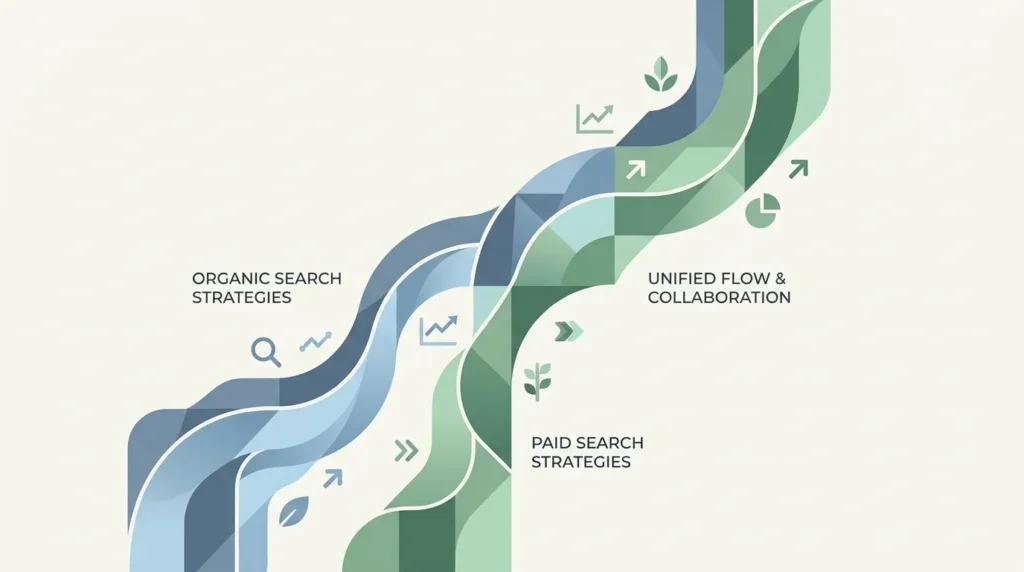
You search for “seo sea”. Good choice. Because in practice Search Engine Optimization (SEO) and Search Engine Advertising (SEA) do not work as separate worlds. They are better seen as a team sport: SEO builds demand and trust. SEA brings in visitors and data quickly, so we learn faster. And together they drive the real outcome: lead generation through the website and sales process.
In this article, we’ll walk you through the strategy behind that collaboration. No theory for the sake of it, just steps you can execute tomorrow. We’ll keep it practical, with attention to tracking, landing pages, and data-driven decisions. Because without measurement, you’re just guessing, and guessing is expensive.
What do we mean by seo sea, and why does the combination work?
Let’s first get clear on what you’re actually trying to solve with “seo sea”. Usually it comes down to one of these three problems:
You want faster results, but SEO takes time.
You pay for traffic, but you want SEA to sell not only clicks but also leads.
You lack insight: which keywords and pages really work for your commercial goal?
The core strategy is simple: SEA enables speed, SEO enables sustainable growth. SEA helps you test which search intents convert. SEO helps you turn those same insights into pages that can keep attracting visitors at a lower cost later on.
SEA has predictable feedback loops, SEO has durable growth
With SEA, everything revolves around the ad auction. Google selects ads with an auction that runs every time someone searches or visits a site where ads are shown. In that evaluation, factors such as the quality of your ad and your landing page play a role, including relevance and user experience. (support.google.com)
With SEO, we focus on visibility and clicks in the organic results. In Google Search Console (GSC), for example, you can see clicks, impressions, and an average CTR, as well as average position as a reporting indicator. (support.google.com)
The practical point: SEA quickly tells you which message and landing page match the searcher’s intent. SEO later tells you which pages keep performing. By connecting them, you avoid learning the same thing twice.
The basics: search intent, landing page, and tracking
If you want to apply seo sea intelligently, it doesn’t start with budget or tools. It starts with three basics: search intent, landing page, and tracking.
1) Search intent: choose clusters, not individual keywords
You don’t want to manage 200 separate keywords. You want to build clusters of intent. For example:
Comparison: “request a quote…”, “alternatives…”, “terms…”
Action-oriented: “take out insurance…”, “schedule an appointment…”, “contact…”
Why this works: your ad copy, your landing page, and your conversion steps need to carry the same promise. Google Ads also emphasizes that alignment between ad and landing page helps with ad relevance and landing page experience. (support.google.com)
2) Landing page: make matching easy
Your landing page is not just a page; it’s your salesperson in a marketing jacket. Google describes that the quality of your landing page and the navigation experience are important for ad quality during the auction. (support.google.com)
Practically, this means the following for your landing pages:
1 clear main message per page, linked to the intent cluster.
A fast route to the CTA, no “scroll for twenty minutes first”.
Proof that is relevant to the intent (costs, process, planning, FAQ).
A form or conversion step that fits the threshold: fewer fields for TOFU, more context for BOFU.
Tip from experience: if you run an SEA campaign with “action-oriented” search intent, but your landing page is more blog than quote request form, your budget is paying for confusion. And confusion is rarely profitable.
3) Tracking: measure conversions, not just click behavior
SEO and SEA only become interesting when you measure what happens after the click. In Google Analytics 4 (GA4), you can base conversions on events and also link conversions to campaign optimization. (support.google.com)
What matters is that your conversion is a commercial action. In lead generation, we are therefore not talking about traffic, but about a lead: a person or company with real commercial interest, visible through completed contact details or an actual inquiry.
Practical tracking checklist:
Define your conversion as a lead (for example: “form submitted”, “contact requested” or “appointment booked”).
Work with key events in GA4 and mark which events are conversions. (support.google.com)
Use Google Tag Manager (GTM) to check whether your events really fire at the right moments (especially with error handling and validation).
How we steer SEO and SEA together, step by step
Now for the fun part: how to run seo sea as a system. Below is an approach we often use with B2B and B2C companies that put lead generation at the center.
Step 1: Use SEA as a test lab for intent and landing pages
Start with SEA campaigns on the most profitable intent clusters. Your goal is not just traffic. Your goal is learning:
Which search terms bring in leads of the right quality?
Which landing page delivers the best CVR (Conversion Rate) to lead?
Which message fits the funnel stage?
SEA helps here because ads are selected based on relevance and landing page experience. So if your ad copy and landing page don’t match, you often see that reflected directly in performance. (support.google.com)
Step 2: Turn SEA winners into SEO content and pages
After a testing period, pull the data from SEA. What you’re looking for:
Search terms or variations that generate leads at an acceptable CPL (Cost Per Lead).
Landing pages that convert better on a structural basis.
Ad variations with clear intent that you can translate into an SEO page structure.
Then you create SEO pages that carry the same “promise” concept. Think of:
Service pages per intent cluster.
Comparison pages with FAQs (costs, process, duration, availability).
Clear internal links to related pages so Google and users understand the logical path.
Why this works: you use SEA as a feedback mechanism. SEO benefits from consistency between intent, content, and conversion path.
Step 3: Use SEO insights to make SEA campaigns smarter
SEO data gives you context on where you are already being found organically. In GSC, you can see how often your site appeared in the results and how often people clicked (clicks and impressions), plus average CTR and average position. (support.google.com)
In practice, you use this like this:
Look for queries where you do have impressions but a low CTR. Improve your ad copy and landing page match.
Look for queries where you already have position, but are generating few leads. Then your conversion path is probably not sharp enough.
Build SEA experiments based on pages that already show signals organically.
KPI’s and budget decisions without driving yourself crazy
When you combine seo sea, your KPI set needs to stay simple. Otherwise you’ll pile up reports until nobody trusts anything anymore.
The KPI’s we actually use
CPL (Cost Per Lead): what it costs to get a lead, including traffic costs and the conversion path.
CVR (Conversion Rate): how well the landing page turns visitors into leads.
CTR (Click-Through Rate): says something about message and intent match, but never as a KPI on its own.
CPA (Cost Per Acquisition) or (Cost Per Action): choose one definition and stick with it. For lead generation, we usually use Cost Per Acquisition as “cost per lead”.
ROAS (Return on Ad Spend): relevant if you can measure real sales value per conversion.
Note, honestly: not every company can measure ROAS with confidence. If your sales cycle is long or offline transactions are hard to connect, ROAS is an estimate. In that case, we primarily steer on CPL, CVR, and lead quality.
Budget allocation: when do you push SEA and when do you invest in SEO?
A workable rule from practice:
If SEA delivers leads with a CVR that fits your conversion path, scale the intent cluster that works.
If SEA attracts traffic but CVR is low, improve the landing page and internal flow before increasing budget.
If SEO pages get impressions and clicks but no growth in leads, the issue is often CTA, form, or content match.
Google Ads quality systems look at landing page experience and relevance. So if that doesn’t fit, you’re pouring money into a hole. (support.google.com)
Common seo sea mistakes, and what to do instead
We really see this often. Here’s how you avoid it.
Mistake 1: SEO and SEA have the same KPI’s, but not the same goal
SEO’s goal is sustainable growth and lower marginal costs. SEA’s goal is speed, testing, and capturing demand. If you force them under one KPI, you lose strategic balance.
So what do we do instead?
SEA focuses on CPL and CVR in the first phase, and on lead quality once you can measure it.
SEO focuses on organic CTR and conversion from pages that cover the intent content-wise.
Mistake 2: One landing page for everything
Your landing page has to match intent. If you use one page for both orientation and action, it becomes a compromise. The user feels that. And Google does too.
So what do we do?
Create a dedicated landing page for each intent cluster.
Align SEA ads with those pages.
Use the same messaging structure so users don’t feel a “switch” between ad and page.
Mistake 3: Tracking isn’t finished, so optimization is blind
If you don’t set up GA4 conversions correctly, you optimize for behavior that isn’t a lead. Then campaigns seem “good”, while your sales pipeline actually stays empty.
So what do we do?
Verify events and conversions in GA4, and create “key events” that truly measure lead generation. (support.google.com)
Use only those conversions as the basis for optimization.
Mistake 4: Scaling too quickly without insight into quality
Lead quality is the difference between “some leads” and “a good pipeline”. Without qualification, you’re only measuring output, not value.
So what do we do?
Work with Marketing Qualified Leads (MQL) and Sales Qualified Leads (SQL) in your process.
Feed those back into campaigns so you don’t only steer on CPL, but also on “measurably usable”.
Your next step: a concrete seo sea work plan for the next 30 days
Alright, enough coffee theory. Let’s turn it into a plan. Use this as a starting point, not as a straitjacket.
Week 1: preparation and measurability
Create intent clusters and select 3 to 5 clusters for SEA.
Check GA4 conversions and key events, and verify that your landing page actions are being passed through correctly. (support.google.com)
Check GSC for the organic pages and queries that are already getting clicks. (support.google.com)
Week 2: SEA live and landing pages tightened up
Launch SEA with ads that match the promise of the intent cluster exactly.
Make sure the landing page navigation and CTA route are logical. Google explicitly mentions that landing page experience and navigation are relevant. (support.google.com)
Use iterations on messaging and form copy, not just on budget.
Week 3: SEO sprint based on SEA data
Identify SEA variations that show better CVR and translate them into an SEO page structure.
Create or rebuild content so the pages address the intent directly.
Set up internal links around the commercial path so users don’t get lost.
Week 4: optimize, consolidate, and lock in the system
Calculate CPL and CVR per intent cluster for SEA.
Use GSC signals to improve SEO CTR and relevant search questions. (support.google.com)
Create a backlog for CRO (Conversion Rate Optimization) on landing pages that are almost there, but not converting.
If you want to discuss this or need acceleration, it can help to have your approach supported. For example, by connecting content and landing pages to your SEA structure, or by streamlining your SEO and CRO planning. For orientation, here are a few relevant internal articles that can help with the practical side:
Conclusion: seo sea as one growth engine for lead generation
If you do seo sea well, you get a growth engine that learns faster and becomes cheaper later on. SEA gives you speed and test data. SEO turns that knowledge into pages that keep performing. But only if you connect it to intent, landing pages, and conversion tracking.
So our recommendation for your next step is not “more budget”. It is: build intent clusters, fix your conversion tracking and optimize your landing page match. Only after that should you scale what really works.
And good news: once you run this as a system, your marketing becomes less of a gamble and more of a routine. The only dry humour we allow is this: your ads are allowed to learn, your leads are not. You want to bring those in right the first time.
Book your free strategy call — 30 min, no strings attached
Cookies on this site
We use analytics cookies to see how the site is used. They are only placed if you agree. Refusing costs you nothing — the site works exactly the same. Privacy statement