
 Written by
Daniel van Hek
Search Clicks·August 3, 2026
9 min read
Written by
Daniel van Hek
Search Clicks·August 3, 2026
9 min read
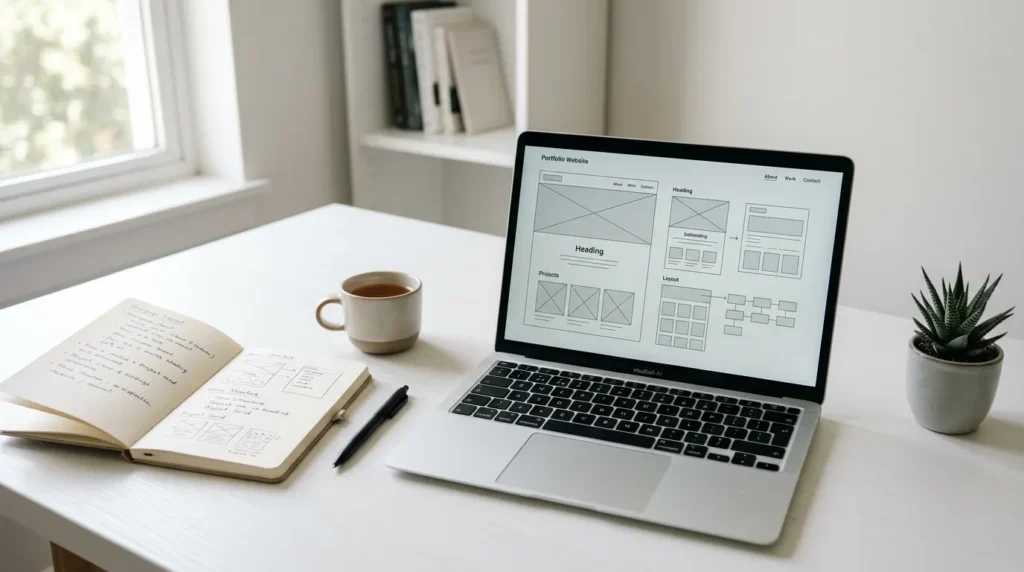
You have a business, you have an offer, and you want people to find you and then take action. In that case, “have a website built” is not a project in itself. It is a marketing tool, with technology as a requirement.
In practice, we often see the same pattern: a website is built based on taste, not on behavior. It feels fresh at delivery. But it generates fewer leads, because the structure is off, the content does not match intent, and the pages load too slowly on mobile.
Our approach is therefore pragmatic: we link every choice to a goal. And we measure along the way, so you do not have to guess until launch.
Let’s be honest: you can put almost anything on a website. But not everything works equally well for your audience. That is why we start with a short set of decisions. No thick reports. Just direction.
What do you want visitors to do? Think of:
You choose one primary goal. That makes your pages sharper. Everything that distracts gets a lower priority.
We want to know which questions people have before they get in touch. Usually you see roughly:
Once this is clear, building suddenly makes sense. You create pages that support the next step.
Search engines and users need to understand your site. Google emphasizes that your website structure and navigation can influence how information is understood. (developers.google.com)
In practical terms, this means:
You can write the best copy, but if people do not scan it, nobody reads it. Research on online reading behavior shows that people often scan using patterns like the “F” pattern, where they mainly pay attention to headings and the first lines. (nngroup.com)
So yes, copy matters. But your layout drives behavior.
Concretely, we recommend:
If your website is slow on mobile, you lose people. And not just a little. We see it has a direct impact on conversion.
Google uses Core Web Vitals in reports and guidelines. Core Web Vitals combines data and status around metrics such as LCP and CLS. (support.google.com)
PageSpeed Insights also explains that it evaluates performance on mobile and desktop and provides improvement points based on lab and real world data. (developers.google.com)
Our starting point when having a website built is therefore simple: speed and stability first, then “polish”. Because polish on a slow page is like makeup on a flat tire.
We focus on the things that are measurable:
Important: speed is not a goal in itself. It is a means to get your message to the right people faster.
We often get this question: “Do we get SEO included when we have a website built?”
Our answer: SEO is not an add-on. Your website must be search-friendly by default, and your content must help solve questions. Google explicitly states that your content should be helpful and made for people. (developers.google.com)
In addition, Google warns that if important parts are “hidden” (for example through CSS or JavaScript in a way Google cannot properly understand), you are less likely to be shown. (developers.google.com)
This is usually where the real difference lies. A website with 10 pages can perform better than a website with 60, if the 10 pages answer exactly the questions people are searching for.
If you want, we can extend this into broader content tracks. For example with Inbound Marketing: attracting customers with valuable content. The point is the same: you build discoverability by delivering value.
The way people search is changing. That is why we think beyond traditional ranking alone. We pay attention to how you present information clearly, so it is easy to use in answer systems.
Want to go deeper on that? Then GEO (Generative Engine Optimization) explained, in practice fits. And if you already want a hub idea: GEO (Generative Engine Optimization): Hub for AI search engines.
This is a direction for advice, not a guarantee of specific positions. But it is a way to make your site futureproof.
Having a website built is never one fixed price. The price depends on scope, depth and delivery speed. What you can do is structure the costs clearly.
If you demand “live in 3 weeks”, you usually create extra pressure. That often comes at the expense of:
So you have to choose: speed or depth. Sometimes you can have both, but then you generally need content already in place and a clear scope.
That prevents you from ending up with a website that is “done” but not “right”. A workable phase structure:
That final step is not a luxury. Without optimization, your website remains a snapshot.
You can find many agencies. But the question is: who thinks along about execution and results?
We use a simple checklist for that. Also see Choosing a marketing agency: what to look for.
If the answer stays vague, that is information. Then it is probably a build agency, not a marketing partner.
Okay, coffee is gone. Let’s keep it practical.
If you are searching “have a website built” today, you usually want one thing: a route to a result that fits your business. That is why we recommend this next step:
Based on that, you can make your scope and planning realistic. Not on instinct. On substance.
A website without follow-up is like opening a shop without staff. That is why we often connect the website to your marketing channels.
By linking data to campaigns and follow-up, your website becomes a system, not a separate page.
Once your website generates leads, you do not want someone to process everything manually. That is why we also look at marketing automation. Think segmentation based on behavior, and smart follow-up flows.
If that applies to you, Marketing Automation: efficiency and scale through smart flows fits.
You can have a website built as a project. Or you can approach it as marketing with a build plan. The first feels faster, the second usually delivers the most.
Our core advice is simple:
If you want, you can then sharpen your broader organic strategy with SEO in practice: strategy, execution and growth. But first: a website that does what it should do.
And that is exactly what we help you with, step by step. Because a good website is not a work of art you admire. It is a machine that turns visitors into opportunities.
Book a free strategy call and discover how many leads we can generate for your business. No obligations — just a concrete growth plan.
Book your free strategy call → Book your free strategy call — 30 min, no strings attached