
 Written by
Daniel van Hek
Search Clicks·July 31, 2026
10 min read
Written by
Daniel van Hek
Search Clicks·July 31, 2026
10 min read
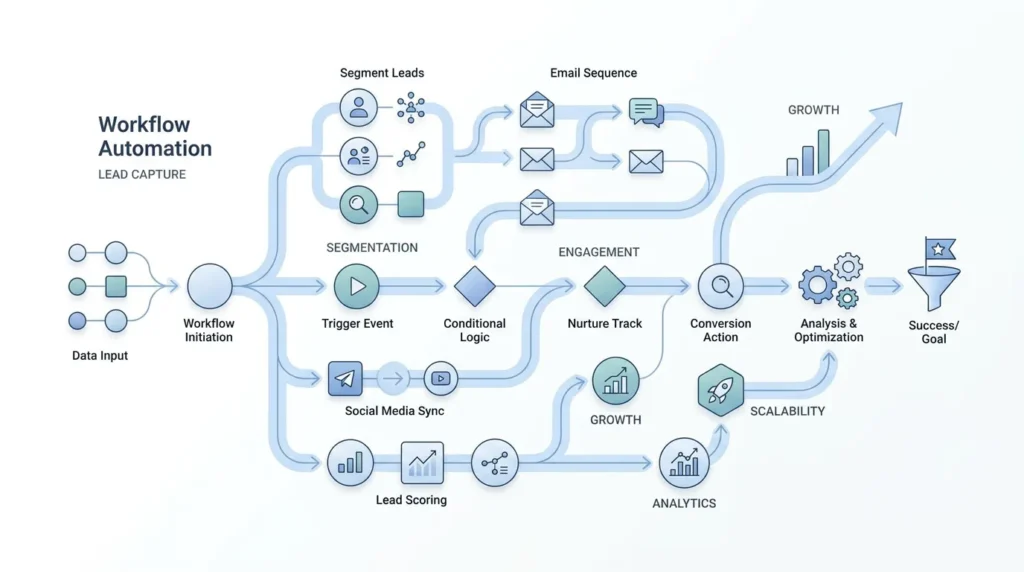
Imagine if we finally treated marketing the way you treat your production department: with process control, measurable steps and clear responsibilities. That is exactly where automation comes into play in marketing. Not as a gimmick. But as a way to free up time, improve consistency and steer your campaigns faster and smarter.
In this article, we walk through what marketing automation means in practice. We discuss which automations really deliver value, where things often go wrong, how to keep it safe and compliant (think privacy), and what the first concrete step is for your team. We keep it practical. And yes, we also show you where the pitfalls are, because automation is not a belief system, it is engineering with marketing insight.
When people say “marketing automation”, they usually mean two things at once:
Important insight: the further you move toward “deciding based on data”, the more you need to pay attention to quality, control and privacy. The marketing gain then comes not only from speed, but from better timing, relevance and less human inconsistency.
In practice, we see that customer behavior is becoming less and less linear. Someone clicks, waits, disappears, comes back later. Automation helps you avoid waiting for manual follow-up. You respond to intent, instead of to a campaign calendar.
But let’s be honest too: automation that is badly designed damages your brand. Think repeating the same email, bad timing, or segments that do not match. That is why the strategy under the hood is at least as important as the tools.
Many teams start with automation by “building a workflow” without defining the problem. That feels productive. It sometimes delivers something too. But for real scale, you need an approach.
We start with one question: where are you losing the most time or revenue right now because of delay, manual work or inaccuracy?
Typical moments:
So you do not choose automation because it is “nice”. You choose automation for impact.
Most automations fall into three goals. If you get this sharp, your choices become easier:
Trade-off to know: relevance requires better data and more governance. Speed mainly requires standardization. Quality often sits in validation and monitoring.
A strong automation always has:
That sounds like a project plan, but it makes your workflow reliable. And reliable workflows are what sales and marketing need to build trust in them.
You do not need to automate everything. You choose the flows that prove themselves in behavior and in business processes. These are the categories we most often see with teams that scale effectively.
We build flows around behavior, not only around “subscribed or not”. Think about:
Why it works: you reduce the time between intent and relevant follow-up. In addition, it feels less like spam because the content connects logically.
You can do multichannel without chaos by using one system as the control source, and other channels as execution. For example:
The reason this works: you prevent someone from getting the same story five times through different routes. Consistency is your hidden advantage here.
An easy win is automatically summarizing behavior for sales. Not as a masterpiece. As usable context:
Why this works: you make follow-up faster and more targeted. And honestly, sales can do without an extra meeting. It would rather have data.
Many teams automate only the marketing output. We recommend building automation into quality as well:
This is less sexy, but it prevents hassle. And hassle costs more than you think, especially when you scale.
Tools matter. But you choose tools to realize a process, not to tick off a “stack”. A practical way to choose is to work with building blocks.
Trade-off to understand: the more you put into one platform, the less integration hassle you have. But you do not always get the best control for every part. That is why we look at fit per building block.
We often speak with teams that build workflows, but nobody is responsible if something goes wrong. That is dangerous, especially when automation sends messages or passes leads on.
That is why we always make agreements:
When you use automation based on behavior and profiles, you quickly touch privacy and legal obligations. We are not giving legal advice here, but we can point out the core you should not skip.
Under the GDPR, rules apply to situations where there is solely automated decision-making with significant effects, including profiling (see Article 22). The regulator in the United Kingdom summarizes this in guidance, with emphasis on when those rules apply. (ico.org.uk)
In practice, this often means:
Your governance does not have to be heavy. It does have to be workable. This works in practice:
Small humor, big truth: if you do not log your automation, it is not automation, it is a mystery with customers in the lead role.
Okay, now the part you were probably waiting for. This is an implementation path we often see succeed. No long consulting cycle, just clear steps.
Note: we do not promise a magical increase. What we do promise based on practice is that this approach gives you fewer surprises, and faster direction for iterations.
You asked for automation. But in practice, it always goes together with content and discoverability. So here is a short, E-E-A-T-driven check: how do you make sure your automated marketing and related content come across as trustworthy?
Google explains in Search Central that their systems want to reward people-first content, with attention to E-E-A-T signals (Experience, Expertise, Authoritativeness, Trustworthiness). (developers.google.com)
What does that mean for marketing automation, concretely?
This is not to “fake” SEO. It is to prevent automation from turning your brand into a printer that is afraid of context.
If we bring this back to one piece of advice, it is this: start small but design seriously. Take a use case that fits your bottleneck, choose one primary metric, and plan iterations within one to two weeks after going live.
If you are already working with email, it is smart to connect your nurture logic to a broader approach. For example, you can look at Email Marketing: Complete Strategy Guide to structure your campaigns and flows better and keep them consistent across channels.
After that, scale growth follows naturally. Not by stacking more workflows, but by better rules, better data and better governance. The real win is repeatability: every new flow becomes faster and more reliable because your building blocks are already in place.
Automation is not an end in itself. It is a way to speed up your marketing process, make it consistent and make it more relevant for customers. If you approach it strategically, with clear triggers, measurable goals and governance around privacy and quality, then you get scale growth you can explain to both marketing and management.
Your next step is simple: choose one concrete flow, define one success metric, build with control, and iterate on data. We would rather do it right once than half-done ten times. And that saves your team energy, plus your customers confusion. That is a win for everyone.
Book a free strategy call and discover how many leads we can generate for your business. No obligations — just a concrete growth plan.
Book your free strategy call → Book your free strategy call — 30 min, no strings attached