
 Written by
Daniel van Hek
Search Clicks·September 25, 2026
11 min read
Written by
Daniel van Hek
Search Clicks·September 25, 2026
11 min read
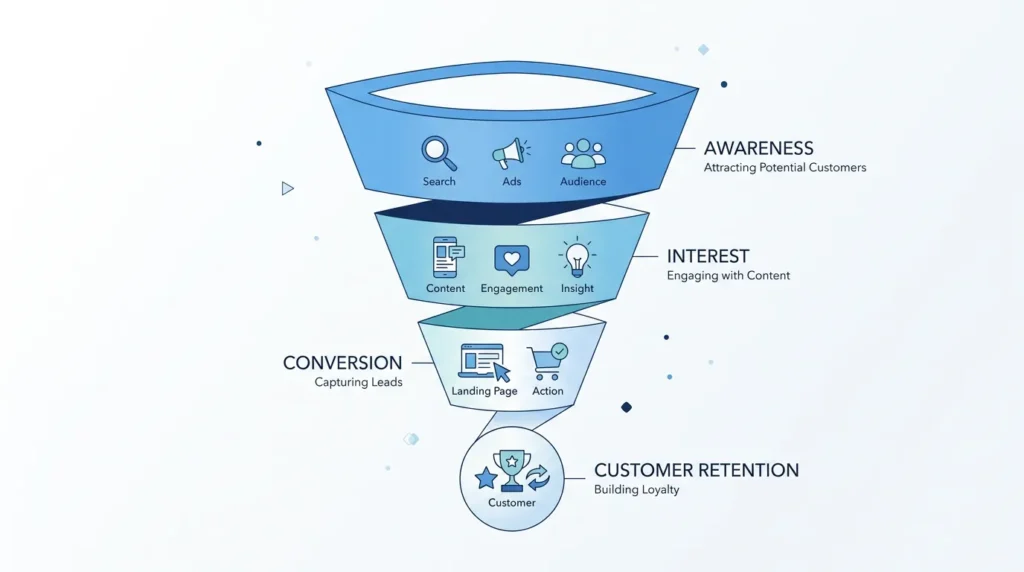
You want to generate B2C leads. Not “more traffic,” not “more sign-ups,” but contact moments with people who could actually become customers. That’s the difference. In B2C, lead generation can seem simple. Click, form, done. In practice, it often falls apart in three places: you’re not measuring it properly, your landing page is off, or your follow-up is too slow or too generic.
So we tackle it systematically. First, we make sure your definition of a lead is right. Then we build a funnel that attracts the right people, converts them, and moves them into the next steps. And finally, we set up tracking and follow-up in a way that lets you actually make improvements.
In B2C, a lead is only a lead when someone gives a clear commercial signal through online channels. Think of: a completed contact form with usable contact details, a request for product advice, a sign-up with an email address, or an appointment request. What you absolutely want to avoid is treating website traffic as “leads.” That’s the recipe for wrong KPIs and wasted budget.
That’s why we work with a small set of measurable definitions. This is what works well in practice:
Why does this work? Because then you can steer on quality, not just volume. And your sales process gets leads that don’t just “sound nice,” but are commercially relevant.
Want to work mainly with Google Ads? Then make sure your conversions for lead generation are measured in a genuinely conversion-focused way. Google, for example, describes best practices for lead form assets where optimization is aimed at a Google lead form conversion goal. (support.google.com)
In B2C, you often see two patterns. Either you win people who are already ready to buy (high intent). Or you win people who are still hesitating and need help (lower intent). Your channel choice needs to match that.
When someone searches for a product or problem, they’re usually closer to a buying decision. These typically work well here:
Practical tip: create a separate landing page for each intent layer. Not one page for everything. One page per “promise.” That lowers friction.
If people are not yet “buying” but still “exploring,” you need to build trust. Then these often work:
Dry humour moment: if you nurture people with a landing page that sounds like a brochure, you’ll end up nurturing them into very low conversion too. That takes time.
Your landing page is usually your conversion machine. Not your ad. The ad gets the clicks, the page earns the lead. And yes, that’s a cliché. It’s still true.
What works for B2C lead conversion:
Lead form assets can in some situations increase conversion because the user has less to type and often finishes the form faster in the ad context. Google provides guidance on criteria and optimization toward a lead form conversion goal. (support.google.com)
But watch the trade-off. You don’t always measure and control every detail as easily as on your own landing page. We use lead form assets mainly when:
For more extensive lead flows and connecting them to qualified steps, you can also look at Online lead generation: from traffic to SQL with a system.
If you don’t measure, you can’t improve. And in B2C it often happens that ad spend rises while true lead quality doesn’t keep up. That’s why we measure on two levels: acquisition and behavior.
GA4 supports measuring lead generation through form events. In the GA4 documentation, for example, it’s described how form interactions are automatically measured via form_start and form_submit events. (support.google.com)
Our approach:
For implementation via tracking tags and conversion measurement, Google developers documentation connects with the idea that conversions and key events provide insight into how ad interactions lead to valuable actions, and that you can measure this with conversion measurement methods. (developers.google.com)
Cost Per Lead (CPL) is useful for steering campaigns on efficiency. But in B2C you also want to look at:
Otherwise you get leads that fill in the form but don’t buy. We sometimes call that internally “professional form seekers.” Useful for the printer, not for your revenue.
Lead generation doesn’t stop at the form. In B2C, speed matters, because competition and comparison sites drive quick decisions. But speed without consent and transparency is asking for trouble.
For direct marketing, there are rules around the lawfulness of processing. The European Commission emphasizes, among other things, that consent must be clear, that people can withdraw consent, and that you must be able to show that data was obtained in line with regulations for advertising purposes. (commission.europa.eu)
The UK Information Commissioner’s Office (ICO) also states that you need to provide appropriate information about what you do with contact details. (ico.org.uk)
Practically, for your B2C flow this means:
Trade-off: extra explanation can slightly lower your conversion. But it increases your compliance and lowers the risk of recurring issues. In practice, that is often a better “ROI” than continuing to push for conversion with unclear consent.
What usually performs well in B2C is a short, clear follow-up with one next step. Think of:
For planning and execution, you can use this internally as a checklist. See also Mailing campaign: planning and execution for results.
You don’t just want leads. You want progress toward customers. That’s why we create a qualification bridge between marketing and sales. In B2C, sales can sometimes be smaller than in B2B, but there is still a conversion ladder.
With CRM (Customer Relationship Management), you can standardize who contacts whom and when, and which leads get priority. The rule set can start simply:
After that, you automate follow-up and planning. But automation should support the process, not cause unintended actions. Think of automated reminders and routing to inbox or sales tasks, with a human check for exceptions.
If you want more focus on system thinking toward SQL, then Online lead generation: from traffic to SQL with a system is a useful addition.
You can’t optimize everything at once. That makes your results unreadable. So choose your bottleneck:
We usually do this in cycles of two to four weeks. Not because that’s magical, but because you need enough data to draw conclusions.
Let’s make it concrete. These are actions we often do first in projects, because they tend to create impact relatively quickly.
Cut everything that doesn’t help. Add what does help: product benefits, proof, and a form with minimal fields.
Make sure your primary lead event is actually “primary.” GA4, for example, measures lead form interactions via form events. (support.google.com)
In addition, you want to steer your advertising channels on conversions. Google describes best practices for lead form assets and optimization toward lead form goals. (support.google.com)
Create one standard: a confirmation within an hour, a substantive follow-up within a day. If you have high volume, templates with personal dynamic fields work well. But keep it readable.
Don’t test fifteen things. Choose one: CTA text, proof block, or form length. Everything else stays the same.
If you’re currently mainly steering on clicks, you often end up buying “leads” that don’t fit. We prefer to steer on Cost Per Lead and lead quality. If you want to set up a SEA specialist role, an internal reference can help. See also Google Adwords Specialist: tasks, approach and checklist.
For B2C e-commerce, Shopping via Google Ads can be interesting. If you want to improve profitability, check out Google Ads Shopping: how to make Shopping profitable.
B2C lead generation is not a trick. It’s a chain. If one link is weak, you pay for it through higher CPL, lower quality, or delays in follow-up.
Our plan is therefore simple and solid:
Next step? Choose one product use case, create one landing page, and tighten up your lead events and follow-up flow. Then we optimize in short cycles. That’s how “B2C lead generation” becomes something you can manage instead of guess.
If you want, you can tell me what you sell, which channels you use now (SEO, SEA, social, email), and what your current lead definition looks like. Then we’ll turn it into a concrete improvement path, with what you do first and what you do last.
Book a free strategy call and discover how many leads we can generate for your business. No obligations — just a concrete growth plan.
Book your free strategy call → Book your free strategy call — 30 min, no strings attached