
 Written by
Daniel van Hek
Search Clicks·November 4, 2026
11 min read
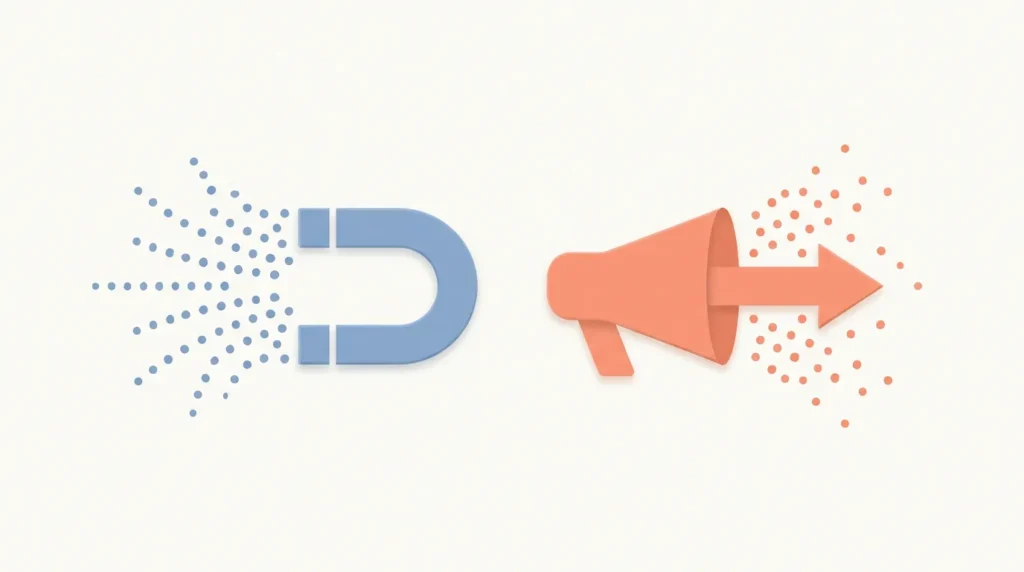
The difference between inbound and outbound marketing comes down mainly to who makes the first move. With inbound marketing, you help potential customers find your company and contact you on their own. With outbound marketing, you actively approach selected audiences with a relevant offer. One approach is not automatically better than the other. The right choice depends on your audience, sales cycle, available resources and how quickly you want to create commercial opportunities.
In practice, a combination often works best. Inbound builds visibility and trust. Outbound helps you start conversations in a targeted way. But a combination is not an excuse to do everything at once. Below, we look at how to distinguish the two approaches, when to use them and how to avoid marketing activity drifting away from sales results.
Inbound marketing attracts interested people with information and experiences that match their questions. Think of search engine optimization (SEO, Search Engine Optimization), in-depth articles, landing pages, e-mail marketing and helpful posts on social media. The potential customer discovers your organization because you answer a question they already have.
A visit to your website is not yet a lead. A lead is a person or organization that leaves identifiable contact details or asks a concrete commercial question. So a reader who views an article may show interest, but only becomes a lead once you have a real business contact opportunity.
A simple inbound route looks like this:
Inbound often takes time before content and visibility match demand well enough. The advantage is that you can keep using and improving the information. A strong article, for example, can help visitors during different stages of their research. That is no guarantee of requests, but it is a reason to create content that answers real decision-making questions. Guidelines for strong search content also emphasize the value of information written for people that genuinely adds value. (developers.google.com)
Want to know when to build SEO expertise in-house or outsource it? Then read SEO Agency: When and Why to Outsource SEO. For the practical setup of your organic approach, SEO Optimization: a complete approach for better rankings is also relevant.
With outbound marketing, your company takes the initiative itself. You choose a target audience and bring a relevant offer to their attention through, for example, targeted e-mail outreach, paid ads, phone follow-up on business inquiries or a personal approach via social networks. The starting point is not reaching as many people as possible, but approaching the right people for a good reason.
Outbound can generate first conversations faster than a new content strategy, because you do not have to wait for someone to find your page. That does not mean every approach becomes an opportunity immediately. You need a sharp audience profile, a credible reason and respectful follow-up. A list of companies is not yet a collection of leads. Only when a person or organization actually shows commercial interest can you treat them as a lead.
A targeted outbound approach usually starts with a clear Ideal Customer Profile (ICP), in other words a profile of the companies that fit your offer best. You research which role or need is relevant, formulate a personal message and measure responses and follow-up actions. For execution, see Outbound marketing: strategy, channel choice and execution.
The same principle applies to paid campaigns: start with the audience and the message, not with the available ad budget. This Advertising on Google: complete guide for beginners helps you explore a paid search approach further.
The core question is: who takes the first step? With inbound, the potential customer looks for information and comes to you through your content or website. With outbound, your team selects the audience and starts the contact. That difference affects speed, the effort required and the way you assess results.
These differences are guiding principles, not laws of nature. An ad can reach someone who is already looking for a concrete solution. An informative article can, in turn, appeal to someone who is not yet ready to buy. So the channel does not tell the whole story. Context, message and next step all influence what you get out of it.
Want to work through the strategic choice in more detail? Then read Inbound and outbound marketing: how to choose the right mix and Inbound vs Outbound: comparing strategies.
Inbound is a logical choice if your audience actively looks for information, has questions you can answer well and you are willing to work consistently on visibility. That fits, for example, organizations with a longer research phase, multiple decision-makers or services that need explanation before someone requests a conversation.
Choose inbound when you have clear subject-matter expertise and can translate it into practical answers. A service provider, for example, can explain cost factors, approach, risks and the trade-off between different solutions. A webshop can clearly explain product categories and remove objections. With a Professional webshop creation: costs and approach, that explanation ideally starts with the questions buyers actually ask.
Keep the investment in mind. Inbound costs time for research, production, technical setup and updates. Publishing without distribution or a conversion path will not automatically generate business requests. So decide in advance which page should move a visitor forward and how you will measure a request. A content strategy without follow-up is mostly just a neat way to build an archive.
Outbound fits when your target audience can be defined clearly and you do not want to wait for potential customers to find you on their own. It can be useful for a new offer, a specific B2B market or a limited number of companies that fit your services well. Even if you want to learn quickly which message resonates, a carefully defined campaign can provide valuable feedback.
Start with a small, relevant audience. Research the business situation, explain why you are getting in touch and make the next step easy. A good approach shows why the conversation could be useful for that specific recipient. A generic message that only says your company delivers quality is not personalization. It is a brochure with a first name in it.
Outbound requires discipline in selection and follow-up. Track which approaches get responses, which objections come up and whether conversations lead to serious sales opportunities. Also respect applicable privacy rules and channel conditions. The exact requirements can differ by country, channel and type of contact, so have your process reviewed by an expert where needed.
A strong combination makes the channels support each other rather than run side by side. Inbound helps potential customers understand your offer. Outbound brings that offer to the attention of organizations likely to benefit from a conversation. The content and the message therefore need to connect.
If someone downloads content, that does not automatically make them a Marketing Qualified Lead (MQL) or Sales Qualified Lead (SQL). Use MQL for a lead that, based on agreed marketing criteria, is ready for further follow-up. Use SQL for a lead that sales, based on agreed criteria, considers a viable sales opportunity. A download, click or e-mail open is not proof of purchase intent on its own.
In a longer buying process, inbound content can support the initial research stage, while outbound helps you connect with relevant decision-makers. Agree together when marketing hands over a lead, what information is passed on and how quickly sales follows up. You can read more about that transition in Generating Sales Leads: From Marketing to Sales.
Do not only measure how many people you reach. Impressions, clicks, website visits and e-mail opens are activity signals. They are not leads unless you have identifiable contact details or a concrete commercial question. So link your measurements to the steps that matter in your sales process.
First define exactly what counts as a conversion. An appointment is not the same as a sales opportunity, and a sales opportunity is not yet a customer. If marketing and sales use different definitions, the numbers can look healthy while nobody agrees on what they mean. So track not only channel performance, but also request quality and the outcome of follow-up.
With e-mail campaigns, do not look only at opens. Also examine which relevant responses, appointments or requests follow and how much effort they required. For a further breakdown of that financial assessment, e-mail marketing ROI: calculate, improve and scale smartly is a suitable next read.
If you are considering external support, first assess which skills, capacity and measurement structure you need. The guide Choosing a marketing agency: services and selection criteria helps you define those selection criteria.
You do not need to build a full marketing machine right away. Start with a plan your team can prepare and assess within a month. Choose one audience and describe their main buying question. Then create one content answer that can be used both on your website and in a personal outreach approach.
This is a recommendation, not a guarantee of a specific number of leads or revenue. The outcome depends, among other things, on your offer, market, price, reputation and execution. The goal of the first round is also to learn: discover which question is alive, which message is clear and where interested people drop off.
The difference between inbound and outbound is easy to describe: with inbound, the potential customer finds you through relevant information; with outbound, your organization starts the contact in a targeted way. Inbound builds findability and trust. Outbound gives you more control over who you approach and when. Both require a clear audience, a suitable message and measurable follow-up.
Choose inbound if your audience is actively searching and you can share knowledge consistently. Choose outbound if you want to reach a well-defined group and have a relevant reason to get in touch. Combine them when content and personal outreach strengthen each other. The best next step is small and concrete: choose one audience, decide which commercial action you want to measure and test an approach your team can follow up carefully.
Book a free strategy call and discover how many leads we can generate for your business. No obligations — just a concrete growth plan.
Book your free strategy call → Book your free strategy call — 30 min, no strings attached