

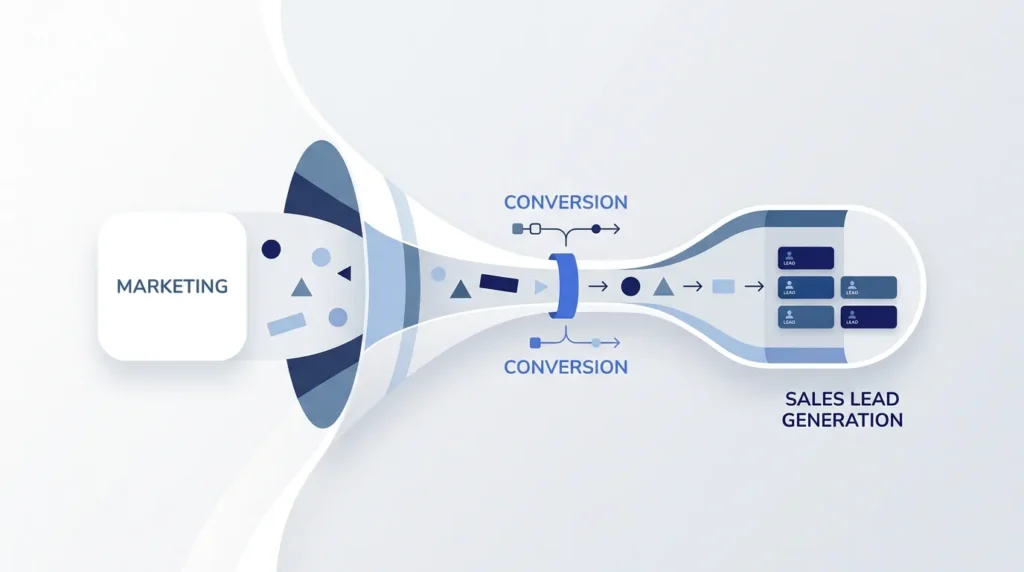
Imagine for a moment that your marketing is only focused on “nice interactions.” Lots of attention. Good content. Maybe even a few inquiries. But once sales wants to get started, it turns out that some of the leads don’t match what we sell. Sounds familiar. And it costs time, energy, and money.
In this article, we walk through the full process of generating sales leads. Not as separate tactics, but as one continuous machine. From traffic and interest, to Marketing Qualified Leads and Sales Qualified Leads, and ultimately to appointments and customers. Clear, practical, and with concrete steps you can apply tomorrow.
1) What “generating sales leads” means in practice
“Generating sales leads” sounds simple. But you need three things that often get mixed up:
- Leads: potential customers with genuine commercial interest, for example because they left contact details or made a clear business inquiry.
- Marketing Qualified Leads (MQL): leads that marketing has qualified as sufficiently promising for sales.
- Sales Qualified Leads (SQL): leads that sales considers a fit and worth a direct follow-up conversation.
We base this on common lifecycle definitions. In lifecycle stage models, MQL and SQL are usually described as marketing qualifying and sales qualifying respectively. You can see this, for example, in HubSpot lifecycle stage definitions: Lead, Marketing Qualified Lead, and Sales Qualified Lead are given increasing meaning toward a sales conversation.
Important, and this is where many teams get stuck: you cannot equate website traffic with leads one-to-one. If someone leaves no contact details and shows no real commercial intent, that is not a lead but interest behavior.
Why this distinction is essential
Because otherwise you optimize for the wrong KPIs. You end up focusing on clicks or visits, while what you really want is a qualified flow for sales. And that doesn’t happen by itself. You need a process.
2) The growth strategy: one funnel, two teams, one definition
Let me keep it human: you want marketing not just to “deliver,” but to deliver what sales wants. And sales wants marketing not to target too broadly up front.
The strategy that always works here is:
- Agree on one shared set of definitions (what is a lead, MQL, and SQL, and what is explicitly not).
- Design the customer journey with intent in mind, not just with offers.
- Build a handoff procedure that protects lead quality.
- Optimize for conversions at each step, not just for volume.
Agree on definitions, don’t debate them later
We see it often: marketing says “we deliver leads,” sales says “they’re not SQLs.” Often it’s not bad work. It’s a language problem.
Work with a simple lead matrix. For example, based on:
- Fit (ICP: industry, company size, role)
- Need (clear pain point or use case)
- Authority (who makes or influences the decision)
- Timing (when there is a real trigger)
- Intent signals (such as a demo request, quote request, or strong content engagement)
You can build this into your CRM lifecycle stages. In lifecycle stage models, stages are also positioned in practice as increasing levels, from Lead to Marketing Qualified Lead to Sales Qualified Lead. That helps keep updates consistent automatically.
If your team doesn’t have this clear yet: turn it into a working document today. That way you avoid “optimizing” for noise later.
Watch your metrics, especially for organic search
If you use SEO or Search Engine Optimization, it’s tempting to focus on clicks only. But in Google Search Console, this means:
- Impressions: how often a link was shown
- Clicks: how often it was clicked
- CTR (Click-Through Rate): clicks divided by impressions
Google also describes this explicitly in its Search Console help.
The takeaway for lead generation: clicks and CTR tell you something about attractiveness, but not automatically whether your leads are high quality. So you want to connect this to conversions on your landing pages and to qualification in CRM.
3) From online marketing to real sales leads
Now for the practical part. We divide execution into four blocks. Each block has a reason, a metric, and a next step.
Block A: Turning traffic and interest into inquiries
You can’t do “lead generation” with blog traffic alone. You need a conversion path to an inquiry or contact moment.
Specifically:
- Landing pages per intent (one page per use case)
- A clear offer: demo, quote request, advisory call, or evaluation
- Forms that don’t add unnecessary friction
- Fast confirmation (confirmation email and what happens next)
Which pages you tackle first depends on where your audience is already searching. If in doubt: start with the pages where you’re already getting qualified questions, or where you see a lot of impressions and low CTR. This is also central in Search Console analyses of queries and CTR.
Block B: Lead capture that doesn’t work against marketing and sales
A good form is one thing. A good lead capture process is another. You want the information you ask for to actually help determine MQL and SQL.
Practical tip: don’t just ask for contact details. Also ask for something that helps assess lead fit and intent. Think of:
- Company type or sector
- Size (rough is fine)
- What challenge is happening right now
- Desired start date or urgency
That makes lead qualification simpler. And simpler qualification means less waste.
If you’re looking for structure, you can look at how to set up lead flows technically and organizationally in a clean way, for example through an overview of inbound and outbound strategies: Difference Between Inbound and Outbound: A Strategy Comparison.
Block C: Lead nurturing that moves toward sales instead of drifting away
Many teams send emails “just to stay in touch.” Not meant badly, but sales is waiting for relevant follow-up actions.
We want nurturing that:
- responds to intent
- offers the next logical step
- generates signals for MQL and SQL
In B2B, you often see that an email campaign only works once you treat it as a journey. That is exactly where you want to go: a set of targeted messages with clear next steps. For a practical approach, this page fits well: B2B Email Campaigns: How to Make Them Profitable and Scalable.
And if you want to sharpen the full path from list to conversion: Email Marketing Strategy: From List to Conversion.
Block D: Conversion optimization at the right level
As your lead generation matures, you don’t want “more traffic.” You want more qualified inquiries per euro and per hour.
That means you optimize for:
- CVR (Conversion Rate): inquiries divided by landing page visitors (or sessions)
- CPL (Cost Per Lead): costs divided by the number of leads
- SQL-rate: what percentage of leads becomes sales qualified
For SEO and SEA, it’s often the same story: SEA and SEO need to work together on intent and conversion. If you want to understand when to use which, this helps: SEO vs SEA: Differences, Benefits, and When to Use Both.
And if you use SEA, it helps to know exactly what your ad setup means. An explanation that can help here is: Google Ads and AdWords: A Clear Explanation and Smart Use.
4) Lead qualification and handoff: avoid the sales leakage point
Okay, you have leads. Now comes the moment where most teams make mistakes: the handoff.
A good handoff ensures three things:
- sales understands why the lead came in
- sales gets the relevant context immediately
- you prevent marketing from having to “sell” it afterward
Create an SLA between marketing and sales
An SLA is a Service Level Agreement within your team. It’s not about contracts with customers. It’s about internal agreements: speed, definitions, and responsibilities.
Examples of SLA points:
- Response time: within X minutes or hours for new SQLs
- Ownership: who calls, who emails, who schedules
- Qualification criteria: which fields make someone SQL
- Escalation: what happens if there is doubt
In lead qualification models, this is often worked out as a process step: lead generation, classification toward MQL and SQL, and then sales engagement. The idea is that teams speak the same language and that handover is not ad hoc.
Automate only what you want to standardize
Automation here means software and workflows to streamline lead capture, enrichment, qualification, and follow-up for online marketing and sales activities. For example:
- Forms automatically place leads in CRM with a provisional stage
- Workflows send follow-up emails based on completed intent questions
- Sales gets tasks and context once SQL criteria are met
- Reporting updates automatically based on events (such as appointment booked or quote requested)
Note: automation should support human control at important steps. Not everything needs to be automatic. But it is a waste if every lead has to be manually “sorted.”
What you should record in CRM at a minimum
If your CRM (Customer Relationship Management) doesn’t provide good context, quality is lost during handover.
Record:
- Which campaign or landing page triggered the lead
- Intent signals from the form (and any additional behavioral indicators)
- Lifecycle stage (Lead, MQL, SQL)
- Next action and deadline
- Outcome of sales contact (meeting scheduled, rejected, followed up)
Lifecycle stage definitions help enforce consistency. For example, HubSpot standardizes lifecycle stages with underlying meaning from Lead to MQL and SQL toward opportunity.
5) Measure, adjust, and scale without losing your calm
Generating leads is not a project. It’s a system. You want to learn every week. Not every quarter.
What to review weekly
Create a small dashboard. Not thirty charts. These three rows are enough to give you steering information:
- Volume: number of leads per channel (SEO, Search Engine Advertising (SEA), outbound, social)
- Quality: MQL and SQL percentage per channel
- Lead time: time to first sales action and percentage of appointments
Your goal is not just more inflow. Your goal is better inflow with less waste.
SEO and SEA aim at the same end result
SEO and SEA can both deliver leads, but the quality often differs by intent. That’s why it’s smart to read performance at query and landing page level for SEO, and at audience and landing page level for SEA.
If you use Search Console to steer SEO, pay special attention to:
- Queries with high impressions and low CTR (adjust title and snippet)
- Pages with relevant searches but low conversion on the landing page
- Converging themes: content that is already close to driving an inquiry
Search Console explains that CTR is clicks divided by impressions, and that performance reports also offer filters and extra dimensions such as query and position, depending on the report.
When you scale, you scale your process too
Scaling doesn’t just mean more budget or more content. It means sales capacity and handoff rhythm scale with it.
If you’re getting more leads but SQL-rate is dropping, then the process isn’t scalable. Then you need to adjust qualification criteria, form questions, or targeting.
Social and channel choice, without magic
Social media often works as distribution and credibility. But if you only focus on reach, you won’t get inquiries.
You want to use social at moments when intent is already growing. For example, through a clear content path toward an inquiry page.
If you outsource social and want to prevent it from becoming a “one post a week” project, you can use this guide for selection criteria: Social Media Marketing Agency: Services and Selection.
If you work with an agency, choose based on process, not claims
Partnership can accelerate you. But you want an agency that thinks in lead quality and handoff, not just visibility.
A checklist that often fits well here is: How to Choose the Best Online Marketing Agency: Do It Right.
And if you’re in a niche market, such as online contractors, it’s even more important that lead definitions and intent are aligned properly. This page can provide direction: Online Marketing Agency for Online Contractors: How to Win.
6) A practical next step for today
If you want to start generating sales leads without immediately getting into a marketing and sales debate, do this:
- Write one page with your definitions: lead, MQL, SQL (and when something does not qualify).
- Create one handoff workflow: from entry, to MQL review, to SQL task for sales.
- Choose one channel to improve (for example SEO, SEA, or outbound) and optimize for SQL-rate, not just lead volume.
- Check your landing page: is the offer clear, does the content match intent, and is the CTA logical?
If you want immediate inspiration for tactics, this hub fits the focus on execution: Generate More Leads: 12 Practical Tactics (2026).
Conclusion: generating sales leads is an alignment problem, not a coincidence
We’ve really said it in one sentence: generating sales leads works when marketing and sales speak the same language and protect the same end result. Not through hope and guessing, but through definitions, handoff, and step-by-step optimization.
If you do one thing tomorrow, make the handoff sharp. Not because it’s exciting. But because it directly determines how many of your leads become real Sales Qualified Leads. And yes, that suddenly feels like your marketing is “back on target.” Less noise. More conversations. In other words, less work. That’s usually the best ROI.
