
 Written by
Daniel van Hek
Search Clicks·October 26, 2026
11 min read
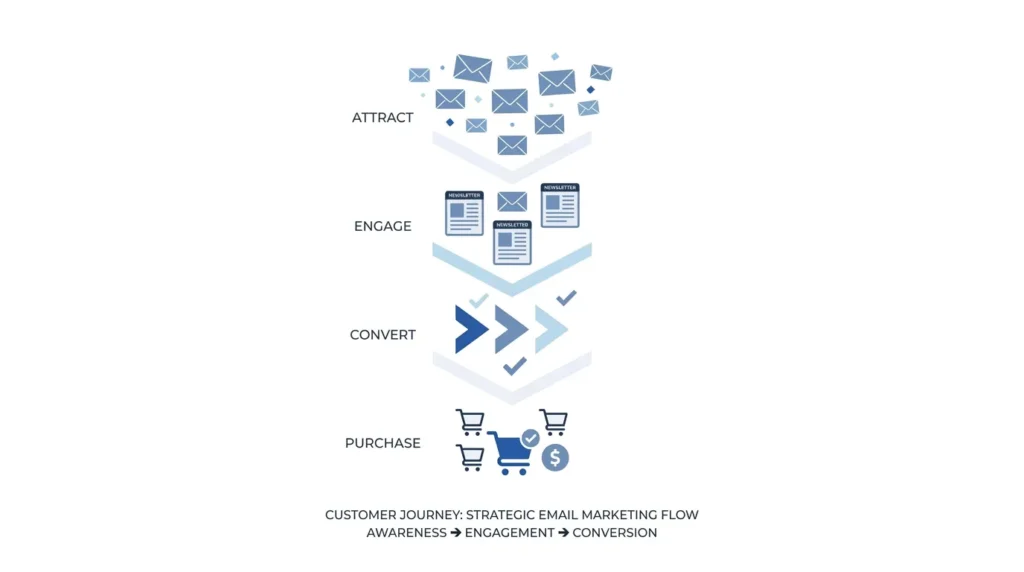
If you approach it the right way, email stops being a “newsletter because we have to” and becomes a channel that helps drive online revenue. Not because we start a magic flow, but because you get the right people to do the right thing at the right moment: click, respond, or buy.
In practice, we keep seeing the same pattern. Companies start with good intentions, send to everyone, measure only a little, and then wonder why the results vary. That is rarely bad luck. It is usually a missing strategy, or execution that is disconnected from goals.
A solid email marketing strategy comes down to four things:
Below, I give you an approach that we often see work in B2B and B2C, with practical steps and clear trade-offs.
You can have the best copy in the world. If you are not compliant legally or technically, you lose reach and trust. That is why a strategy starts with consent and unsubscribe handling, plus deliverability basics.
For commercial email, privacy rules apply. In the EU, the focus is on consent and e-privacy rules (often referred to as PECR in the United Kingdom), and in the US rules such as the CAN-SPAM Act apply. In any case, you need:
The EU and UK guidance states that people can withdraw their consent and that pre-ticked consent does not count as valid consent. (ico.org.uk)
For CAN-SPAM, the FTC emphasizes that every marketing email must clearly explain how to opt out, and that the subject line must not be misleading. (ftc.gov)
Trade-off: Strict and correct consent management can shrink your list. But it usually improves engagement and reduces reputational damage. That is exactly what you need for the long term.
Make unsubscribing one click when possible. If you send multiple types of emails, let people set preferences too (for example, updates versus offers). ICO explains that opt-out requests after unsubscribing must be respected. (ico.org.uk)
In practice:
Deliverability is not a fancy term. It means: do you actually land in the inbox, or in spam? Major inbox providers look at authentication, behavior and reputation.
A practical start is to properly configure your sending domain with SPF and DKIM, and to implement DMARC policy. Considerations around bulk sender requirements, and the difference between the header and the visible one-click unsubscribe option, are covered in deliverability guidance from platform providers. (help.salesforce.com)
Trade-off: Setting up authentication is usually one-time work, but it can depend on your IT team. Plan for it early, otherwise you will later be “optimizing” a problem that has not actually been solved.
Many email marketing strategies fail because segmentation is too broad. You choose “interests” and hope that reflects intent. In reality, you want to segment on behavior and stage in the customer journey, without turning your data model into a novel.
Build segments based on what someone does:
Why does this work? Because email then feels like context, not “general interest”. And context lowers friction for the recipient.
A segment without a goal is just work. So agree per segment on:
If you do not write down your goals, you later test “everything” and learn nothing. And then email suddenly feels like a guess again.
We often see marketing teams checking opens and clicks, but not really knowing what happens after the click. Make sure your tracking is set up correctly in your analytics environment and that you can attribute conversions to email campaigns.
If you use Google Analytics 4 (Google Analytics 4), pay attention to consistent campaign tagging and event naming. (I am not going to pretend I know your setup. The key is: measure what matters on the site, not just interaction in the inbox.)
Email works when you treat it like a conversation, but at scale. That means: one email, one core message, one most important next step.
A good email usually has one of these roles:
One practical detail that is often underestimated: make sure your subject line matches the content. Both privacy rules and CAN-SPAM emphasize that the subject line must not be misleading. (ftc.gov)
For B2B and B2C, this often works:
Trade-off: Too many elements reduce focus. Too little context can make people drop off. That is why you test per segment, not just per subject line.
You do not need to become a lab, but you do need to test in a structured way. Work with hypotheses:
Open rate is often a weak indicator. Especially because opens can be distorted by privacy technology. That is why we prefer to look at click behavior and conversions.
Automation can speed up an email marketing strategy. But automated emails only add value if they:
And importantly: automation should help your marketing and sales become more efficient, with measurable improvements. That is exactly where it makes a real difference in practice.
Trade-off: Automation can also create irritation if timing is poor or if you send duplicates alongside campaigns. That is why you need rules for frequency and overlap between campaigns and flows.
In lead generation, it is important to define what a lead actually is. A click or page view is not automatically a lead. A lead is only a person or company with real commercial interest that you can follow up on, for example through a form or a direct meeting.
In your automation, you therefore want to distinguish between:
If your CRM (Customer Relationship Management) supports this properly, it suddenly becomes useful for sales instead of becoming an inbox problem.
Set up a small KPI dashboard. Think of:
And make one rule: if a campaign stays below an agreed threshold, you stop or fix it. Otherwise your sender reputation keeps getting worse, and that makes future results worse too.
Strategy is not a document. It is a working routine. That is why we build a rhythm in which you learn and improve.
A workable rhythm:
Why this works: you turn performance marketing (email is part of that in practice) into a process. You stop doing isolated actions.
Email marketing performs best when it is part of your overall online approach. For example, if you combine SEO and Search Engine Advertising (SEA), traffic becomes a source and email becomes the conversion layer. If you want a clear view of that distinction, also read: SEO and SEA: differences, benefits and when to use both.
If you want to understand how paid campaigns and tracking connect, this explanation is relevant: Ads and AdWords: explained clearly and used smartly.
What you do here is often less visible, but it pays off. Think of:
Trade-off: Cleaning sometimes means less volume. But your quality increases. And quality is what inbox providers and recipients both value.
Sometimes you simply do not have enough time or enough experience in email deliverability, tracking and CRO (Conversion Rate Optimization). Then external support can help.
If you are looking for a partner that takes this more seriously than “we also do email”, look at this approach: How to choose the best online marketing agency.
And if your email marketing is part of a broader growth mix (SEO, SEA, Social, conversion), this may also be useful:
For B2B, the connection between email and lead generation is often the difference between “we have sign-ups” and “we have Sales Qualified Leads”. See also: B2B lead generation: reaching business prospects.
And if you work in a niche such as online contractors, this context fits what happens in the funnel: Online marketing agency for online contractors: how to win.
If you take only one thing away, let it be this: email marketing works best when you design it around intent, deliverability and measurable decisions.
Your next step, very concretely:
And yes, that takes discipline. But that is also exactly why your team notices the difference in results. Email then becomes not “a channel we always do”, but a system that supports your sales process. Coffee is welcome, of course; strategy works better when you execute it together.
Book a free strategy call and discover how many leads we can generate for your business. No obligations — just a concrete growth plan.
Book your free strategy call → Book your free strategy call — 30 min, no strings attached