
 Written by
Daniel van Hek
Search Clicks·October 30, 2026
11 min read
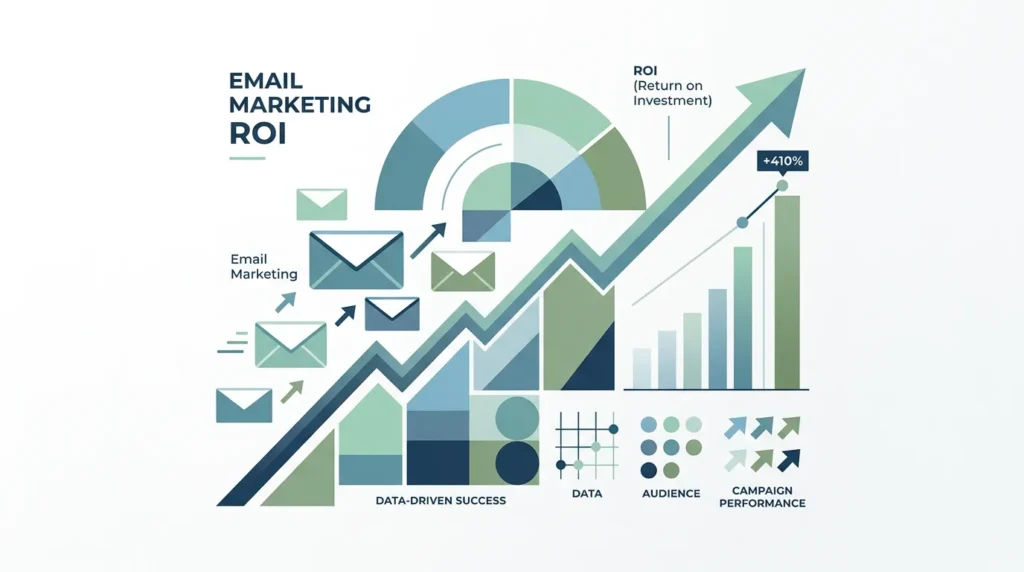
Grab your coffee. When you think about ROI email marketing, you really mean one thing: you want to know whether your email efforts are generating money, and you want to get better faster than your previous campaign. That is exactly where many teams go wrong.
In this guide, we walk through the approach we use in practice, step by step. We calculate ROI in a way that matches your commercial reality. We spell out what you can and cannot measure (privacy and platform limitations). And we finish with a clear “next step” you can execute tomorrow, not in three quarters.
ROI (Return on Investment) means in marketing: how much value you get back compared with what you put in. Usually, you write that as: (revenue minus costs) divided by costs. That principle is universal. What differs by company is how you define revenue and costs.
Where it often goes wrong:
If we want ROI that your team trusts, we first need to tighten up your measurement logic. Only then do we optimize campaigns.
You can calculate ROI in different ways. We usually choose a model that fits how leads and customers enter your business. A common baseline for ROI in marketing is: ROI = (revenue minus costs) divided by costs, often expressed as a percentage. (You can also find a similar ROI logic in marketing overviews from email marketing platforms.) (mailchimp.com)
In email marketing, you usually have three revenue levels:
Practical advice: start with direct revenue so you quickly have a visible baseline. Once your measurement quality is stable, you can expand your attribution models.
We recommend linking your “conversion events” to your commercial goals. For example:
Avoid the trap of “website traffic is not a lead”. Only when you identify a person or company with real contact details or a commercial inquiry does it make sense to count it as a lead.
Costs are more than the email subscription. We usually include:
If you do not do this, you get an ROI that sounds like a good story internally but does not hold up externally.
You can use open rates as a trend indicator, but not as absolute truth. Platforms and privacy measures make open tracking less reliable.
Our rule of thumb: focus on clicks and conversions to measure behavior. Use opens only as a supporting signal, for example in deliverability checks.
Now that we are measuring ROI honestly, the next step is improvement. Below you will find what makes the biggest difference in practice. We keep it concrete: what do you do, why does it work, and what measurable expectation should you have.
You can write a perfect email and still get poor ROI if you send it to the wrong people. So segmentation is not about “more lists”. It is about intent.
Segmentation that often works:
Why it works: you reduce the mismatch between message and need. You increase the chance of a click, and clicks are a better foundation for conversion ROI than opens. (As mentioned, open tracking is less reliable.) (help.litmus.com)
“Nice to see you reading this” does not build ROI. Your email should support a next step.
A strong CTA is:
Practical tip: if you send a newsletter but your measurement expects “purchase” or “meeting”, then there is a logical gap. Either align your conversions with that, or send content that leads to an intermediate step.
Deliverability is not magic. You can see it in:
Gmail tabs are also relevant, but not in the way many online stories suggest. Some sources describe that the Promotions tab may have a lower read rate, but not necessarily major swings for all sectors. (help.activecampaign.com)
Our no-nonsense approach: treat deliverability as a system. You monitor, you correct, you test again. And you use click and conversion as your main metric, not “opens”.
Automation is only worth it if it makes a measurable difference in response, conversion, or efficiency. Think about:
A smart flow shortens the time between intent and action. And that directly affects your ROI.
If you want to improve ROI, you need a dashboard that drives decisions. Not “reporting for reporting’s sake”.
We usually look at two layers: contact quality and commercial impact.
Note: CTR and opens are only intermediate steps. Real ROI comes from conversions and the cost side.
To measure email contribution, you want:
In practice, I often see teams only start measuring after the campaign is already live. Then you optimize with too little information. You want tracking in place beforehand so you learn instead of guess.
No long projects. We do this:
After that, optimization becomes logical and measurable. You can then divide your budget based on impact, not gut feeling.
Here is a practical approach we often use with teams that “do send email” but do not yet have a sharp ROI. The goal is one workable plan for the next 30 to 45 days.
Write down one sentence that everyone internally understands:
Then choose your primary conversion event. For example, “meeting booked” or “acquisition” (CPA as Cost Per Acquisition).
In email, there is often one bottleneck:
Your baseline helps you see this quickly.
If you do everything at once, you learn nothing. Choose:
When you combine those two, you usually see faster effects on CTR, conversion, and therefore ROI.
Email is rarely the final stop. That is why it pays to align your approach with sales. If you speak each other’s language around Marketing Qualified Lead, Sales Qualified Lead, and the handoff, ROI suddenly becomes much clearer.
If you want to go deeper, also look at:
You do not have to treat email in a silo. But you do want to avoid confusing attribution.
The most common situation: SEO or Search Engine Optimization creates intent, email provides follow-up. SEA, or Search Engine Advertising, can provide speed, while email supports conversion and retention.
About SEO and SEA together:
About ads and your link to measurability:
The measurement rule we always apply: if you combine email with other channels, keep your ROI model consistent. Otherwise, you optimize against conflicting data.
Social media can create attention and initial interaction, after which email helps close the conversion. If you are already investing resources here, you want the landing page and CTA to stay consistent with your email message.
For B2B, it is even more important that your segments and messaging match specific commercial situations. That also means a profitable approach, not just higher volume.
Then we do it step by step, without convincing ourselves that “we will see”. You can still make a reliable start with limited data.
And if you need external capacity, make sure your scope and measurement agreements are clear upfront.
Budget is also part of ROI. If you still need to invest in assets such as a website, include that in your cost picture:
ROI email marketing is not about one “magic” metric. It is about a system in which you:
The next step is simple: define your ROI today and set your 2-week baseline. Then choose one flow and one landing step to improve. That gives you a learning cycle in a short time. And yes, that brings email back to what it is meant to do: support revenue, not just “be sent”.
If you want to look beyond email at Lead Generation, including what you should test first, you can also use this:
Book a free strategy call and discover how many leads we can generate for your business. No obligations — just a concrete growth plan.
Book your free strategy call → Book your free strategy call — 30 min, no strings attached