
 Written by
Daniel van Hek
Search Clicks·October 31, 2026
13 min read
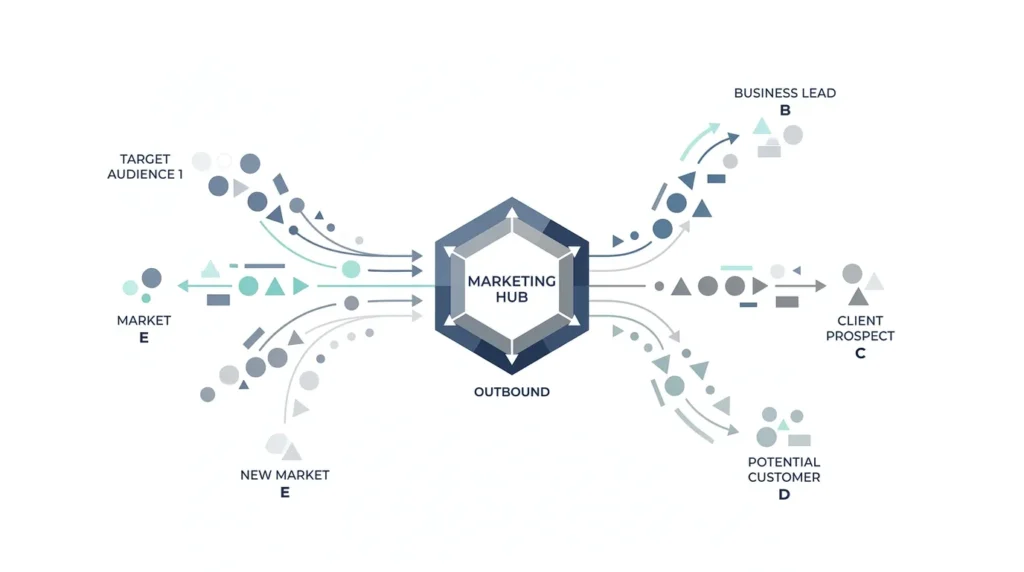
Outbound marketing is the active approach of potential customers through targeted online channels, with the aim of generating appointments, conversations, or other commercial actions. Think of cold email outreach, social selling-like approaches, or paid targeting that leads to a specific message.
If you do this well, it doesn’t feel like “spam with a fresh coat of paint.” It feels like relevant contact at the right moment, with clear next steps and measurable results. And yes, it takes discipline. Outbound is not a sport for people who prefer to steer by gut feeling rather than data.
Outbound marketing works especially well when your target audience responds to a concrete, recognizable problem and when your offer matches their situation. In practice, I see four conditions that often make the difference.
People don’t respond to your company. They respond to what you solve. That’s why your proposition must quickly answer three questions:
If this is missing, you get a high “send rate” and low commercial value. That is usually not a channel problem, but a message problem.
Outbound can scale, but you don’t have to start at scale. Start with an ICP (Ideal Customer Profile). If your ICP is vague, your message becomes generic. And generic gets exposed faster.
Many teams stop after one attempt. Then outbound “doesn’t work.” Instead, we build a cadence with clear stages, for example:
That setup prevents you from just spamming, while still giving people enough chances to respond.
You can have the best message, but if you ignore the rules, you may win briefly. After that, you get deliverability problems, complaints, or legal attention. In the EU, this is about the GDPR and ePrivacy rules, including a lawful basis and alignment with direct marketing rules. The European Commission explains that you must determine a lawful basis and that direct marketing tools, such as email, also fall under the ePrivacy rules. (commission.europa.eu)
In a B2B context, balancing legitimate interests is often possible, but you still need to substantiate it carefully and take the direct marketing requirements into account. The EDPB states that you must identify a lawful basis for processing, with “legitimate interest” among the options depending on the context. (edpb.europa.eu)
For email campaigns outside the EU, the CAN-SPAM Act is a well-known reference for commercial messages, including clear identification and an opt-out mechanism. The FTC summarizes this with requirements such as labeling clearly as an advertisement and the right to stop. (ftc.gov)
Note: this is not legal advice. Involve your lawyer or compliance team, especially if you reuse data or buy contact lists.
You don’t need to do every channel at once. Outbound gets better when you test one channel hard and feed the learnings through. Here is a practical way to choose.
Cold email is popular because you can test subject lines, timing, CTA, and proposition relatively quickly. You measure response, reply quality, and ultimately appointments or conversations.
An important reality check: “personalization” is not always a magic switch. There are signals that in some datasets the impact can decline or be more complicated than just naming. For example, a Sales.co research article discusses based on their own analysis that “personalization” no longer seems to be the decisive factor, and that reply rates can decline. (sales.co)
My interpretation as a practitioner: personalization works best when it is context that is truly relevant, not when it is just “the company name in the greeting.” Think about recent activity, role changes, or a measurable trigger that your offer addresses.
You can also approach outbound through paid targeting. Think of ads that send people to a landing page with a specific message for a segment. In that case, you are doing outbound in the sense that you are actively going to people, rather than waiting for them to search on their own.
The practical advantage: you can direct budget toward segments. The downside: if your landing page and message don’t match, you burn money on CTR (Click-Through Rate) without real conversion. That is why this route needs to be tied to a strong funnel, landing page, and tracking.
Social and messaging are often less “raw measurable” than email, but powerful when your deal cycle requires trust-building. You work more with conversations than with one-way messages.
Tip: treat this as a pipeline with stages. Measure how many conversations end in SQL (Sales Qualified Lead) or how many appointments are booked. Otherwise, you are steering on likes, not on commercial value.
Multichannel does not mean “more channels is better.” It means “one story, multiple touchpoints.” We prefer to build one consistent message and distribute it smartly:
If you tell a different story per channel, you create noise. And noise is the quietest form of revenue loss.
Here is the framework we use with commercial teams. No theory to show off with, but a sequence you can repeat.
For outbound marketing, you want two things on paper:
If your trigger is missing, you get “interesting message, but later.” That later rarely comes.
Your core message stays the same. Your variants differ in one element:
Why this works: you’re not testing everything at once. You make it learnable. The team gets faster “yes, this element resonates” instead of “it was probably something.”
Outbound often fails at the step after the click. That’s why it needs a clear destination:
If you’re curious about how to align landing pages and campaigns more closely with ROI and tracking, it helps to look at ROI e-mailmarketing: calculate, improve and scale smartly. That is exactly about measuring real value, not just engagement.
Outbound is only “on brand” when your pipeline sees it that way too. That’s why we choose KPIs that flow logically:
In paid outbound-like routes, you look at CTR and conversions, and you monitor costs based on CPA (Cost Per Acquisition or Cost Per Action, depending on your definition). Agree internally on what your CPA measures exactly. Is it an appointment, demo, or a sales action? Otherwise, everyone talks past each other.
You don’t need a quarterly plan. You need a learning cycle. For example:
Do one test at a time, otherwise you won’t know what caused the effect. It sounds boring, but that is exactly why teams improve faster.
Because you sell online, we steer on behavior. Not on assumptions.
Name in the greeting is cheap. Context is more valuable. You can get context from information that is public or semi-public, such as roles, company growth, recent initiatives, or themes that align with their industry.
Support this with real content. For example: “We see that teams in your situation often get stuck on X, and that’s why we use Y approach.” That is not hype, it is direction.
A CTA (Call to Action) can be short. But it must offer a choice. Think of:
If your CTA is too big, you get “nice idea” without action.
Outbound marketing is ultimately a bridge to sales. That is why the transition from Marketing Qualified Leads (MQL’s) to SQL’s is essential. If you don’t set this up, you lose leads in handoff. Then outbound seems “ineffective,” while it is actually a process error.
If you want to work this out, Generating Sales Leads: From Marketing to Sales fits this topic well. It helps you agree on what qualification means and how you organize follow-up.
Timing is often about internal availability. People read, but they respond when it suits them. That’s why we optimize on:
The last one is often the biggest “invisible” lever. If your outreach does match but sales only responds three days later, then your message is aging. Not dramatic, but costly.
Outbound marketing is direct marketing. That means: you need to account for privacy and opt-out rules.
The core is that you choose a lawful basis for data processing. The EDPB explains that organizations must determine a lawful basis under the GDPR. (edpb.europa.eu)
The European Commission also explains that you need to take ePrivacy Directive rules into account for direct marketing. (commission.europa.eu)
In a B2B context, privacy regulators often provide guidance on when consent or “legitimate interests” may be appropriate and how to manage a “do not email” opt-out list. (ico.org.uk)
At a high level, it comes down to two practical actions:
If you also activate in the US, the CAN-SPAM Act is a useful checklist. The FTC emphasizes requirements such as recognizable commercial message, clear identification, and an opt-out mechanism. (ftc.gov)
Even if you are not fully covered by that law, these principles often force healthy outbound hygiene.
Automation is not a goal in itself. The goal is better follow-up, faster learning, and consistent quality. If you use automation badly, you miss faster. So we do it in phases.
Automation should support your performance, not replace your judgment.
For email and scalability, it can help to read B2B mailing: how to make it profitable and scalable. That is often exactly the bridge between strategy and execution, especially around costs, deliverability, and follow-up.
The smart approach is not “either inbound or outbound.” It is “what speeds up our pipeline the most, with the least waste?”
If you still need to sharpen how inbound and outbound differ, then Inbound and Outbound difference: strategies compared is a useful starting point.
And if you use SEO and SEA interchangeably in your planning, check SEO and SEA: difference, benefits and when to use both. That helps you decide where budget and capacity should land first.
For paid targeting and measurability, Ads and AdWords: Ads AdWords explained, used smartly is useful if you want your ad setup and account structure to fit your outbound funnel better.
Use this as short preparation for your next campaign. You don’t need to make it perfect. You only need to execute it consistently.
And finally, a slightly dry truth: outbound marketing is not hard because it is complicated. It is hard because you have to do it every day as if someone will check your results later. So do it well. Then it becomes simple.
Outbound marketing works when you treat it as a commercial system, not as a standalone campaign. You win with a sharp ICP and trigger, a proposition that becomes relevant quickly, a follow-up process that supports sales, and a measurement plan that teaches you what the next iteration should be.
Start small, test deliberately, and improve based on behavior. If you do that, outbound becomes not a fire hazard, but a predictable part of your online sales machine.
Want to move faster from list to conversion? You can do that with Email marketing strategy: from list to conversion. And if you still need to strengthen the basics of your online presence, then Cost of building a website: cost overview and factors can help you decide what should take priority in your funnel.
If you want, tell me your industry, your average deal size, and your target audience. Then we’ll sketch out an outbound setup together with channel choice, KPIs, and an initial test plan for the next two weeks.
Book a free strategy call and discover how many leads we can generate for your business. No obligations — just a concrete growth plan.
Book your free strategy call → Book your free strategy call — 30 min, no strings attached