
 Written by
Daniel van Hek
Search Clicks·November 2, 2026
11 min read
Inbound and outbound marketing can sometimes seem like two opposite choices. With inbound, you help potential customers find your business. With outbound, you actively approach suitable audiences. But the most useful question is usually not which approach wins. The question is how we combine them so that you reach the right people, build trust, and follow up on commercial interest.
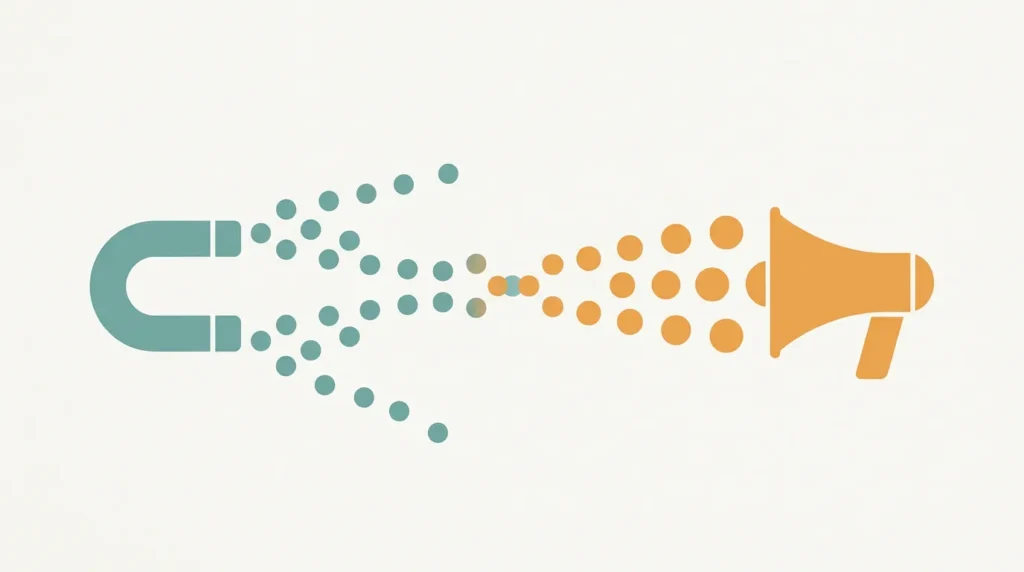
That takes more than a list of channels. You need a clear offer, a solid understanding of your audience, and measurable agreements between marketing and sales. In this article, you’ll read what inbound and outbound marketing mean, when to use each approach, and how to turn them into a workable strategy.
Inbound marketing is about attracting potential customers with information and experiences that match their questions. Think of search engine optimization (Search Engine Optimization, SEO), in-depth articles, webinars, email content, and landing pages. You’re not only trying to get attention; you’re helping someone move forward in their decision-making process.
Outbound marketing is about actively reaching a defined audience. Examples include targeted email outreach, paid ads, and relevant messages on business social channels. You don’t just wait for people to discover you; you take the initiative yourself. That only works if your message and targeting are relevant. An unsolicited message without a clear reason quickly feels like noise.
The difference is mainly about the direction of the first step. In inbound, the potential customer usually starts with a question or need. In outbound, your organization starts the contact. In both cases, you ultimately want a commercially relevant next step, such as an inquiry or a conversation.
Inbound and outbound marketing differ in speed, control, and the kind of effort they require. Inbound is usually an investment in discoverability and trust over a longer period. Outbound gives you more control over who you try to reach and when. Neither guarantees interest or sales. The outcome depends, among other things, on your offer, timing, audience, and execution.
Those differences are directional, not fixed laws of nature. A strong inbound campaign can generate inquiries in the short term. A targeted outreach approach may only become relevant after several contact moments. So compare channels based on their contribution to your sales process, not on a simple choice between fast and slow.
If you want to look at the trade-off in more detail, read Difference Between Inbound and Outbound: Comparing Strategies.
Inbound is especially logical when potential customers are actively looking for information, comparing their options, or needing explanation before they get in touch. You often see this with products or services that have a longer decision cycle, multiple decision-makers involved, or a clear need for advice.
Don’t start publishing just for the sake of publishing. First, research which questions your audience asks during exploration, evaluation, and choice. A good article gives a concrete answer. A strong landing page makes it clear who the offer is for, which problem it solves, and what the next step is. That requires content that is useful for people, not just placing search terms in the right spots. Search guidelines also emphasize readable, helpful, and reliable content, but they do not guarantee a specific position in search results. (developers.google.com)
SEO fits inbound when you want to build organic visibility. Research relevant search queries, improve existing pages, and create content that genuinely helps people make a decision. The next step is connecting it to your commercial offer: if your information page attracts a lot of visitors but offers no suitable next step, you may be leaving value on the table. For a detailed approach, see SEO Optimization: A Complete Approach for Better Rankings.
Inbound requires patience and maintenance. An article is not an asset that will keep performing forever after publication. Check whether the information is still accurate, whether the page still matches your audience’s questions, and whether the desired action is clear. If your website itself is unclear or outdated, fix that foundation first. The investment in Website Development Costs: Overview and Factors can help you map the practical factors behind a new website.
Outbound is useful when you have a recognizable audience and do not want to wait for that audience to look for your offer on its own. For example, if you are introducing a new service, want to reach a specific industry, or want to approach a small number of suitable organizations. The strategy stands or falls with your selection: who likely has a relevant challenge, and why is your offer a logical conversation partner right now?
Make outreach specific. Refer to a recognizable business context, explain why you are getting in touch, and offer a modest next step. An initial message does not need to include every sales argument at once. The goal can be to test whether the topic is relevant, not to close a contract immediately. The same principle applies to paid ads: choose a clear audience, align the ad and landing page, and measure meaningful actions. Read more about execution in Outbound Marketing: Strategy, Channel Choice, and Execution and about paid search advertising in Advertising on Google: A Complete Guide for Beginners.
Outbound via email requires care. A relevant audience selection is not the same as permission to contact any address you want. Check which rules apply to your situation and country, be transparent about your purpose, and respect objections. European guidelines make it clear that direct marketing by email can also be subject to rules for electronic communications. The exact requirements depend on the circumstances and national implementation, so treat this as something to check in advance, not as a legal box to tick afterward. (commission.europa.eu)
If you want to use email, work with a clear audience, a relevant message, and suitable follow-up. These guides cover specific parts: Email Marketing ROI: Calculate, Improve, and Scale Smartly and B2B Email Campaigns: How to Make Them Profitable and Scalable.
A strong combination uses the channels for different tasks. Inbound builds information and trust. Outbound brings that information to the attention of a selected audience. The two reinforce each other when they share the same audience, message, and commercial next step.
A Customer Relationship Management system (Customer Relationship Management, CRM) helps you record interactions and follow-up clearly during that handoff. Automate where it saves repetitive work, such as logging inquiries or scheduling a reminder. Don’t let software independently adjust budgets or make major commercial promises without human oversight.
Also distinguish between contact stages. A lead is not yet a qualified lead, an appointment is not yet a sales opportunity, and a sales opportunity is not yet a customer. Marketing can define a Marketing Qualified Lead (MQL) as a contact that, based on agreed signals, deserves further marketing follow-up. A Sales Qualified Lead (SQL) is a contact that sales has assessed as suitable for active commercial follow-up. Agree on the criteria together so the same inquiry is not interpreted differently by different teams. Read more about that handoff in Generating Sales Leads: From Marketing to Sales.
Traffic, impressions, clicks, followers, and email opens can help you understand campaign behavior. They are not leads unless you have identifiable contact details or a concrete commercial request. So measure what you want to know at each step: which audience responds, how many suitable inquiries arise, how many are followed up, and which sales opportunities result from them.
Choose a limited number of Key Performance Indicators (KPIs) per channel. For inbound, you can look at organic traffic to relevant pages, inquiries from those pages, and the quality of those inquiries. For outbound, reach within the chosen audience, substantive responses, qualified meetings, and their follow-up are relevant. For paid campaigns, measure conversions that align with real business goals, such as an inquiry or a purchase. Conversion measurement can show which campaign elements contribute to desired actions, but interpretation depends on correct setup and suitable definitions. (support.google.com)
Keep measurement limits in mind. An inquiry may have involved several touchpoints, and not every contact is recorded digitally. So define in advance how you assign contribution, check the data, and discuss the results with sales. A dashboard full of decimals is not a strategy. A small number of reliable figures is often more useful than a long list no one uses.
You don’t have to build a complete marketing program right away. Start with a short test you can evaluate. In week one, define your audience, main need, offer, and desired next step. Then choose one inbound element, such as improving an existing page, and one outbound activity, such as a carefully selected approach to a limited audience.
In week two, check whether your website communicates the message clearly and whether getting in touch is easy. In week three, launch the activities and record responses and inquiries in a consistent way. In week four, discuss with sales which contacts were suitable, which questions came up, and where people dropped off. Use those signals to adjust your content, targeting, or follow-up. This is a working method, not a promise of a specific result.
If you’re looking for support in choosing an external partner, use concrete selection criteria and define goals and responsibilities in advance. The guide Choosing a Marketing Agency: Services and Selection Criteria can help you structure that decision. For using social channels, you’ll find more context in Social Media Marketing Agency: Services and Selection.
Inbound and outbound marketing are not camps you have to choose between. Inbound helps you get found and understood. Outbound helps you make targeted contact with potential customers you might otherwise not reach. The right balance varies by offer, audience, sales cycle, and available capacity.
Start with one audience, one clear message, and one measurable next step. Connect content and active outreach, make agreements between marketing and sales, and evaluate results on commercial quality, not attention alone. Then you’ll know not only which channel drives traffic, but also which activities help develop relevant leads and sales opportunities.
Book a free strategy call and discover how many leads we can generate for your business. No obligations — just a concrete growth plan.
Book your free strategy call → Book your free strategy call — 30 min, no strings attached