
 Written by
Daniel van Hek
Search Clicks·October 1, 2026
9 min read
Written by
Daniel van Hek
Search Clicks·October 1, 2026
9 min read
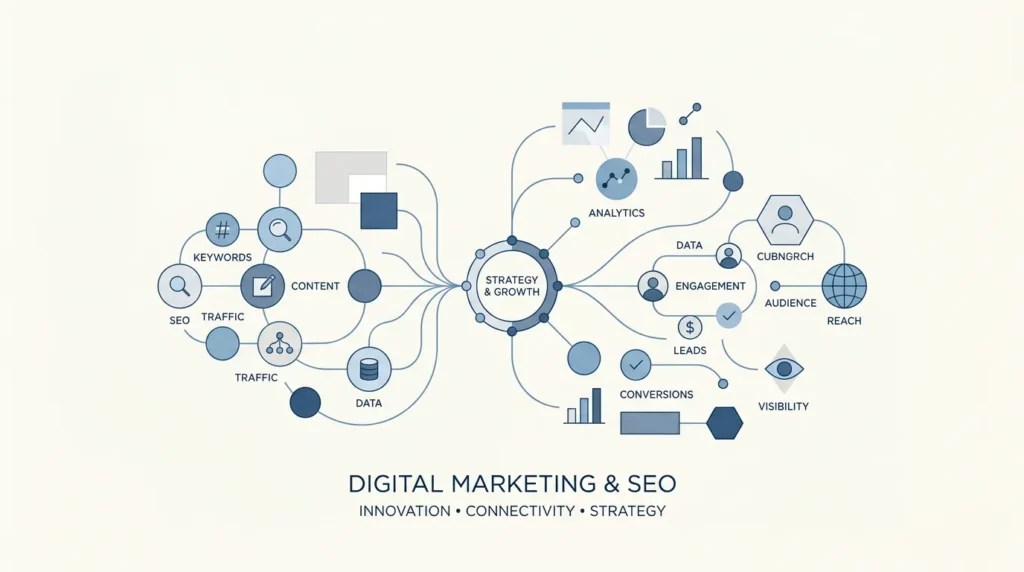
To be honest, a “SEO marketing agency” sounds like a bureaucratic name for something simple. Namely: you want to be found in Search, and you want that visibility to actually support your commercial goals.
In practice, that usually means two things at once:
So we are not just talking about “more traffic”. We are talking about the chain from search query to conversation. What is the intent behind the search term? Are visitors landing on the right page? And is their interest turning into a lead, appointment, or other valuable action?
That integration is exactly where a good SEO marketing agency is stronger than isolated optimization. We see it often with teams that already have an SEO strategy, but still do not make the bridge to CRO (Conversion Rate Optimization), tracking, and campaign architecture.
Ask yourself this: “If we get twice as many clicks from Search tomorrow, what happens to our revenue opportunities?”
An agency that only looks at positions often stops there. An agency that combines SEO with marketing looks further. That is why their approach usually follows this logical order.
Keywords are useful, but intent comes first. People do not search for “SEO”; they search for things like:
A SEO marketing agency translates that into a content and page structure. That sounds like marketing language, but it becomes practical as soon as you translate it into landing pages, sections on existing pages, and internal links.
Google’s own guidelines put the emphasis on helpful, reliable content made for people. That is not a “nice to have”; it is the foundation for how your site can carry value over the long term. (developers.google.cn)
You can run SEO perfectly, but if you cannot measure what that effort does, you are steering by gut feeling. And that is expensive.
That is why we usually build a measurement system around two things:
What works in practice here? First we choose which actions represent real commercial interest. For example: form submission, a demo request, or an appointment intent that you are allowed to follow up on. Then we set up tracking and test whether reporting matches reality.
And yes, we are clear about the distinction: website visit is not a lead. A lead is only a person or organization showing demonstrable commercial interest, for example with contact details or a real request.
Many SEO projects build content. We think it is stronger if you also plan the route from that content to conversion.
A SEO marketing agency therefore treats landing pages almost as the end point of a campaign. That means:
For performance, we also look at Core Web Vitals. In Search Console you can see URL performance grouped by status and relevant metric types. (support.google.com)
Trade-off: speed and content can sometimes be in tension. An extra section with extra media can increase conversion, but lower speed. That is why we test and adjust based on data.
SEO often delivers over the longer term. SEA can provide faster volume and feedback. Combine them intelligently, and you get a loop that strengthens itself.
In practice, we see it like this:
We do not promise a straight line to success. But we do reduce the chance that your ad spend burns away on pages that are not ready for the intent you are buying.
If you are looking for an agency, you do not want a vague roadmap. You want a plan you can check. This is the approach we usually follow at the start.
What you notice as a client here: we ask questions. Many. Not because we are difficult, but because SEO marketing without commercial context often ends up as “more traffic in the wrong place”.
Then we choose 3 to 6 improvement streams. For example:
Important: we define a KPI (Key Performance Indicator) in advance for each stream. Not 10 KPIs. A set your team can understand and follow.
In this phase we do two things at once:
We use data for decisions, but we stay realistic. Some SEO effects are delayed. That is why we plan evaluation moments, so you do not draw conclusions too early from one week of data.
You do not automatically need to hire an agency. But there are clear signs when it does make sense.
Google itself describes ranking as being about helpful, reliable information made for people. That is a broad direction, but you can immediately see the link with E-E-A-T and content quality. (developers.google.cn)
If you are talking to an agency soon, ask these questions. Short and sharp.
Core Web Vitals sits in Search Console with reporting on URL performance and metric types. (support.google.com)
I will give you a scenario we often see in B2B. Suppose you sell a service where the decision-maker first explores and only then gets in touch.
GA4 works event-based, and you can define conversions by marking events as conversions. (support.google.com)
A SEO marketing agency is not just “someone who does SEO”. It is a partner that connects SEO to your broader online marketing and your sales logic.
If you do it well, you get a system that:
Our recommendation for your next step is simple. Pull out a short diagnosis, review which pages are already showing traction in Search Console and which conversion events in GA4 really match commercial interest. (support.google.com)
After that, you can build a plan that does not just “perform better”, but also sells better. And that is, honestly, the only KPI story we like to tell over coffee.
Book a free strategy call and discover how many leads we can generate for your business. No obligations — just a concrete growth plan.
Book your free strategy call → Book your free strategy call — 30 min, no strings attached