
 Written by
Daniel van Hek
Search Clicks·July 28, 2026
10 min read
Written by
Daniel van Hek
Search Clicks·July 28, 2026
10 min read
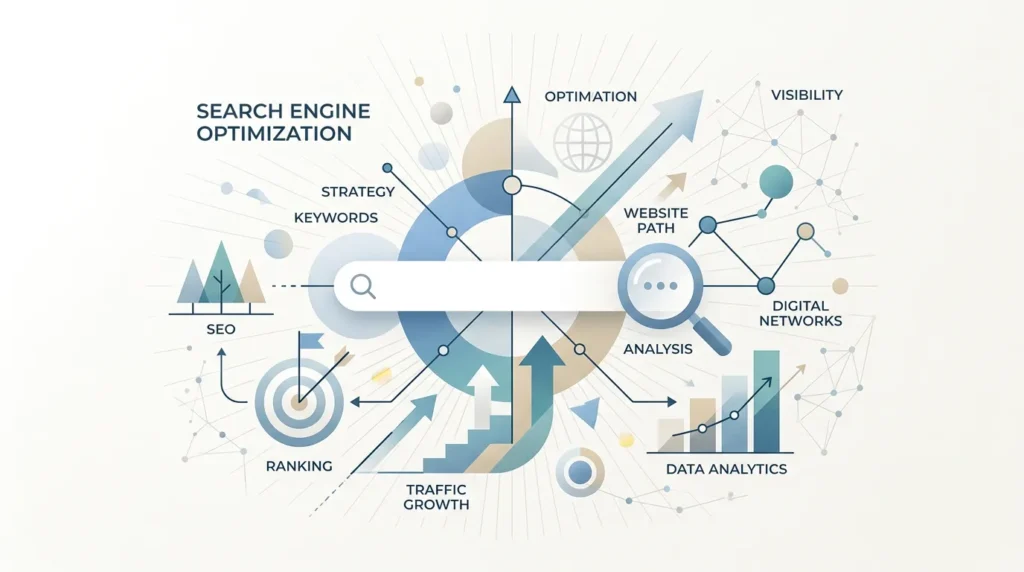
Picture your website as a shop for a moment. You can have the best selection in the world, but if people can’t find you, you’re standing still. That’s exactly where seo comes in. Not as a trick. As a system.
In practice, we keep seeing the same pattern: companies that treat SEO as a one-off project lose momentum. Companies that see it as an ongoing growth engine win structurally. In this article, we’ll take you through the strategy behind SEO, what really works, why it works, and what your next step can be today.
We’ll keep it practical. No promises about rankings, no exaggerated claims about turnover. Just an approach we often use in the field to improve visibility, with clear trade-offs.
SEO is the process of making sure search engines understand your site and users find your pages relevant. Google describes this as organizing and assessing huge amounts of content to show the most helpful results. That means you don’t just want to be “found” — you want to be “chosen”. (google.com)
Google is explicit that automated systems help prioritize useful, reliable content, not content that is only meant to manipulate rankings. (developers.google.com)
Yes, your page needs to be relevant. But relevance is more than word frequency. You help search engines by structuring your content clearly (headings, internal logic, clear topics), and by making sure your content actually matches the intent. In the SEO Starter Guide, it’s also emphasized that you should create primarily for users, and help with fundamental best practices for crawl, indexing and understanding. (developers.google.com)
If you want SEO to work, you need to start with the marketing side. Technical SEO is the engine, but you need fuel: the right topics on the right pages, for the right stage of the customer journey.
Your search strategy works better when you build a cluster. Think of one main topic, with multiple pages within it that together form a complete answer. For example: one page that explains the topic, plus supporting pages for variations, step-by-step guides, FAQs and specific use cases.
Why this works: users often don’t want one single “answer”. They want a route. And search engines also measure whether content helps the user, rather than simply repeating terms. (developers.google.com)
We like to make an intent map per cluster with three categories:
If you don’t follow this logic, you often end up with content that “sounds SEO-friendly” but doesn’t land commercially.
Instead of just “producing a text”, we work with quality criteria you can test:
Trade-off: this takes more time than just “optimizing a bit”. But it also prevents you from having to redo the same page multiple times because the intent is off.
On-page SEO isn’t only about what’s on the page. It’s also about how your page appears in search results and how well the search engine can interpret it.
Google builds the title link (the visible title in results) from different sources, including prominent text material and headings. (developers.google.com)
Practical advice:
Why this works: you increase the chance that the click is relevant. Not every impression has to become a click, but every click should match intent.
The meta description mainly helps with CTR. We often see that strong descriptions improve the first step, especially when your audience is actively searching but still hesitating.
Format we often like:
Trade-off: a better description can increase CTR, but if your page doesn’t deliver, bounce rises and your quality signal worsens. So describe honestly, and make sure your content matches.
Headings are your navigation. In the Google SEO Starter Guide, it says that using headings in semantic order helps and that it makes it logical for search engines to understand content. (developers.google.com)
Practical:
Technical SEO isn’t sexy. It is where growth starts, though. If search engines can’t reach or understand your pages properly, you can write content until you’re blue in the face. Your site still won’t win.
Google explains how search works and how information is organized based on crawling and indexing. (google.com)
What we check in practice:
If you don’t measure this, you’re working in the dark. So measure it in your own dashboards. That’s not a fancy step, it’s necessary.
Structured data can give search engines extra context, so your page is understood better and richer displays are sometimes possible. Google advises developers to provide explicit clues about the meaning of content via structured data. (developers.google.cn)
Practical advice:
Trade-off: incorrect or unnecessary markup can be confusing. So take a phased approach.
Because Google can assemble title links and titles from multiple sources, duplication or a confusing heading structure can make your results look messy. (developers.google.com)
Our rule:
The core of SEO isn’t “writing content”. It’s creating content people use. Google says there are automated systems that prioritize helpful, reliable content, written for people instead of manipulation. (developers.google.com)
In reporting, we usually look at patterns such as:
Trade-off: if you only optimize content for traffic, but the page doesn’t help commercially, growth lags behind. That’s why we connect SEO to funnel thinking.
For a topic page, we usually use:
This may sound obvious. But many sites skip “steps” and the “junk drawer” of pitfalls, which makes the page feel unfinished.
The internet is full of lists. That’s fine, as long as you bring better input. Original doesn’t just mean “new words”. It also means better structure, clearer choices, real details, and a clear perspective from someone who has done the work.
SEO is not a sprint. But it doesn’t have to be a gamble either. We build a cycle your team can repeat, without starting from scratch every month.
Google doesn’t explicitly warn against iterating, but the system is clearly focused on delivering helpful results, so improving is usually rewarded when you hit the intent well. (google.com)
This is tough, but important. Sometimes you can keep tweaking a page and still get nowhere. Then stop micro-optimizing and check the fundamentals:
Trade-off: rebuilding is painful. But continuing in the wrong direction often costs even more time.
If you do one thing today, make it this:
That’s a manageable scope. You learn quickly. And you build a system you can scale later.
If you also want to make internal processes more efficient, this can help when your team runs SEO alongside other work. For example with Automating: Make Processes More Efficient, Hub brief. And if you’re just starting out or want to standardize your approach, then SEO Agency: Complete Guide to Search Engine Optimization is a good fit for setting up a workable approach.
SEO comes down to three things: search engines understanding your site (technical), your page answering the question better than alternatives (content), and a system for measuring and improving (process). Google describes that focus on helpful and reliable content, and in practice we see that this is also the only sustainable route. (developers.google.com)
If you do it well, you don’t just get more traffic. You get better visitors, because you match intent. And that’s often where commercial growth starts: with relevance, followed by trust.
So, choose your first cluster today, make your improvement plan concrete, and roll it out in phases. Then you’ll have clear signals within a short time, and after that you can scale smartly. SEO is work, yes. But it’s work you can steer.
Book a free strategy call and discover how many leads we can generate for your business. No obligations — just a concrete growth plan.
Book your free strategy call → Book your free strategy call — 30 min, no strings attached