
 Written by
Daniel van Hek
Search Clicks·October 16, 2026
11 min read
Written by
Daniel van Hek
Search Clicks·October 16, 2026
11 min read
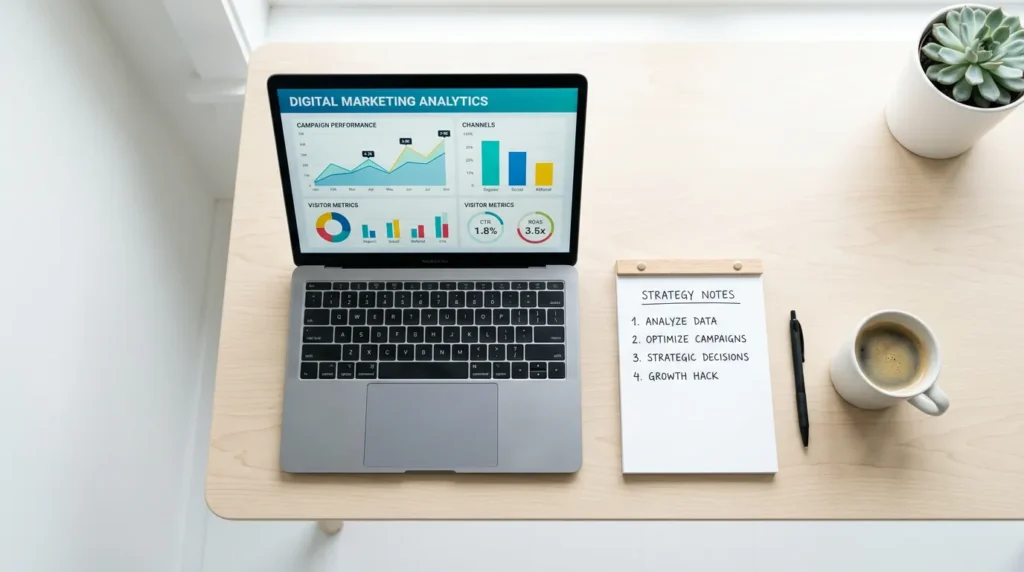
Imagine your business has a smart shop, but the display window is facing the wrong way. Your offer is solid, only new customers struggle to find you. That is exactly the gap a search engine agency fills. Not with magic tricks, but with a workable combination of Search Engine Optimization (SEO) and Search Engine Advertising (SEA), plus conversion improvements on your website.
If your first thought is mainly “we need more traffic”, then the next step is usually: less guessing and more focus on search intent, performance and lead quality. That sounds logical, but in practice there is far too little happening at the level of measurement plan, campaign structure and landing pages. We see that in many teams that are growing without a real foundation. Then you pay for clicks, but you do not get a steady flow of commercial opportunities.
In this article we walk you through what a strong search engine agency does, how to spot the difference, and what you can set down tomorrow. No jargon to impress. Just an approach you can check.
A search engine agency helps you improve online visibility and demand generation through search engines. At its core, it comes down to three parts:
What it often is not, is “set up one campaign once” or “optimise a few pages and you’re done”. Search results and ad markets move. Without a measurement rhythm and iteration, it becomes a one-off action, not a system.
We usually steer by a simple truth: search behaviour is driven by intent. So your job is to capture that intent with a combination of:
That is why we often view SEO and SEA as one system. SEA can deliver budget-driven data faster, SEO builds long-term value. Together, you get direction faster.
SEO is not a separate project. It is a rhythm of finding, improving and publishing, with a measurable effect on organic search results.
Before we make changes, we look at where you score now, where you are close to scoring, and where you are missing traffic. A practical starting point is to monitor your search performance through Google Search Console and mainly work with queries, clicks and impressions. There you can, for example, sort and filter by query to see what is happening. (support.google.com)
If you do not yet have a structured SEO analysis process, then this is a logical next step: Run an SEO Analysis: tools, measurement and action plan.
A common mistake: targeting terms that bring traffic, but not the right customers. So we translate search intent into content formats. For example:
Your content does not need to be long. It does need to do exactly what the visitor expects.
Rankings are a signal, not the end goal. In practice we focus on:
Here too Search Console helps, because it shows how often you appear in Google Search and how many clicks that generates. (support.google.com)
SEA can deliver results quickly, but only if we set the basics up properly. Otherwise you optimise for the wrong KPI (Key Performance Indicator).
In Google Ads, keyword match types determine how closely your keyword is linked to the search query. Google describes three main types: exact match, phrase match and broad match. (support.google.com)
Why does this matter for you? Because it affects:
Our approach is usually pragmatic: we combine match types based on intent and measurability. We start stricter with high intent. Exploration can be broader, but only with tight negative keywords and a fast optimisation rhythm.
Quality Score is a measure Google uses to describe the relevance and quality of your ads and landing pages, with elements such as expected CTR, ad relevance and landing page experience. (support.google.com)
Note the nuance: Quality Score is not a guarantee. It is a useful diagnostic compass for deciding where to improve.
In SEA we therefore do the following, in that order:
If you want, you can also connect this to a broader SEA foundation such as: Search engine advertising agency: smart SEA strategy.
A classic. Teams measure “something”, but not what matters commercially. In Google Analytics 4, a conversion is created based on an event and can be measured consistently across channels, including actions that can also run through Google Ads. (support.google.com)
For you, this means: we agree in advance which actions count as a conversion. For example:
After that, we build campaign optimisation around that definition. Without that, you are measuring noise.
Traffic is not the goal. Commercial opportunities are the goal. So we need to make sure your website and follow-up do what they are there to do.
In online marketing and online sales optimisation, a “lead” is only a lead when there is real commercial intent and usually identifying contact details or a clear request. So not “just click behaviour” or “just website visit”.
We often also distinguish:
This discipline prevents your budget from going to volume while your team actually needs higher-quality appointments.
A landing page is not a brochure. It is a micro-conversation with the visitor.
We pay attention to:
If you want to work on this structurally, this also fits your journey: Website optimisation agency: growth with focus.
We often see teams jump straight into technical improvements. It feels productive, but it can block your measurement. The practical order we usually use is:
If, for example, you are doing B2C or funnel-driven lead generation, this can help as a framework: Generate Leads B2C: tactics from TOFU to CRO.
You want an agency that does not drown you in dashboards, but helps you make decisions. These are the signals we look for.
A good agency can answer:
For SEO we expect them to work with performance reports in Search Console and to analyse queries and trends. (support.google.com)
For SEA we expect them to use match types and quality as steering information, including understanding the components of Quality Score. (support.google.com)
Keep asking: what happens after a click or request? Is there a consistent follow-up route in your CRM (Customer Relationship Management)? Are MQL and SQL tracked? This is where many journeys still fail, because marketing and sales do not measure together.
If you want to create structure for lead generation, this is practical: Build a Lead Generation Website: conversion-focused step-by-step plan.
Not just “do SEO” or “run SEA”. But a plan that says: what comes first, what comes next, and when we draw conclusions.
If you are looking for a complete approach, this matches how we usually think: SEO optimisation agency: complete approach for growth.
All right, now it gets concrete. Choose one scenario and schedule an appointment or sprint around it right away.
If you are looking for someone to help with execution in this context, this article helps as preparation: Hire a SEA Specialist: what you need to know (2026).
If you are just starting out or building in-house expertise, this can help with the foundations: Google Ads advertising: getting started with Google Ads (guide 2026).
If you are getting leads but sales is complaining about quality, the problem is often qualification and timing. In B2B we then work with automated checks and a consistent messaging flow.
For a practical email setup that supports sales follow-up, also read: B2B mailing: setting up business email campaigns.
That depends on your goal and your timing. SEA can learn and deliver faster, SEO builds structural visibility. In most journeys, the real win is combining both and keeping the same lead goals central.
Not necessarily. Sometimes it is smart to use SEA as a data source to validate search intents and objections faster. After that, you can build SEO more precisely. But then tracking and measurement definition must be right first.
SEM means Search Engine Marketing and is an umbrella term for marketing in search engines. In practice, you often see it used as SEO plus SEA together. If you want the difference and the relationship clear: SEA and SEM: difference and relationship explained (2026).
If you choose a search engine agency, you are really choosing a way of working. Not a package. We look at intent, match it to ads or content, make sure landing pages move people forward, and measure conversions in a way that sales and marketing both understand.
Remember this if you need to make a choice today:
And then, the next step: schedule a session in which you set down the intents, landing pages and conversion definitions together. Only then optimise. That is often the difference between “we do marketing” and “we build a system that works”.
Book a free strategy call and discover how many leads we can generate for your business. No obligations — just a concrete growth plan.
Book your free strategy call → Book your free strategy call — 30 min, no strings attached