SEA vs SEM: difference and relationship explained (2026)
Written byDaniel van HekSearch Clicks·October 13, 2026
9 min read
If you’ve ever heard “SEA” and “SEM” mentioned, you already know the feeling: the terms sound like they control the same button. In practice, it’s like coffee and espresso: same ingredient, different method. For your online marketing and sales, that difference matters. Not to collect jargon, but to make your budget, your measurement and your funnel choices logical.
In this article, we explain the difference and the relationship between sea sem terms, but also what you can practically do with them. You’ll know what to do, in what order, and why it works. No vague promises, just a workable approach.
What do we mean by “SEA” and “SEM”?
Let’s keep the definitions sharp. We want to avoid talking past each other.
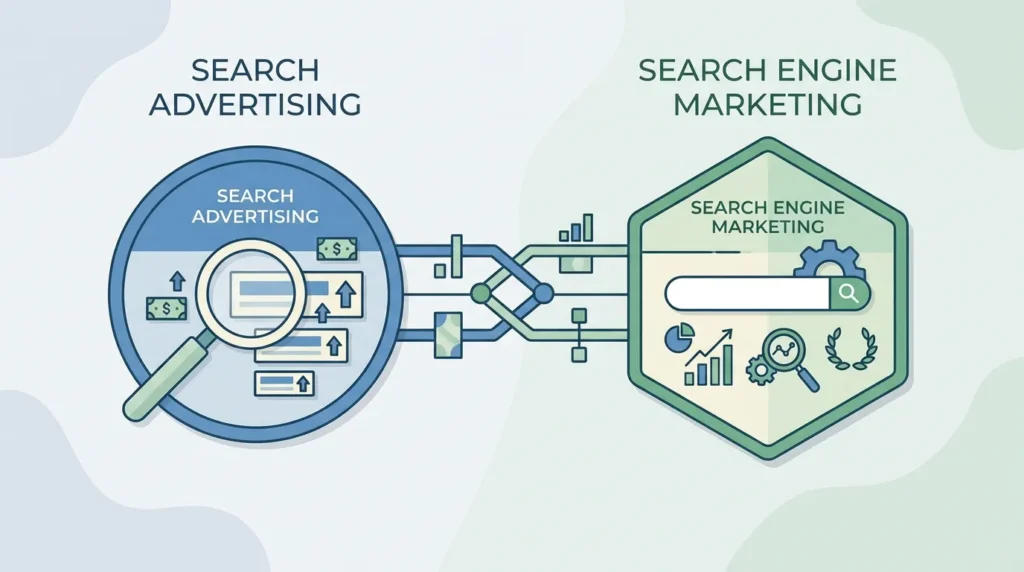
SEA, Search Engine Advertising
SEA means Search Engine Advertising. That is paid visibility based on search queries. Think of ads that are shown when someone searches for relevant terms. In most cases, you pay per click, per view or based on another ad pricing model, depending on your setup. In Google Ads, conversion-focused bidding strategies are also widely used, where the system optimises toward conversions or conversion value. (support.google.com)
SEM, Search Engine Marketing
SEM means Search Engine Marketing. That is an umbrella term. In practice, many teams use SEM to mean all marketing activities around search engines. In that category, both of these fall under it:
SEA (paid ads)
SEO (Search Engine Optimization, meaning non-paid visibility)
In other words: SEA is a part of SEM. That is the core relationship.
SEA and SEM in one funnel: why this difference shows up in your results
You can see SEA and SEO as two different engines for the same vehicle. They both use “search intent”. But their behaviour and timing differ.
SEA works faster, SEO builds structurally
SEA is often faster to deploy. Turn on your campaign, with the right targeting and a working conversion measurement setup, and you can collect data quickly. That also brings two practical sides straight away:
You quickly gain insight into which search terms, landing pages and bidding strategies get people to take action.
You can adjust based on conversions, for example toward a target CPA or target ROAS, depending on your measurement model. (support.google.com)
SEO takes more time. But in the long run, it can improve your cost efficiency and expand your reach with content that keeps working. That makes SEM logical as the bigger picture: the paid engine brings speed, the organic engine brings stability.
Why this changes your measurement strategy
In online marketing, “what you measure” is almost always “what you optimise”. That’s why you need to keep one measurement line across SEA and SEM.
Conversion measurement is the starting point
For SEA, you need a conversion goal that is correct. Google Ads optimises bids based on conversions and conversion value within your setup. The definitions and calculations around CPA matter here. Google, for example, defines Average CPA as total cost divided by the total number of conversions. (support.google.com)
For SEO and technical performance, you need a source of truth about how Google sees your site and how pages perform. Google Search Console gives a summary of your performance in Google Search and helps you analyse what you can improve. (support.google.com)
The practical strategy: using SEA smartly within SEM
Okay, the definitions are clear. Now for the real work: how do you turn this into an approach that generates leads and keeps your budget under control?
Step 1: Make your KPI’s concrete (and choose the right definition of CPA)
We often talk about KPI’s, so let’s make it concrete. First choose which action your business values. For lead generation, that could be a form submission, an appointment, or a qualifying event.
Next, choose a measurement value for your optimisation. Pay attention to CPA. In this article, by CPA we mean either Cost Per Acquisition or Cost Per Action. Choose one definition and keep it consistent in your reporting. (Here we use “Cost Per Action” as the standard for marketing actions, but you need to define that for your own process.)
Step 2: Build SEA around “conversions that really matter”
SEA without good conversion data is guesswork with a neat interface. Google Ads Smart Bidding uses conversion data to optimise bids toward your goals, such as Target CPA or Target ROAS. (support.google.com)
What works in practice:
Start with a small set of landing pages that clearly match your search intent.
Use ad copy that matches the page (messaging match). That lowers friction and speeds up learning.
Optimise for conversion, not for “traffic”. Website visits are not leads. Only a real action with commercial value is.
Trade-off: if you track too few conversions or optimise too broadly, the system will learn more slowly. That’s not a “software bug”, that’s data reality.
Step 3: Use SEA data to feed SEM (SEO and content)
This is where SEM gets interesting. You don’t use SEA only to buy leads, you also use it as training data for your organic roadmap.
Specifically:
Which search terms drive conversions? Turn those insights into SEO content clusters.
Which pages convert? Build SEO variants that match the same intent.
Which questions keep showing up in conversions? Translate them into FAQ’s and problem-focused landing pages.
Why this works: in SEA, you pay for fast signal creation, while SEO later gives you scale without having to buy every click.
Step 4: Make sure your reporting tells the SEA and SEO story together
In many organisations, teams report separately. That feels efficient, but it makes decisions messy. SEM needs one story.
At minimum, you want this in your monthly reporting:
SEA: cost, CPA or ROAS, conversion volume and conversion quality
SEO: Search Console trends per query and page, plus indexing and visibility signals (support.google.com)
Based on that, you steer budget and content priorities. You don’t have to measure everything, but you do need to measure what influences your decision.
What should you do now? A 14-day action plan for “sea sem” clarity
Let’s make it practical. Below is a plan you can execute as a professional without turning it into a three-month project.
Days 1 to 3: clean up the measurement base
Check your conversions: are they up to date, correctly classified and linked to the right goals?
Record your KPI’s: choose one primary KPI for optimisation (for example CPA or ROAS) and one KPI for quality (for example MQL or SQL, depending on your process).
Open Search Console and check your Search performance and which pages and queries are relevant. (support.google.com)
Days 4 to 7: set up the SEA campaign for learning
Create ad groups per intent (for example problem-focused, solution-focused, price-focused).
Use bidding strategies that fit your measurement goal. Smart Bidding can optimise toward conversions or conversion value. (support.google.com)
Turn on 1 variable at a time so you know what made the difference. (For example, test one landing page at a time.)
Trade-off: if you change too many things at once, you lose learning. And learning is your biggest advantage at this stage.
Days 8 to 10: refine landing pages and CTA logic
Create one path for the visitor. Keep your CTA clear, and avoid forcing someone through twenty steps before they see the same message.
Common SEA and SEM mistakes (and how to avoid them)
I see a few patterns come up again and again. Not because teams don’t try, but because marketing complexity is often greater than the planning.
Mistake 1: Reporting SEA and SEO as two separate businesses
Then you pay for clicks without knowing whether organic can reduce costs later. Or you build SEO on assumptions without knowing which intent really drives conversions. SEM needs one steering model.
Mistake 2: Optimising for the wrong conversion
If your conversion does not measure real commercial interest, your system will optimise toward the wrong behaviour. Google Ads Smart Bidding works best when conversions are correct and usable as the target signal. (support.google.com)
Mistake 3: Setting targets too aggressively
If your target CPA or target ROAS is not realistic for your market, you either get low delivery or a cocktail of irrelevant visitors who just about make it through. This is not a maths problem, it’s a pacing problem.
The limit here is honest: we can’t promise what your target should be. That depends on your margin, your conversion quality, your offer and your historical data. What we can say is what works in practice: start with a range that gives the system room to learn, then adjust in small steps.
Mistake 4: Confusing leads with traffic
Viewing a page is not a lead. Filling in a form often is a lead. Booking an appointment can become a Sales Qualified Lead, depending on your qualification. Make that step clear in your CRM. It prevents misinterpretation in your KPI’s.
Conclusion: SEA is the tool, SEM is the working method
In short, and in a way you can explain to a colleague without putting them to sleep:
SEA (Search Engine Advertising) is paid search advertising. It delivers speed and fast data.
SEM (Search Engine Marketing) is the broader search domain. SEA and SEO both sit within it.
The real gain comes when you use SEA to better understand your funnel and intent, and translate those insights into your SEO roadmap.
If you do one thing tomorrow: set up your measurement base, choose your primary conversion goal, and start with SEA so you can gather signals. Then translate those signals into your SEM backlog, meaning your SEO and content priorities. That is the order that usually gets you to clarity and control the fastest.
Book your free strategy call — 30 min, no strings attached
Cookies on this site
We use analytics cookies to see how the site is used. They are only placed if you agree. Refusing costs you nothing — the site works exactly the same. Privacy statement