
 Written by
Daniel van Hek
Search Clicks·October 12, 2026
12 min read
Written by
Daniel van Hek
Search Clicks·October 12, 2026
12 min read
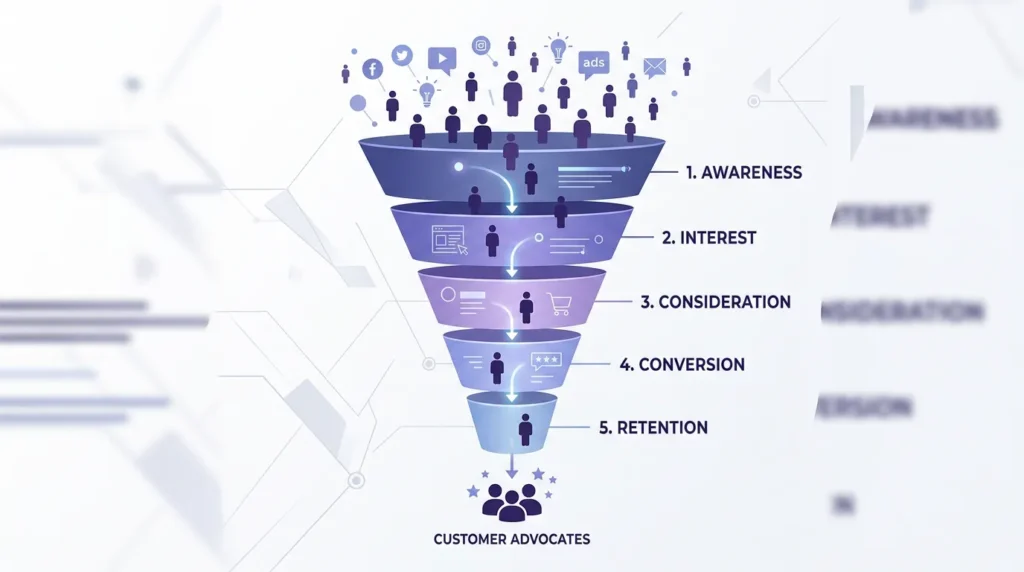
Okay, you want to generate b2c leads. Not with vague “more traffic” talk, but with a system that works from awareness through to conversion. We always tackle it in the same order: first get your target audience clear, then build your funnel, then use your channels smartly, and finally optimize your tracking and conversion. Sounds logical. In practice, the tricky part is usually in the details: the message is off, the page is too broad, or you’re measuring the wrong moment.
In this article, we’ll take you through a practical approach to consumer-focused lead generation. You’ll get strategy, but above all execution. And we’ll keep it honest, because every tactic comes with trade-offs. You have to choose what you want to maximize: volume, quality, or speed.
Before your budget, your ads, your SEO, everything: you need one thing that is correct. What is a “lead” for you? In B2C, that can mean something different than in B2B.
In B2C, we often see two mistakes:
We recommend using at least three levels:
Why this works: you can optimize campaigns for quality, not just volume. And you avoid paying for ads that generate “leads” you actually don’t want.
In B2C, lead generation is usually one of these main routes:
After that comes nurturing, or quick follow-up. The route you choose determines your landing page, your ad copy, and your measurement plan.
Write this on one page:
If you don’t finish this today, everything after it is guesswork. (And guessing is expensive, even when it sounds “creative”.)
Your funnel doesn’t need to be complicated. It does need to match what consumers expect. B2C is faster, more emotional, and more sensitive to friction.
You can use the familiar structure, but we turn it into actionable tasks:
What usually works in B2C:
A landing page is your conversion machine. Not your mini-website. Google has its own publications that emphasize practical optimizations such as mobile usability and a clear focus on conversion. (services.google.com)
In practical terms, we keep it like this:
Trade-off: if you make the form too short, you’ll get more “false” leads. That’s why your MQL definition should filter quality back in, not only afterward.
Pick one campaign or one channel. Rebuild the landing page around that single intent. And measure the right conversion from day 1. Want to click through later to a concrete step-by-step plan? Then use this internal article: Lead Generation Site Building: conversion-focused step-by-step plan.
Generating b2c leads is rarely about one channel. It’s a mix. But you do want every channel to have a job. Otherwise your funnel becomes a messy pile of campaigns.
SEO works strongly when you’re dealing with steady search demand: “how much does”, “which choice”, “why”, “how does it work”. The upside is that traffic gets cheaper later, but the downside is timing. SEO only becomes profitable when your rankings and conversions line up.
What we often do:
Want a complete approach for online leads with SEO? Then this internal article fits well: Marketing SEO Agency: complete guide to more online leads.
SEA works when you can drive demand directly. Think search ads and retargeting. But you need to measure conversions properly, otherwise you optimize the wrong thing.
If you need a budget process, a simple rule helps: you want to learn and optimize without wrecking your data sensitivity. This internal article can help you with that: SEA Budget Setting: how much to invest in Google Ads?.
Social ads and display are often less direct for “form now”. Their strength lies in:
Trade-off: retargeting only works if your landing page isn’t “random”. Your message has to match the stage your audience is in.
Set one KPI (Key Performance Indicator) per channel that matches the goal:
And if you’re looking for a practical implementation of SEO and decision-making in practice, also take a look at: Implement SEO Online: practical step-by-step plan.
You can write brilliant ad copy and build a beautiful landing page. If your tracking is off, you’re steering on noise. And then lead generation is mostly a creative project with spreadsheets.
For SEO insight, Google Search Console (GSC) is an important tool. It tells you how your pages perform in Google Search results, including clicks, impressions, average CTR and average position. (support.google.com)
One nuance to note: metrics like average position are averages across all the moments your pages were seen in that period, because position can vary by search query and moment. (support.google.com)
Why this matters for generating b2c leads: CTR (Click-Through Rate) often moves with your snippet and relevance. But conversion on the landing page determines whether that CTR delivers “good leads”.
In Google Analytics 4 (GA4), it’s all about event tracking and marking “conversions” on the events that really matter for your funnel. GA4 is based on events and conversions are based on key events. Google also provides guidance and information around event reference and recommended events. (developers.google.com)
In practice, we keep it like this:
Trade-off: too many events and too many conversions make your reporting unclear. Choose a small set of primary conversions and use additional events as supporting signals.
For SEA, you want to connect conversions to campaigns. Otherwise you optimize for clicks or for “incomplete” forms. The goal is to optimize in your campaign tools for the lead step that delivers MQL or SQL for you.
Next step: make a measurement plan in table form. Columns: funnel stage, primary conversion (what you measure), secondary signals (what you use as support), and where that conversion is used (GA4, ad tool, CRM follow-up).
You can lower your ad costs, but conversion optimization is usually the fastest route to more leads from the same budget. But optimization is not guessing. You do it in a structured way.
Based on what we see in projects, and aligned with general landing page optimization principles, improvements often fall into these categories. (services.google.com)
No A/B test “because we feel like it”. You want a hypothesis you can test.
Examples of good hypotheses:
Limitations, to be fair: test populations that are too small create noise. Then you need to test over a longer period or narrow your scope (for example, by audience segment).
Many B2C journeys take longer than you think. That’s why follow-up almost always works. And that raises a practical question: what is your follow-up channel and pace?
If you do a lot of online requests, email nurturing is often the most scalable option. We also have internal material that fits this seamlessly: Calculate ROI Email Marketing: measuring returns, steering smartly.
And if you want to start faster with a better setup and segmentation (even if it’s not B2B), look at the logic of campaign structure in: Inbound and Outbound Marketing: difference and combination.
Choose one landing page. Choose one primary conversion. And improve one lever per test. At the same time, set up your follow-up flow for the first 7 to 14 days after lead capture.
Generating b2c leads is only truly “sales-ready” when your follow-up works. Sometimes the difference between lots of leads and lots of customers is timing and quality.
We want your CRM to reflect the funnel stage. Concretely:
Trade-off: more fields and more qualification can reduce conversion. So qualify through smart questions or through behavior, not only through long forms.
Automation here means: software and workflows to streamline lead capture, follow-up, enrichment and reporting. Not “send everything automatically and hope for the best”.
Practical use cases:
And yes, this requires discipline in data. That’s why it’s smart to keep lead definitions consistent between GA4, ad tools and CRM.
Start with one simple workflow: lead submitted, send confirmation, choose segment, and route to the next step. Link that to your KPIs. Want the broader approach behind lead flows and segmentation? This internal article is a good addition: Inbound and Outbound Marketing: difference and combination.
Let’s pull it together. If you take generate b2c leads seriously, you approach it in this order:
If you want to take one step tomorrow: choose one funnel route and one conversion. Get tracking right. And then improve your landing page on message match and friction. Those are the places where B2C usually gets better fastest. And honestly, it almost feels like using a cheat code, only without the magic.
If you want extra background on the technical side or broader growth, feel free to have a look at these internal links where relevant:
Book a free strategy call and discover how many leads we can generate for your business. No obligations — just a concrete growth plan.
Book your free strategy call → Book your free strategy call — 30 min, no strings attached