

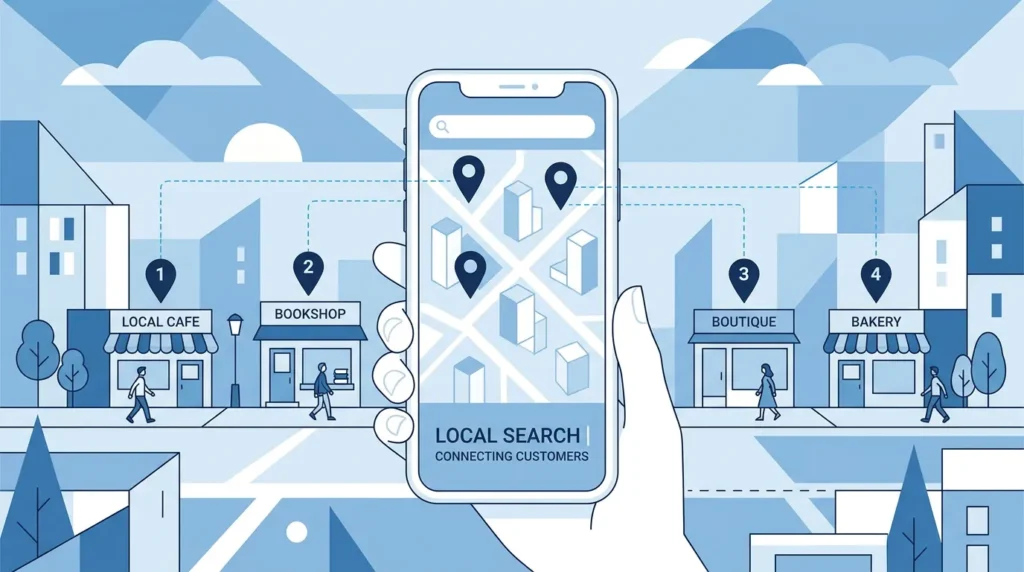
Picture this: your company ranks well in the regular search results, but the moment someone searches “near me,” your brand disappears. That is exactly where a local seo bureau comes in. Not with vague promises, but with an approach that fits local intent, local visibility, and especially local appointments.
We see it in practice again and again. Local SEO is not a standalone SEO trick. It is a system. A mix of setup, content, technical foundations, reviews, and making what happens measurable. In this article, we walk you through what a good local SEO bureau does, why it works, and what your next step is if you want to perform better in Google Maps and local search today.
What to expect from a local SEO bureau — and what not to expect
A professional local SEO bureau works from a simple starting point: your customer is not looking for “a service,” they are looking for a solution nearby. So you need to be findable the moment someone needs your type of business, and you need to build trust in the search results.
The 5 elements we always see in effective local SEO
- Google Business Profile (GBP) setup, so Google understands who you are and where your service is active.
- Consistent business information (name, address, phone, plus business details). Inconsistencies cost you visibility and trust.
- Local landing pages that match the search intent, not an internal menu structure.
- Reviews and review behavior that really connect with your target audience (how you ask, when you ask, and how you respond).
- Making it measurable what local SEO does, so we are not optimizing based on gut feeling.
What we deliberately do not promise
You do not get a “guaranteed top spot” promise. Search results are dynamic. What we do deliver is predictable work: we set priorities, execute, measure impact, and improve. That is the only way to move from local visibility to real lead generation without driving yourself crazy.
The core strategy: from local visibility to appointments
This is the strategy your bureau should focus on. Not on “more traffic,” but on more commercial actions: call requests, contact forms, route requests, and follow-up appointments. Note that we use “lead” here only for real commercial intent with recognizable contact or a request.
Step 1: make your performance visible in Google Search Console
If you do not know which search terms, pages, and countries have impact, you are optimizing in the dark. In Google Search Console you can see performance in Google Search, including clicks, impressions, CTR, and average position. That helps us determine whether we mainly need to get “more visibility” or mainly need to earn “more clicks” with better snippets and page content. Google describes the Performance report as the overview with these metrics over a chosen period. (support.google.com)
Step 2: GBP as a local engine, not an afterthought
Local search results often come about through Google Maps and local search. Google states that you can improve local ranking through your Business Profile, and that factors such as information on your profile and reviews play a role. (support.google.com)
We see that companies often “maintain” GBP instead of “optimizing” it. Maintaining means updates every now and then. Optimizing means every change has a reason, and we make sure your profile matches your landing pages, your offer, your service areas, and your tone of voice.
Step 3: landing pages that answer the local question
Local SEO is not about 50 pages with the same text and only a place name changed. What works is a page that answers the real question, including why you, including proof, and including friction-free conversion paths (call, form, route, or request).
In practice: we do not write “for Google,” we write for a person who is already moving toward a decision. Short, concrete, and locally relevant. And yes, the technical side also has to be right: indexability, internal links, and fast pages.
Step 4: conversion optimization for local intent
Many agencies stop at ranking. We look further. If someone finds you, your website or route page must make the next step logical. Otherwise you only get impressions, not appointments.
A simple example. A visitor from a specific region usually wants to get in touch quickly. So your conversion paths need to be clear above the fold, and your page should already answer the main questions. That is not “extra marketing,” that is simply less doubt.
What work does a good local SEO bureau deliver?
You want to know concretely what you get. Below, we turn the work into a practical delivery package. You will also see which trade-offs come with it, so you do not get expectations that are not realistic.
GBP and local presence
- GBP audit: category, services, service areas, opening hours, descriptions, photos, and consistency with your website.
- Review strategy: not just “more reviews,” but better relevance. Think about timing, request moments, and a template for responses.
- Local attributes and their impact on the customer journey.
Trade-off: Optimizing GBP takes time, especially if reviews and information are lagging behind. But once it is in place, it becomes your foundation. It is the local version of “your store is open.”
On-page SEO with a local focus
- Optimization of existing service pages for local intent.
- New landing pages for primary locations or service areas, with unique content and clear structure.
- Internal linking structure so Google and visitors can find the right pages.
Technical foundation and measurability
Technical SEO for local visibility is often less sexy, but it is where you avoid headaches. We set up tracking and data quality so we can say: this works, that does not.
- Check indexability, crawlability, and technical consistency.
- Reporting on performance metrics in Google Search Console, including clicks, impressions, CTR, and queries. (support.google.com)
- Conversion events and a clear definition of what a real lead is.
Trade-off: You can optimize all you want, but if your measurement definitions are wrong, you are optimizing for the wrong KPI.
Review management, reputation, and trust
Reviews are part of trust and local relevance. In the Business Profile context, Google notes that reviews play a role in local ranking. (support.google.com)
We work from a process, not isolated actions. Who asks, and when? Who responds? And what do we do with recurring objections? That last one is really product and service quality with a marketing lens.
How to choose the best bureau without regretting it later
You do not have to guess. You can have the conversation based on execution and measurability. These are the selection questions we ask as well, because they quickly show whether a bureau is technically strong and thinks commercially.
1) Can they explain how they measure, not just how they optimize?
Ask how they translate your goals into KPIs. For example: number of calls, contact forms, and quality of requests. And ask how they use Search Console and your website data to test hypotheses. Google Search Console is a core source for clicks, impressions, and CTR in Google Search results. (support.google.com)
2) Do they have a plan for priorities instead of a task list?
A strong local SEO bureau makes choices. Not every page deserves the same attention. We want a roadmap based on impact: what delivers the most for your primary services and regions.
3) What do their content choices look like?
Ask for sample sections of landing pages. What appears in the first 200 words? How do they show proof? How do they make the CTA clear without becoming aggressive?
4) Do they also work with SEA, or can they explain well when not to?
Local SEO is often a growth journey. SEA can capture demand in the meantime. If you are thinking about this, it also makes sense to look at budget and measurement setup. If you want a framework to determine how much to invest, read How Much to Budget for Google Ads: A Practical SEA Budget Guide
If you want to know how SEO and SEA can work together for growth, Google optimalisatie bureau: SEO en SEA voor groei fits your orientation well. And if you are curious how a bureau combines this in execution: SEO Marketing Agency: Combining SEO and Marketing Smartly
Next step: how to start a measurable local SEO trajectory within 14 days
Okay, coffee ready. Here is the concrete plan you can start tomorrow, whether you bring in a bureau or handle it internally.
Day 1 to 3: baseline measurement and data definitions
- Open Google Search Console and note clicks, impressions, CTR, and top queries per relevant page or service. (support.google.com)
- Define what counts as a real lead for you (for example, a filled-out form, call request, or appointment). We focus on commercial intent, not “visits.”
- Make a short list of your primary locations or service areas, and which services matter most for them.
Day 4 to 7: GBP and conversion paths
- GBP audit: category and services sharp, service areas logical, business info consistent.
- Check your contact routes for friction: form, phone, and any route information. The visitor should understand in 10 seconds how to reach you.
Day 8 to 14: landing pages and priority testing
We start with the pages that already get impressions. Then we improve the snippet, structure, and content for local intent. After that, we build targeted additions.
If you also use SEA alongside SEO to generate appointments faster, make sure your measurement setup is correct so you do not only pay CPC but also understand cost per valuable action. You can also read about SEA optimization and continuous improvement via SEA Optimization: Continuously Improve Campaign Marketing.
Lead generation as the goal, not a byproduct
Local SEO is part of lead generation. But lead generation is a process with a measurable system, not a random mix of channels. If you are thinking broader than local visibility, read Online Lead Generation: Smartly Using Digital Channels. And if your target audience is B2C, B2C lead generation: strategy, channels and a measurable system takes a practical approach.
Frequently asked questions about local SEO bureau (short and honest)
How long does it take before we see results?
That depends on your current foundation and competitive pressure. Expectations need to become more realistic after the baseline measurement. A bureau that only mentions time, without a plan and KPIs, is not sharp enough. A bureau that makes a priority list based on impressions, CTR, and conversion is professional.
Should we also do SEA alongside local SEO?
Often yes, especially if you want appointments quickly. But not always. Sometimes your SEO foundation is not in order yet. If you choose SEA, make sure conversion tracking is correct; otherwise you are steering on click behavior instead of value.
Which metrics are really relevant?
For SEO we look at performance in Google Search (clicks, impressions, CTR, queries). (support.google.com) For ads we look at cost per action. In Google Ads, cost per action (CPA) is the total cost of receiving the desired actions. (support.google.com)
Conclusion: choose a bureau that executes, measures, and focuses on appointments
A local SEO bureau is not a “place-name producer.” It is someone who turns your local visibility into measurable commercial actions. If you choose a bureau, pay attention to priorities, measurability, and execution quality. Be critical of what they say, and especially of what they show you in their plan.
If you want extra guidance right away for planning SEA as a complement, also check out How to Set Up a SEA Campaign: Strategy to Execution (Step by Step). And if you still need to decide which bureau fits your approach, these selection pages can help: How to Choose a SEA Marketing Agency: Strategy and Execution and Choosing a SEA Marketing Agency: Selection Criteria.
If you do one thing today: start with the baseline measurement in Google Search Console and make your definition of a real lead razor sharp. Then you have a foundation we can improve step by step, without guesswork. And yes, that is less exciting than a “magic trick.” But it works.
