B2C lead generation: strategy, channels and a measurable system
Written byDaniel van HekSearch Clicks·October 2, 2026
13 min read
You’re trying to generate B2C leads, but you notice that “more traffic” does not automatically become “more customers.” Sound familiar. We see it happen again and again in practice: without a sharp offer, a clear route from interest to contact, and a measurable system, lead generation stays a guessing game. And nobody wants that.
In this article, we tackle leadgeneration b2c in a practical way. We translate strategy into execution, with choices you can justify and optimize. You get a step-by-step plan, examples of what we see work in campaigns, and a measurement setup you won’t want to leave until afterward.
What B2C lead generation really means
Let’s first get the foundation right. For us, lead generation is the process in which we hook potential customers through online marketing and online sales activities. A lead is therefore not “someone who visited your site,” not “someone who saw an ad,” and not even “someone who opened a newsletter.” It only becomes a lead when there is a genuine commercial interest and usually identifiable contact information has been captured, or a concrete commercial action you can follow up on.
In B2C, things often move quickly, but that does not make it any less important to make a distinction:
Lead: someone who leaves contact details or makes a concrete request.
Marketing Qualified Lead (Marketing Qualified Lead): someone we see as “likely” based on behavior or answers.
Sales Qualified Lead (Sales Qualified Lead): someone who meets the criteria to be approached directly commercially (for example price level, request type, region).
Appointment: someone who schedules a time, or confirms the intention to do so.
Customer: someone who actually buys.
Why does this matter? Because otherwise you optimize for the wrong KPI. You might then get lots of “form fillers,” but with low purchase value or a poor fit. That looks like success, but usually it isn’t.
The B2C lead generation journey: from attention to appointment or purchase
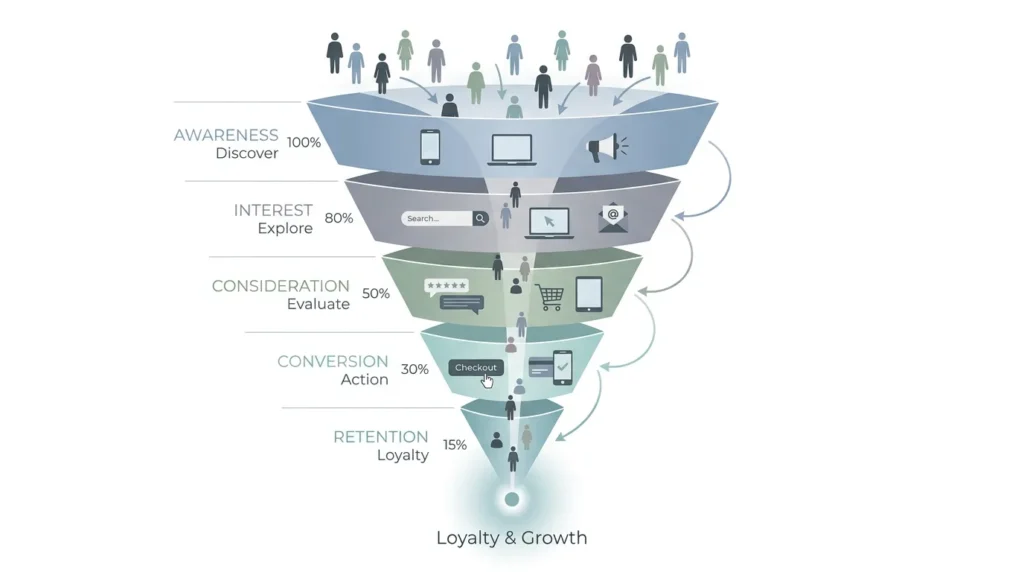
B2C has a shorter decision cycle than B2B. That sounds like an advantage, but it also means you have to prove faster that your offer is right. That is why we always design a route with three clear phases:
TOFU, Top of the Funnel: attention and problem recognition. Your goal is not an immediate purchase. Your goal is interest and a click to a landing page.
MOFU, Middle of the Funnel: trust and relevance. Your goal is that the visitor sees, “okay, this is for me.”
BOFU, Bottom of the Funnel: turn intent into contact or purchase. Your goal is a clear step, with minimal friction.
What usually works, and why
Based on what we often implement and optimize, three “win conditions” keep showing up in B2C:
Message match: the promise in your ad comes back on your landing page. If that does not match, your conversion drops. People immediately feel it is “a bait-and-switch.”
Fast proof: reviews, figures, clear terms, and an FAQ that actually answers questions. Not a list of claims.
Removing friction: short form, or smart pre-qualification. Sometimes an appointment is more valuable than “buy now.” Sometimes buying immediately is better. It depends on your product and price.
If you apply this, you often see that you improve not only conversion, but also the quality of your leads. And yes, that improves your measurability. A better-fitting lead makes your whole funnel more honest.
Next step
Make a simple route map for yourself. Set out per phase:
Which audience do you start with (based on intent or context)?
Which promise are we sending (1 sentence, maximum)?
Which action are we asking for (click, form, appointment, purchase)?
How do we qualify afterward (Marketing Qualified Lead and Sales Qualified Lead logic)?
If that route map is clear, you can align channels, budget and tracking much more easily.
Channels for B2C lead generation: choose smart, measure honestly
You do not need to do “everything at once.” You do need to make sure your channels tell one story together. This is how we approach it.
SEA (Search Engine Advertising) for fast inflow
SEA is often the fastest route to measurable leads, especially if you already know which questions customers ask in Google. That is why we do not aim SEA at “general” traffic, but at intent.
Practical approach:
Use campaigns per intent cluster (for example “price”, “compare”, “available”, “store near me”).
Make sure every ad group has a landing page that fits the topic.
Optimize on Cost Per Acquisition (CPA) or Cost Per Lead (CPL), depending on your goal. For B2C, we often use CPL in the testing phase, because purchase often takes too long for fast feedback.
SEO (Search Engine Optimization) for steady demand
SEO does not work like a tap you turn on today. It is more of a foundation. But that is exactly why SEO is valuable for B2C lead generation: once a page ranks, you get consistent inflow at lower cost per lead.
Our starting point:
Start with search intent that is already moving toward purchase or contact. Think “costs”, “review”, “pros and cons”, “compare”, “delivery”, “location”.
Write not only for rankings, but for conversion. The page must answer the question and make the next step logical.
Build internal links from blog to landing page, so your top-of-funnel pages can feed leads.
Social, display and remarketing, but with a clear role
Social and display can work well for repetition and brand trust. Only: if you use them without a landing page and without tracking discipline, you get lots of “engagement” and very few usable leads.
We usually give these channels one role:
TOFU: reach and first click to a relevant landing page.
Remarketing: bring back people who were almost ready, or who were already involved with the content.
The core point: your remarketing should offer a logical next step, not the same ad again.
Landing pages for B2C: design for conversion, not for opinions
Your landing page is your revenue machine in silent mode. And yes, you can absolutely work on it with a smile, but with measurable choices.
The checklist we almost always use
1 primary promise: one sentence above the fold, directly linked to the ad or search query.
Proof: reviews, testimonials, guarantees, figures, or clear terms. No loose marketing talk.
FAQ that addresses real objections: delivery time, costs, returns, privacy, what happens after filling in the form.
Lower form friction: ask only for what you need to move forward. In B2C, “fewer fields” is often not a slogan, but a conversion lever.
Order and microcopy: guide someone through the steps. If people doubt, text helps just as much as a good color palette.
What you especially need to avoid: pages that throw all the information from your whole website into one heap. Then it feels to the visitor like opening a phone book right when they want to call.
Forms and privacy: stay measurable, without unnecessary risk
For lead generation, correct privacy and consent are essential. For example, if you work with lead forms in SEA, there are policy requirements, including a link to your privacy policy. (support.google.com)
In addition, you need to organize email marketing and tracking with personal data in a legally appropriate way. In the EU context, “consent” or “legitimate interests” are often relevant grounds, and organizations must be transparent and offer the ability to withdraw. (ico.org.uk)
And pay attention to tracking pixels in emails. Different regulators describe that the rules primarily concern the email channel itself, and that tracking choices require extra attention. (ico.org.uk)
Practical advice: work with a privacy expert or legal advisor if you are unsure. We design the marketing part so that it connects neatly to your chosen legal approach.
Next step
Now define your “form type”:
Lead-form if you want direct contact and your product can benefit from a follow-up conversation.
Appointment if advice or choice is important, and you want to schedule a short consult.
Direct purchase if your offer is low-threshold and you can provide proof quickly.
After that: write your headline, subheadline, 3 proof blocks and your form fields. Then let data judge it, not your gut feeling.
Tracking and CRM: turn leads into a predictable process
You can have the best campaign, but without tracking and CRM flow it stays random. In B2C, speed matters even more. If you wait three days before following up, you are often too late.
Measure what you want to improve
We measure in layers:
Top layer: traffic to the landing page (without mislabeling it as a lead).
Middle layer: lead events (form submitted, appointment scheduled, purchase completed).
Bottom layer: qualification, sales result and lead time.
For campaigns, CPA or CPL is useful, but choose one primary KPI per campaign in the test phase. CPA can point to purchase, for example. CPL to lead event. Choose consciously, otherwise you optimize on noise.
GA4 and event setup, simple and consistent
In Google Analytics 4 (GA4), you can set up events and use enhanced measurement events for extra insight into user interactions. (support.google.com)
We recommend:
Define your conversion events tightly (which event is a real lead, which is assist behavior).
Do not use enhanced measurement as a replacement for your own conversion logic. It is an addition.
Treat consent and data quality as design variables, not as something to “fix later.”
That sounds dry, but it saves you weeks of discussion with yourself and your team.
CRM follow-up: speed plus quality
Lead generation does not end when the form is filled in. You win when your follow-up:
automatically registers the lead in your CRM (Customer Relationship Management),
qualifies the lead with simple rules (Marketing Qualified Lead and Sales Qualified Lead),
sets up or starts a suitable contact moment (phone, email, WhatsApp, or appointment flow).
We see that “sending to sales” too often means the same as “sending into a black hole.” That is why we always build pipeline logic. A lead that does not meet your minimum criteria gets a different route than a lead that does fit.
Next step
Make your CRM definitions concrete now:
Which fields are mandatory for lead qualification?
When does a Marketing Qualified Lead become a Sales Qualified Lead?
What is the SLA, Service Level Agreement, for follow-up (for example within 5 to 30 minutes for warm leads, depending on your capacity)?
If that is clear, you can also use automation intelligently, without it unintentionally harming commercial quality.
Automation in B2C lead generation: efficient, but never sloppy
Automation is not the goal, it is a tool to make your funnel faster, more consistent and more measurable. In practice, we use automation for:
Lead capture and data synchronization (form to CRM).
Lead enrichment (so your sales team has less to guess).
Email outreach and follow-ups with rules based on intent.
Reporting and campaign optimization on KPIs.
Appointment scheduling and reminder sequences.
Important: automation must remain under human control at points where things can go wrong. Especially with budget changes, contractual commitments and financial decisions, human-in-the-loop is wise.
What we recommend as an approach
Start small. For example:
Automate the registration and tagging of new leads in your CRM.
Automate assignment to a follow-up owner based on region, product choice or request type.
Automate one follow-up flow with clear exclusion rules (no spam, no duplicates).
Then expand. You first want your basics to be right, otherwise you are automating mistakes with a neat interface. That looks smart, but not in results.
From strategy to execution: a 30 day plan
Okay, enough theory. Here is a plan your team can actually run.
Days 1 to 7, foundation and tracking
Define lead, Marketing Qualified Lead and Sales Qualified Lead in your CRM.
Check your conversion events in GA4 and make sure lead events are unambiguous.
Set the privacy basics for your lead flows (at minimum a privacy policy link where required). (support.google.com)
Days 8 to 14, landing page and offer sharpened
Write or rebuild 1 landing page per main intent cluster.
Make proof and FAQ concrete for B2C objections.
Minimize form friction based on your information needs.
Days 15 to 21, SEA and test campaigns
Start SEA with campaigns based on intent, not general terms.
Choose one primary KPI per campaign, usually CPL or CPA (depending on your goal).
Only implement optimizations that actually improve your test (message match, landing page, targeting, budget shifts with reason).
Days 22 to 30, CRM follow-up and optimization
Automate lead routing and follow-up flow.
Monitor speed, qualification and drop-off reasons.
Improve 1 bottleneck per week, not everything at once.
Confusing leads with traffic: then you optimize clicks and not contact.
No message match: ad promises X, page says Y.
Unclear follow-up: leads are not approached within a logical time.
Too many fields: you can always collect more information, but first the lead has to come in.
No quality logic: Marketing Qualified Lead and Sales Qualified Lead remain implicit, so sales thinks it is “all priority.”
Conclusion: make B2C lead generation measurable and executable
Lead generation b2c only becomes fun (and profitable in a commercial sense) when you treat it as a system. You need:
a clear lead route (TOFU, MOFU, BOFU) with a concrete action per phase,
channels that target intent (SEA) and build trust (SEO and landing pages),
a landing page that combines message match and proof,
tracking and CRM follow-up that makes lead quality visible,
automation that speeds up repeatable steps without losing control.
If you take one step today, finish your route map and connect it to your landing page and conversion events. After that, optimization stops being a debate and becomes a series of small, measurable improvements.
Book your free strategy call — 30 min, no strings attached
Cookies on this site
We use analytics cookies to see how the site is used. They are only placed if you agree. Refusing costs you nothing — the site works exactly the same. Privacy statement