

📞 +31 85 060 9801 ✉️ hello@searchclicks.com
17.000+ leads gegenereerd

Online leads genereren: strategie en systeem dat werkt

Online leads genereren: strategie en systeem dat werkt

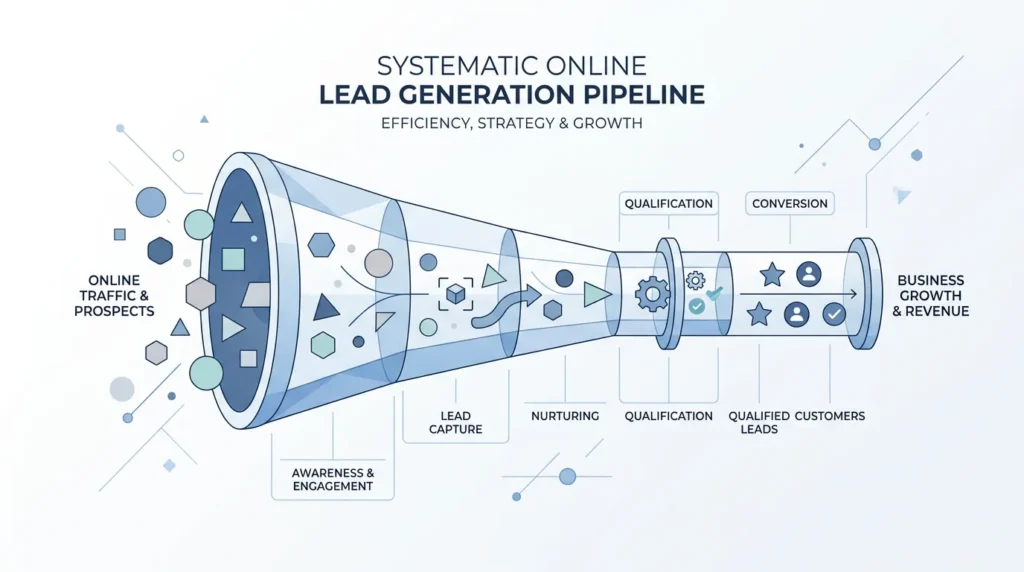
Kom even met me wandelen door de echte wereld van online leadgeneratie. Je ziet advertenties, je ziet formulieren, je ziet verkeer. En toch lijkt “meer leads” vaak op een loterij. Dat is niet omdat je team het niet probeert, maar omdat de stappen niet strak genoeg aan elkaar hangen: van boodschap naar klik, van klik naar aanvraag, van aanvraag naar Sales Qualified Lead (SQL), en van SQL naar klant.

In dit artikel geven we je een complete strategie om online leads genereren, zonder loze beloften. We maken het concreet, van meetplan tot uitvoering. Je krijgt ook een checklist voor je volgende sprint. Zodat je morgen al beter presteert, niet pas over “een paar maanden”. (Die paar maanden zijn meestal drukke maanden, geen winnende maanden.)

Wat is een “lead” en waarom dat alles verandert

Als we het over leadgeneratie hebben, bedoelen we het zakelijke resultaat: een persoon of bedrijf die mogelijk een echte commerciële interesse heeft in jouw producten of diensten, doordat er een herkenbare commerciële aanvraag of contactmoment ontstaat.

Belangrijk detail, want het bepaalt hoe je rapporteert en optimaliseert. Bezoek, vertoningen, klikken en volgers zijn geen leads. Het zijn signalen. Pas wanneer je contactgegevens of een echte commerciële intentie ziet (bijvoorbeeld een aanvraagformulier of een demo-aanvraag), kunnen we spreken van een lead.

Lead, MQL en SQL, in gewone mensentaal

  • Lead: mogelijk commercieel geïnteresseerde contactpersoon of organisatie, verkregen via online marketing of online sales activiteiten.
  • Marketing Qualified Lead (MQL): een lead die marketing als passend beoordeelt op basis van criteria zoals onderwerp, fit met je doel en intentiesignalen.
  • Sales Qualified Lead (SQL): een lead die sales voldoende passend en concreet vindt om serieus op te volgen (bijvoorbeeld vanwege budget, timing, proces of specifieke behoefte).

Waarom dit praktisch is: je kunt verkeer optimaliseren, maar je kunt alleen écht sturen op kwaliteit als je van lead naar MQL naar SQL meet.

De kernstrategie: één verhaal, meerdere kanalen, één conversiesysteem

Je kunt online leads genereren via Search Engine Optimization (SEO), Search Engine Advertising (SEA), content, social, e-mail en automatisering. Maar die kanalen moeten hetzelfde verhaal vertellen, met één doel per pagina en één meetpunt per stap.

Stap 1: definieer je ICP en maak het meetbaar

Je vraagt vaak: “Wie moeten we bereiken?” Antwoord: je Ideal Customer Profile (ICP). Niet als vage slogan, maar als criteria.

Voorbeelden van criteria die je wél kunt gebruiken in marketing en sales:

  • Branche of type bedrijf
  • Rol of functie van de contactpersoon
  • Regio of taal
  • Minimale behoefte, zoals “zoekt implementatie binnen 90 dagen”
  • Vrije velden in formulieren die intentie bevestigen

Pro-tip uit de dagelijkse praktijk: als je ICP niet leidt tot andere landingspagina’s, andere advertentieteksten of andere kwalificatievragen, dan is je ICP nog een poster, geen stuurmiddel.

Stap 2: kies je kanalen op basis van intentie, niet op basis van voorkeur

Zo pakken we het meestal aan:

  • SEO voor duurzame instroom op zoekintentie. Je bouwt aan vertrouwen en relevantie. Verwacht groei via weken en maanden, niet via uren.
  • SEA voor directe instroom. Je kunt snel testen welke boodschap en welke landingpagina werken.
  • Retentie en nurturing via e-mail en remarketing voor leads die net te vroeg waren.

Trade-off die je moet accepteren: SEO is vaak langzamer te “fixen”, SEA is sneller te sturen maar kan sneller duur worden als je conversie lekt.

Stap 3: maak van je landingspagina een sales gesprek

Je landingpagina is geen brochure. Het is een conversie-werkplek. Daar hoort minimaal dit in te staan:

  • Heldere belofte die aansluit op het advertentie- of zoekwoordverhaal
  • Proof, zoals cases, werkwijze, certificeringen, of concrete deliverables (geen alleen maar claims)
  • Vragenformulier dat intentie scheidt van “ik kijk even”
  • CTA (Call to Action) die logisch is bij de fase van de bezoeker
  • Een eenvoudige route naar afspraak of intake

Als je landingspagina’s generiek zijn, krijg je generieke leads. En generieke leads kosten tijd in sales. Dat is de droogste grap in marketing, maar wel waar.

Stap 4: conversie tracking die klopt met je doelen

Je kunt pas optimaliseren als je conversies betrouwbaar meet. In Google Analytics 4 kun je conversies koppelen aan events, en vervolgens gebruiken om campagnes beter te sturen. Het idee is: je markeert relevante acties als conversies, zodat je kunt meten welke kanalen daadwerkelijk leads opleveren. (support.google.com)

Daarnaast is Google Search Console je gezondheidsscan voor hoe Google jouw site ziet en hoe je presteert in Google Search. Gebruik het om zichtbaarheid en mogelijke issues te begrijpen. (support.google.com)

Van verkeer naar SQL met een lead-kwalificatie workflow

Veel teams stoppen bij “we krijgen leads binnen”. Dat is alsof je stopt bij “de auto start”. Je wilt rijden.

Daarom bouwen we een workflow die leads kwalificeert en sales duidelijkheid geeft. Niet alleen meer werk, maar slimmer werk.

Definieer je lead-kwalificatie criteria

Werk met 2 lagen:

  1. Marketing Qualified Lead (MQL) criteria: fit op basis van formulierdata, onderwerp, websitegedrag (alleen als je dit betrouwbaar meet) en regio
  2. Sales Qualified Lead (SQL) criteria: concreetheid zoals timing, besluitvormingsproces, budgetrange, of specificiteit van de aanvraag

Praktisch advies: zorg dat criteria direct in het CRM (Customer Relationship Management) kunnen worden vastgelegd. Anders wordt kwalificatie een spreadsheet-ritueel.

Volgorde van opvolging: snelheid wint, maar alleen met context

Als een lead binnenkomt, moet je team niet eerst nadenken over “wat moeten we zeggen?”. We sturen op drie dingen:

  • Timing: opvolgen met een korte responstijd
  • Relevantie: het antwoord matcht de reden van aanvraag
  • Route: de lead krijgt een duidelijke volgende stap, zoals intake, offerte-aanvraag of een korte vragenreeks

Je doel is niet “meer contactmomenten”. Je doel is minder misfit en meer gesprekken met juiste leads.

Automatisering mag, maar alleen als het meetbaar helpt

We noemen “automation” alleen wat het is in onze wereld: software, workflows en integraties die online marketing en online sales optimaliseren.

Voorbeeld van zinvolle automatisering:

  • Formulier invullen, daarna automatische bevestiging per e-mail
  • Automatisch taggen in CRM op basis van ingevulde velden
  • Sales notificatie wanneer een lead aan SQL-criteria voldoet
  • Nurturing e-mailserie voor leads die nog geen SQL zijn

Beperking om eerlijk te zijn: automatisering verhoogt snelheid, maar kan ook misfit verhogen als je criteria te ruim zijn. Dus begin klein, meet, en schaal alleen wat werkt.

Als je dit als systeem wilt opzetten, is dit een nuttige verdieping: Online leadgeneratie: van verkeer naar SQL met systeem.

SEO en SEA tactieken die je conversie verbeteren, niet alleen zichtbaarheid

SEO en SEA zijn geen doel op zich. Ze zijn brandstof. Het rendement komt uit conversie en kwalificatie.

SEO: maak je content “aanvraag-gedreven”

We zien vaak twee fouten:

  • Content is informatief, maar leidt niet naar een logische volgende stap
  • Content antwoordt wel op vragen, maar niet op de commerciële drempels (tijd, kosten, aanpak, risico)

Wat wél werkt:

  • Werk met pagina’s per intentie, bijvoorbeeld “prijs en aanpak”, “implementatie”, “vergelijkbare cases”
  • Voeg matchende CTA’s toe, bijvoorbeeld een intake of een berekening
  • Gebruik feedback uit Search Console om content te verbeteren op basis van echte zoekqueries (support.google.com)

SEA: test met focus op de landingspagina en het formulier

Met Search Engine Advertising (SEA) kun je snel testen welke vraag je doelgroep echt heeft. Maar let op waar je het testbudget aan uitgeeft:

  • Test advertentieteksten, maar ook de boodschap op de landingpagina
  • Test formulierlengte en velden op intentie
  • Stuur niet alleen op CTR (Click-Through Rate), stuur op leadkwaliteit

Als je inzicht wilt in kosten en waar je werkelijke uitgaven vaak weglekken, lees dan: Google Advertentie Kosten: Wat Betaal Je Werkelijk?.

Conversie meten met events in Google Analytics 4

In Google Analytics 4 draait het om events en conversies. Je kunt belangrijke acties markeren als conversies, zodat je meet wat leidt tot leads en je marketing daarop kunt optimaliseren. (support.google.com)

Belangrijke nuance: niet elke actie is een goede conversie. Als je “bijna lead” te vaak als conversie markeert, optimaliseer je op de verkeerde KPI. Daarom zijn heldere conversiedefinities essentieel.

Kleine maar slimme privacy en tracking realiteit

Tracking en consent kunnen invloed hebben op meetnauwkeurigheid. Voor Europese consent mechanieken verwijst de industrie naar Transparency and Consent Framework (TCF) documentatie en updates. (iabtechlab.com)

Geen paniek: het betekent vooral dat je meetplan realistisch moet zijn. Verwacht minder precisie in sommige situaties en gebruik daarom ook CRM data als bron van waarheid voor SQL.

E-mail, nurturing en planning die leiden tot afspraken

Als je online leads genereert, krijgt sales vaak dezelfde vraag: “Wat moeten we doen met leads die nog niet klaar zijn?” Daar komt e-mail nurturing om de hoek.

Wanneer e-mail het verschil maakt

E-mail werkt vooral wanneer:

  • De lead wel intentie heeft, maar timing ontbreekt
  • Je product of dienst uitleg nodig heeft
  • Je wil differentiëren met aanpak en bewijs

Het misgaat wanneer e-mail puur promotioneel is. Dan krijgen leads “veel tekst, weinig richting”. En richting is precies wat we willen.

Maak een mailcampagneplan dat je kunt uitvoeren

Een goede e-mailcampagne heeft:

  • Een duidelijke volgorde, bijvoorbeeld intake, case, aanpak, FAQ, afsluiting
  • Segmentatie op basis van MQL of onderwerp
  • Meetbare doelen per mail, bijvoorbeeld reply rate of afspraakklik
  • Een moment waarop sales overneemt

Als je een werkbare aanpak zoekt, dit is een relevante leidraad: Mailing Campagne: planning en uitvoering voor resultaat.

Cold e-mail kan werken, maar alleen met kwalificatie en follow-up

Cold Mailing (koude e-mail) is geen spam als je het goed doet. Het is een gecontroleerde benadering, met een duidelijke propositie en een opvolgingsplan.

Onze voorkeur: laat koude e-mail direct helpen aan kwalificatie. Bijvoorbeeld door een korte vragenreeks of een voorstel voor een intake die echt aansluit op hun situatie.

Voor praktische tactiek en uitvoering, zie: Cold Mailing: Effectieve Email Acquisitie (2026).

Speciale aandacht voor B2B versus B2C

B2B vraagt vaak meer overtuiging, meer bewijs, en meerdere signalen richting Sales Qualified Lead. B2C is vaker kort-cyclisch en draait sneller op relevantie en frictie minder maken.

Als je B2C doet, is dit een handige start: Leads genereren B2C: bewezen online strategieën.

Als je B2B doet, lees vooral ook: Leadgeneratie B2B: plan, kanalen en conversie tot SQL.

Een praktische 14-dagen aanpak om te verbeteren

Oké, geen theorie alleen. Hier is een plan dat je team echt kan uitvoeren. We gaan uit van online marketing en online sales optimalisatie, met een focus op meetbaarheid.

Dagen 1 tot 3: meetplan en definities

  • Definieer lead, MQL en SQL criteria (schriftelijk, kort en toetsbaar)
  • Controleer conversies en events in Google Analytics 4, en markeer wat echt relevant is (support.google.com)
  • Check Search Console voor zichtbaarheid en technische aandachtspunten (support.google.com)

Dagen 4 tot 7: landingspagina en formulier aanscherpen

  • Maak één landingpagina per belangrijkste intentie
  • Verwijder ruis: minder afleiding, meer duidelijke uitleg
  • Pas formulier aan op intentie, niet op gemak voor de bezoeker
  • Zorg dat CTA logisch is voor de fase

Dagen 8 tot 10: campagne- en kanaaltests

  • Start met beperkte tests, maar meet leadkwaliteit
  • Optimaliseer op SQL, niet alleen op klikken
  • Maak een lijst met hypotheses, bijvoorbeeld “meer specifieke velden verhogen SQL aandeel”

Dagen 11 tot 14: nurture en sales opvolging

  • Bouw of herschrijf de e-mailflow voor niet-SQL leads
  • Stel sales opvolgscript en intakevragen vast op basis van je kwalificatiecriteria
  • Maak feedbackloop: welke MQL’s worden vaak geen SQL, en waarom?

Als je ook outbound telefoontjes of scripts inzet als aanvullend kanaal, kan dit nuttig zijn: Koude Telefonische Acquisitie: Scripts en Technieken.

En als je e-commerce hebt, dan kan kanaaloptimalisatie via Shopping campagnes waardevol zijn. Zie: Google Ads Shopping: zo maak je Shopping winstgevend.

Wat als je nu nog weinig meet of veel “ruis” ziet?

Dan is je volgende stap niet meteen meer budget. Je volgende stap is dat je lead definitie en opvolging kloppen. Zonder dat worden rapportages een soort sportkommentaar zonder scorebord.

Conclusie: online leads genereren is een systeem, geen stunt

Je kunt online leads genereren met elk kanaal, zolang het systeem klopt:

  • Je ICP is meetbaar en vertaalt zich naar pagina’s en kwalificatievragen
  • Je landingspagina’s koppelen intentie aan een duidelijke volgende stap
  • Je tracking in Google Analytics 4 en Search Console is consistent met je doelen (support.google.com)
  • Je leadkwalificatie maakt MQL en SQL zichtbaar in je CRM
  • Je e-mailflow en opvolging reduceren misfit en verhogen gesprekken

Als je dit vandaag nog niet compleet hebt, is dat geen reden om te wachten. Pak de eerste 3 stappen uit je 14-dagen plan. Dan wordt “leads” ineens een proces dat je kunt sturen, in plaats van een onderwerp waar je team naar kijkt terwijl het budget verdampt.

Klaar voor een volle agenda?

Plan een gratis strategiegesprek en ontdek hoeveel leads we voor jouw bedrijf kunnen genereren. Geen verplichtingen — wel een concreet groeiplan.

Plan je gratis strategiegesprek →

Online leads genereren: strategie en systeem dat werkt

Online leads genereren: strategie en systeem dat werkt

Take a walk with me through the real world of online lead generation. You see ads, you see forms, you see traffic. And yet “more leads” often feels like a lottery. That is not because your team is not trying, but because the steps are not tightly connected enough: from message to click, from click to request, from request to Sales Qualified Lead (SQL), and from SQL to customer.

In this article, we give you a complete strategy to generate online leads, without empty promises. We make it concrete, from measurement plan to execution. You also get a checklist for your next sprint. So you can perform better tomorrow already, not only in “a few months”. (Those few months are usually busy months, not winning months.)

What is a “lead” and why it changes everything

When we talk about lead generation, we mean the business outcome: a person or company that may have real commercial interest in your products or services because a recognizable commercial request or contact moment appears.

Important detail, because it determines how you report and optimize. Visits, impressions, clicks and followers are not leads. They are signals. Only when you see contact details or real commercial intent (for example, a request form or a demo request), can we speak of a lead.

Lead, MQL and SQL, in plain language

  • Lead: a potential commercially interested contact or organization, acquired through online marketing or online sales activities.
  • Marketing Qualified Lead (MQL): a lead that marketing judges to be a fit based on criteria such as topic, fit with your target audience and intent signals.
  • Sales Qualified Lead (SQL): a lead that sales finds sufficiently relevant and concrete to follow up seriously (for example because of budget, timing, process or specific need).

Why this is practical: you can optimize traffic, but you can only truly steer on quality if you measure from lead to MQL to SQL.

The core strategy: one story, multiple channels, one conversion system

You can generate online leads through Search Engine Optimization (SEO), Search Engine Advertising (SEA), content, social, e-mail and automation. But those channels have to tell the same story, with one goal per page and one measurement point per step.

Step 1: define your ICP and make it measurable

You often ask: “Who do we need to reach?” Answer: your Ideal Customer Profile (ICP). Not as a vague slogan, but as criteria.

Examples of criteria you can actually use in marketing and sales:

  • Industry or type of company
  • Role or job function of the contact
  • Region or language
  • Minimum need, such as “looking for implementation within 90 days”
  • Free fields in forms that confirm intent

Pro tip from day-to-day practice: if your ICP does not lead to different landing pages, different ad texts or different qualification questions, then your ICP is still a poster, not a steering tool.

Step 2: choose your channels based on intent, not preference

This is usually how we approach it:

  • SEO for sustainable inbound based on search intent. You build trust and relevance. Expect growth over weeks and months, not hours.
  • SEA for immediate inbound. You can quickly test which message and which landing page work.
  • Retention and nurturing through e-mail and remarketing for leads that were a bit too early.

Trade-off you have to accept: SEO is often slower to “fix”, SEA is faster to control but can become expensive faster if your conversion leaks.

Step 3: turn your landing page into a sales conversation

Your landing page is not a brochure. It is a conversion workspace. It should include at least this:

  • A clear promise that matches the ad or search term story
  • Proof, such as cases, methodology, certifications, or concrete deliverables (not just claims)
  • A form that separates intent from “I’m just browsing”
  • A CTA (Call to Action) that fits the visitor’s stage
  • A simple route to an appointment or intake

If your landing pages are generic, you get generic leads. And generic leads cost time in sales. That is the driest joke in marketing, but it is true.

Step 4: conversion tracking that matches your goals

You can only optimize once you measure conversions reliably. In Google Analytics 4, you can link conversions to events and then use them to steer campaigns better. The idea is: you mark relevant actions as conversions, so you can measure which channels actually deliver leads. (support.google.com)

In addition, Google Search Console is your health check for how Google sees your site and how you perform in Google Search. Use it to understand visibility and possible issues. (support.google.com)

From traffic to SQL with a lead qualification workflow

Many teams stop at “we are getting leads in”. That is like stopping at “the car starts”. You want to drive.

That is why we build a workflow that qualifies leads and gives sales clarity. Not just more work, but smarter work.

Define your lead qualification criteria

Work with 2 layers:

  1. Marketing Qualified Lead (MQL) criteria: fit based on form data, topic, website behavior (only if you measure it reliably) and region
  2. Sales Qualified Lead (SQL) criteria: concreteness such as timing, decision-making process, budget range, or specificity of the request

Practical advice: make sure criteria can be recorded directly in the CRM (Customer Relationship Management). Otherwise, qualification becomes a spreadsheet ritual.

Follow-up order: speed wins, but only with context

When a lead comes in, your team should not first wonder “what should we say?”. We steer on three things:

  • Timing: follow up with a short response time
  • Relevance: the answer matches the reason for the request
  • Route: the lead gets a clear next step, such as intake, quote request or a short question flow

Your goal is not “more touchpoints”. Your goal is less mismatch and more conversations with the right leads.

Automation is fine, but only if it helps measurably

We only call “automation” what it is in our world: software, workflows and integrations that optimize online marketing and online sales.

Example of useful automation:

  • Form submission, then automatic confirmation by e-mail
  • Automatic tagging in CRM based on completed fields
  • Sales notification when a lead meets SQL criteria
  • Nurturing e-mail sequence for leads that are not SQL yet

Limitation to be honest about: automation increases speed, but it can also increase mismatch if your criteria are too broad. So start small, measure, and only scale what works.

If you want to set this up as a system, this is a useful deep dive: Online lead generation: from traffic to SQL with a system.

SEO and SEA tactics that improve conversion, not just visibility

SEO and SEA are not goals in themselves. They are fuel. The return comes from conversion and qualification.

SEO: make your content request-driven

We often see two mistakes:

  • Content is informative, but does not lead to a logical next step
  • Content answers questions, but not the commercial barriers (time, costs, approach, risk)

What does work:

  • Work with pages per intent, for example “pricing and approach”, “implementation”, “similar cases”
  • Add matching CTAs, for example an intake or a calculation
  • Use feedback from Search Console to improve content based on real search queries (support.google.com)

SEA: test with a focus on the landing page and form

With Search Engine Advertising (SEA), you can quickly test which question your target audience really has. But pay attention to what you spend test budget on:

  • Test ad texts, but also the message on the landing page
  • Test form length and fields for intent
  • Do not steer only on CTR (Click-Through Rate); steer on lead quality

If you want insight into costs and where your actual spend often leaks away, read: Google Ad Costs: What Do You Really Pay?.

Measure conversion with events in Google Analytics 4

In Google Analytics 4, everything revolves around events and conversions. You can mark important actions as conversions, so you measure what leads to leads and can optimize your marketing accordingly. (support.google.com)

Important nuance: not every action is a good conversion. If you mark “almost lead” too often as a conversion, you optimize for the wrong KPI. That is why clear conversion definitions are essential.

A small but smart privacy and tracking reality

Tracking and consent can affect measurement accuracy. For European consent mechanisms, the industry refers to Transparency and Consent Framework (TCF) documentation and updates. (iabtechlab.com)

No panic: it mainly means your measurement plan has to be realistic. Expect less precision in some situations and therefore use CRM data as the source of truth for SQL as well.

E-mail, nurturing and planning that lead to appointments

When you generate online leads, sales often gets the same question: “What should we do with leads that are not ready yet?” That is where e-mail nurturing comes in.

When e-mail makes the difference

E-mail works especially when:

  • The lead has intent, but timing is missing
  • Your product or service needs explanation
  • You want to differentiate with approach and proof

It goes wrong when e-mail is purely promotional. Then leads get “a lot of text, very little direction”. And direction is exactly what we want.

Build an e-mail campaign plan you can actually execute

A good e-mail campaign has:

  • A clear sequence, for example intake, case, approach, FAQ, close
  • Segmentation based on MQL or topic
  • Measurable goals per e-mail, for example reply rate or appointment click
  • A point where sales takes over

If you are looking for a workable approach, this is a relevant guide: E-mail Campaign: planning and execution for results.

Cold e-mail can work, but only with qualification and follow-up

Cold Mailing (cold e-mail) is not spam when you do it well. It is a controlled approach, with a clear proposition and a follow-up plan.

Our preference: let cold e-mail help with qualification right away. For example, by using a short question flow or a proposal for an intake that really fits their situation.

For practical tactics and execution, see: Cold Mailing: Effective Email Acquisition (2026).

Special attention for B2B versus B2C

B2B often requires more persuasion, more proof, and multiple signals toward Sales Qualified Lead. B2C is often shorter-cycle and runs faster on relevance and less friction.

If you do B2C, this is a useful starting point: Generating Leads in B2C: proven online strategies.

If you do B2B, also read: B2B lead generation: plan, channels and conversion to SQL.

A practical 14-day plan to improve

Okay, no theory only. Here is a plan your team can really execute. We assume online marketing and online sales optimization, with a focus on measurability.

Days 1 to 3: measurement plan and definitions

  • Define lead, MQL and SQL criteria (written down, short and testable)
  • Check conversions and events in Google Analytics 4, and mark what is truly relevant (support.google.com)
  • Check Search Console for visibility and technical issues (support.google.com)

Days 4 to 7: tighten landing page and form

  • Create one landing page per main intent
  • Remove noise: less distraction, more clear explanation
  • Adjust the form to intent, not to visitor convenience
  • Make sure the CTA fits the stage

Days 8 to 10: campaign and channel tests

  • Start with limited tests, but measure lead quality
  • Optimize for SQL, not just clicks
  • Create a list of hypotheses, for example “more specific fields increase the SQL share”

Days 11 to 14: nurture and sales follow-up

  • Build or rewrite the e-mail flow for non-SQL leads
  • Set the sales follow-up script and intake questions based on your qualification criteria
  • Create a feedback loop: which MQLs often do not become SQL, and why?

If you also use outbound calls or scripts as an additional channel, this can be useful: Cold Calling Acquisition: Scripts and Techniques.

And if you have e-commerce, channel optimization via Shopping campaigns can be valuable. See: Google Ads Shopping: how to make Shopping profitable.

What if you still measure little or see a lot of “noise”?

Then your next step is not more budget right away. Your next step is making sure your lead definition and follow-up are right. Without that, reports become a kind of sports commentary without a scoreboard.

Conclusion: generating online leads is a system, not a stunt

You can generate online leads with any channel, as long as the system is right:

  • Your ICP is measurable and translates into pages and qualification questions
  • Your landing pages connect intent to a clear next step
  • Your tracking in Google Analytics 4 and Search Console is consistent with your goals (support.google.com)
  • Your lead qualification makes MQL and SQL visible in your CRM
  • Your e-mail flow and follow-up reduce mismatch and increase conversations

If you do not have all of this in place today, that is no reason to wait. Start with the first 3 steps from your 14-day plan. Then “leads” suddenly becomes a process you can steer, instead of a topic your team looks at while the budget evaporates.

Klaar voor een volle agenda?

Plan een gratis strategiegesprek en ontdek hoeveel leads we voor jouw bedrijf kunnen genereren. Geen verplichtingen — wel een concreet groeiplan.

Plan je gratis strategiegesprek →
Search Clicks Plan je gratis strategiegesprek — 30 min, geheel vrijblijvend