
 Written by
Daniel van Hek
Search Clicks·September 23, 2026
13 min read
Written by
Daniel van Hek
Search Clicks·September 23, 2026
13 min read
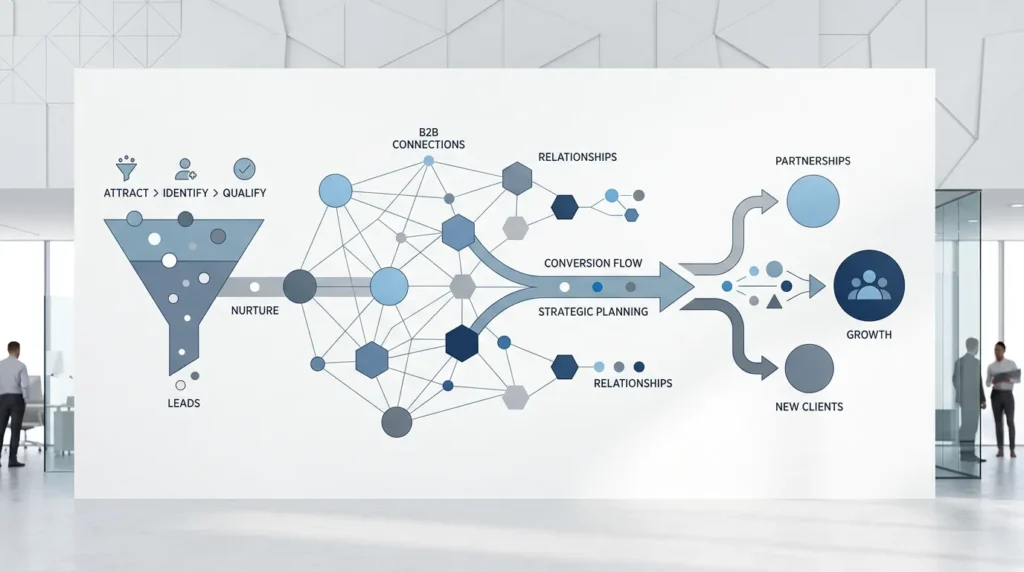
Imagine for a moment that you see B2B lead generation as a workshop. You can buy parts, but without a process and quality control, you end up with junk in your pipeline. And that is exactly where things often go wrong: traffic is bought or content is published, but we do not measure whether it actually creates real interest, and we do not give sales the right materials to work with.
In this article, we take you through it step by step. You get a practical approach you can use tomorrow. Including what works, why it works, and what your next step should be. We keep it concrete, without promises of magical results. That is not how serious online sales works.
B2B lead generation is not about “visibility”, but about collecting potential customers who may have a commercial interest. In an online context, that usually means: a contact detail and a signal of intent. Think of a request, a demo request, or a content-related enquiry that fits your offer.
To manage this properly, you need to keep three things separate:
Why is this so important? Because otherwise you optimise for activity. You end up with more form submissions, but not necessarily more SQLs. That feels good in a dashboard, but it does not pay the bills. In many B2B organisations, the biggest conversion leak is not the ad or the landing page, but the handoff and the definition of “qualified”.
Practical advice: make one short agreement between marketing and sales. What is MQL? What is SQL? And what happens in between? If you record that in writing and calibrate it regularly, optimisation suddenly becomes very honest and very measurable.
For the thinking behind MQL and SQL and the need for alignment between teams, you can use this as context. You choose the exact format yourself, but the principle of shared definitions is visible everywhere. (f.hubspotusercontent20.net)
If you build B2B lead generation by intuition, you get randomness. We want predictability. You get that by connecting your target audience and your message to the type of intent you see in each channel.
Your ICP is not a slogan. It is a list of characteristics you actually need to close deals profitably. Tip: split it into two layers.
Be strict on fit. You can always scale later. If you start with broad fit, you will get “leads” that never become SQL. And then you will burn your budget on follow-up that nobody wants.
Your funnel does not need to be complicated, but you should not contaminate it.
Why this works: B2B buyers often are not in a hurry. They want proof and direction. If you offer only demos from day one to TOFU visitors, your conversion becomes a lottery.
A “free consultation” sounds friendly, but it is often too broad. Choose a lead offer that matches your sales process.
The next step should be simple, but not vague. And your landing page should explain exactly what someone gets, how much time it takes, and what happens next.
There is no single channel that always wins. We like to combine, but with discipline. Below are the channels that often deliver the best mix in practice, with the key metrics.
Search Engine Optimization (SEO) is strong when you find topics your ICP is actively searching for. The advantage is that you invest in existing demand. The downside: growth takes time, and your pages must truly match intent.
Search Engine Advertising (SEA) works faster, especially for BOFU keywords. But the risk is also greater: if your landing page is not right or your targeting is too broad, your Cost Per Lead (CPL) becomes a cost item instead of an investment.
If you take this route, it helps enormously to connect your landing pages to conversion goals. In our experience, “lead generation website optimisation” is often faster to improve than people think. For example, take this focused approach: Lead Generation Website: Conversion Optimisation (Brief).
Paid Social can generate leads, but you need to avoid filling marketing with “interest” while sales needs real work. That is why we usually steer on:
Yes, friction can help. But too much friction kills conversion. Choose a balance that fits your deal size and sales process.
Outreach is often underestimated, and sometimes overrated too. It works when your segmentation and follow-up are in order, and when your message is tailored to a concrete problem.
For cold mailing, the key is relevance plus speed. If you respond too late, “reach” no longer beats “timing”. Read this as a starting point: Cold Mailing: Effective Email Acquisition (2026).
And for telephone acquisition: Cold Calling Acquisition: Scripts and Techniques.
Many teams launch ads and let the landing page “do the rest”. That rarely works. An ad claims intent; your landing page must fulfil that intent immediately.
If you work with Google Ads, we want your campaigns and pages to speak the same language. For example, with strategy, structure and execution: Google Ads Campaign: From Strategy to Execution (2026).
And if you want to avoid error messages or configuration issues that cost money, then you want this checklist-style knowledge alongside it: Google Ads 400: how to prevent error messages and profit loss.
For those specifically focused on product-led discoverability, Shopping is a different game. In that situation, this may be relevant: Google Adwords Specialist: tasks, approach and checklist and also Google Ads Shopping: how to make Shopping profitable.
Your KPI set should be simple. We recommend measuring the same core metrics for each channel:
Why this works: you can see immediately where it is leaking. Many leads but a low SQL rate usually means a fit or qualification problem. A high MQL rate but low SQL rate more often points to handoff, message or follow-up process.
A landing page for B2B lead generation is not a brochure. It is a decision page. Your goal is not “explanation”, your goal is “action in a clear way”.
A form of structured data can help if your pages are also meant for rich results in Search, but treat this as supportive. First make sure your page is clear, and that the content matches the purpose of the page. Google Search Central emphasises the importance of making the primary purpose of a page clear. (developers.google.com)
In B2B, a short form sometimes works well. But if you collect too little qualification, you get lots of low quality. Then sales still has to ask questions. That takes time, and time is usually the scarcest ingredient in B2B.
A practical method:
You can start with a short contact question, and then set a follow-up question based on the topic. Instead of putting everything into one form, you create a simple next step that does not feel like bureaucracy.
That requires good tracking and CRM integration, otherwise you do not know why someone did or did not move forward.
This is where many teams stop thinking. They have leads. “Great,” everyone says. But B2B lead generation only really exists when those leads are turned into SQLs through follow-up.
Work with a clear route:
The most important thing is that marketing and sales use the same words, and have the same expectations. This is exactly why many teams explicitly agree on MQL and SQL definitions. (f.hubspotusercontent20.net)
In B2B, “responding too late” is often fatal. You do not need to bombard every lead with emails. But you do need to be consistent.
A healthy follow-up strategy:
Be honest: if your sales team is only available two days a week, your follow-up has to match that. Otherwise you create unnecessary friction and intent disappears.
Automation is useful when it:
But automation should not decide on budget changes or contractual obligations. For high-impact choices, human approval remains decisive.
You want to measure and optimise B2B lead generation. At the same time, you need to handle personal data carefully. For email and online tracking, GDPR applies. Exactly how you apply it depends on the context, and we always recommend having your legal side review it. What we can provide is a reliable framework.
GDPR names several legal bases. One of them is legitimate interest. The European Data Protection Board (EDPB) explains when legitimate interest is and is not appropriate. (edpb.europa.eu)
In the same line, direct marketing follows rules, and consent in certain situations may be preferred or required. The EDPB also refers to the idea that processing for direct marketing can under circumstances be seen as legitimate interest, but that you must carry out the balancing test and that legal and ePrivacy rules may also apply. (edpb.europa.eu)
Practical for you as a marketer: make sure you:
If you work with email marketing, guidance from national regulators can also help you with practical application. For example, guidance from the UK Information Commissioner’s Office on direct marketing by electronic mail. (ico.org.uk)
For measurability, you want consistent recording of:
That prevents you from optimising for clicks instead of qualitative sales output.
Okay, enough theory. Let’s turn it into work. This is a realistic plan for teams that want to improve B2B lead generation without drowning in busyness.
No. Traffic and sign-ups are not leads in themselves. A lead only really exists when there is a commercially relevant contact or request that you can follow up. So track MQL and SQL as quality indicators, not just clicks.
Then it is almost always an alignment issue. Check MQL/SQL definitions, form information and speed to lead. Often it turns out that your “quality criteria” are interpreted differently. The solution is usually not more traffic, but a better handoff.
If you take one thing away, let it be this: B2B lead generation is only valuable when it ends with Sales Qualified Leads (SQL). To get there, you can use a mix of SEO, Search Engine Advertising, outreach and landing page conversion, but your success depends on definitions, follow-up and measurability.
First make your MQL and SQL agreements. Then make your landing pages and forms lead-focused. Automate what is repetitive. And optimise for quality, not volume. Then your campaigns become less “hopefully” and more “manageable”. And honestly, that is what we all hope for at the coffee machine.
Small extra tip for your content strategy: If you want to deepen your funnel and channel choices, this practical angle often fits teams that want more than just ads: SEA SEM: from search intent to measurable leads with SEM. For outreach to business prospects, this route is also useful: Cold B2B acquisition: approaching business prospects. And if you work in a sector where booking flow matters, this angle can be useful: Google hotel ads: how to get bookings via Google.
Book a free strategy call and discover how many leads we can generate for your business. No obligations — just a concrete growth plan.
Book your free strategy call → Book your free strategy call — 30 min, no strings attached