
 Written by
Daniel van Hek
Search Clicks·September 20, 2026
11 min read
Written by
Daniel van Hek
Search Clicks·September 20, 2026
11 min read
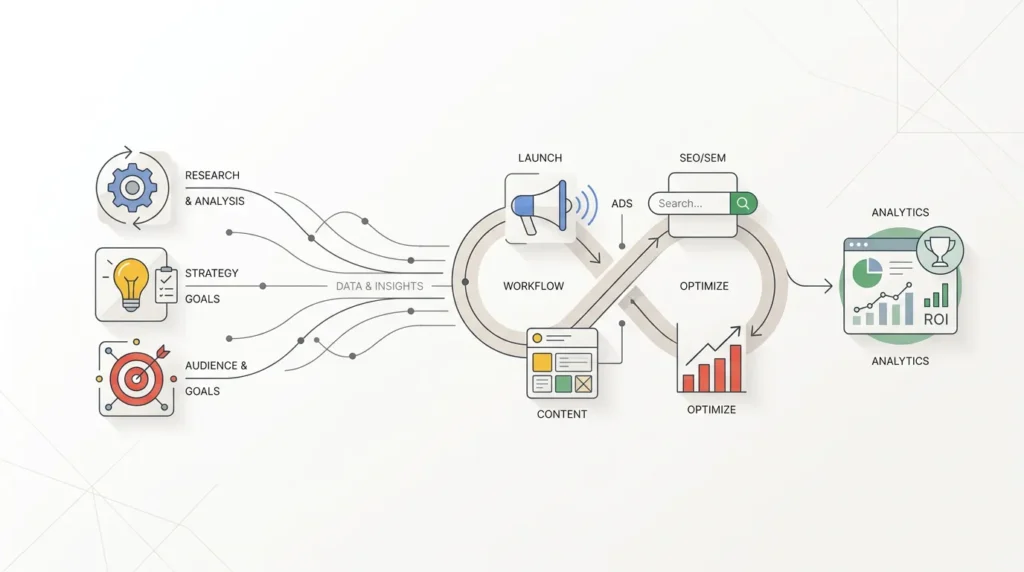
You probably know the feeling. You want to run a Google Ads campaign, you set something up, you see a few signals in the dashboards, and yet it still feels like you are optimising by guesswork. That is exactly what we are going to cover today. In this piece, we take you from strategy to execution, with a structure that makes sense for both your ad account and your measurement plan.
We are keeping it practical. No buzzwords. Just a clear line of thinking: what you want to achieve, how your budget and targeting support that, and how you measure conversions so you can improve without guessing. (And yes, sometimes the first “optimisation” is simply: measure what you really mean.)
Setting up a campaign does not start with ad copy. It starts with one simple question: what counts as success for us?
For online marketing and Lead Generation, that is usually one or more conversions, such as:
This is not a “nice-to-have”. Your bidding strategy in Search Engine Advertising (SEA) and your optimisation depend on conversion data. Google describes Performance Max as a goal-based campaign that optimises based on assets and bidding goals, so without consistent conversion measurement you are effectively steering on noise. (support.google.com)
We recommend making a distinction between:
Why? Because your system often first learns from signals with enough frequency. After that, you can steer on the primary conversion. Google also provides guidance on conversion measurement and the use of tags and offline conversions. (support.google.com)
Your measurement plan is more than Google Ads alone. You want insight into behaviour and quality. For example, Google recommends linking Search Console to Google Analytics 4 for data comparison and monitoring. (support.google.com)
And if you make that connection, make sure both properties collect the same set of pages. That sounds logical, but in practice it often goes wrong. (support.google.com)
Structure is not an administrative hobby. It determines how quickly you learn and how clearly you can intervene. Especially when you combine multiple campaign types, such as Search and cross-channel variants.
A useful structure for many B2B and B2C accounts is:
Google confirms in its documentation that a Google Ads campaign is built with budget, bidding strategy and targeting criteria, and that campaigns are further divided into ad groups. (developers.google.com)
You do not need to do everything at once. But you do want to know what each campaign type is strongest at.
Search is often your best starting point for “we have interest now”. You can steer closely on keywords, match types and ad copy. This is especially helpful for building a base with clear intent quickly.
Display can be relevant for reaching an audience that is not searching directly yet. Google explains that Display campaigns can help you reach a relevant audience across websites, apps and Google properties. (support.google.com)
Be careful though: Display without clear segmentation can quickly become broad and expensive. So we use Display as a supplement, not as a “standard all-in-one”.
Performance Max (PMax) is a goal-based campaign that can access multiple Google Ads inventory sources from a single campaign. Google explains that your assets and settings are combined with Google AI to optimise based on your goals. (support.google.com)
In practical terms, this means:
And yes, the same rule applies here: if your input is messy, the optimisation will be messy too. Smart bidding cannot compensate for an unclear offer.
Now it gets interesting. Because in practice, “Google Ads campaign” mostly means: targeting, bidding strategy and conversion measurement plan. These are the levers that usually affect performance the most.
Our preferred approach is iterative. You want enough data to learn, but you also want to avoid ending up in the wrong intent from the start.
Specifically:
This is not one size fits all. In some markets, something broader works just fine. In other markets, “too broad” only pays off once you have more conversions. And by then, you have often already spent the money.
Google has different smart bidding approaches. In practice, bidding strategies work best when your goal is clear. In documentation about bidding strategy types, you can see that there are different strategies you link to campaign goals and inventory. (developers.google.com)
We turn that into a practical selection guide:
For many teams, the trap is setting bidding goals on conversions that are not “real”. For example: a micro-event that says very little about quality. Then the system optimises hard for something that is not your real result.
If you notice that conversions are not coming through as well as they should, look at Enhanced Conversions best practices. Google states that you use the Google tag to capture conversion data that is relevant to you, and that conversion sources can be combined from different systems. (support.google.com)
This is usually not a “quick fix”. But it can help make your bidding strategy more stable, because it learns from a more complete conversion signal.
You are not only asking: “how do I set up a Google Ads campaign”. You are also asking: “how do I combine them so we are not paying twice for the same effect”. That is where many accounts get stuck.
Use this logic and you will keep an overview:
Performance Max can build inventory across channels from a single campaign. Google explicitly describes this as access to multiple Google Ads inventory sources in one campaign. (support.google.com)
You can never separate the exact incrementality of each campaign type 100 percent perfectly in day-to-day practice. That would be marketing magic, and we do not have that (unfortunately).
But you can prevent decisions based on misleading metrics. That is why we always look at:
And if your data is inconsistent, we fix the measurement problem first. Only then do we optimise.
With campaign types like Performance Max, asset quality is extra important. Google explains that assets and settings are combined with Google AI and optimised based on your goals. (support.google.com)
So this is what we do:
It sounds basic. Yet I still often see people trying to save the ad while the landing page is the problem. That is like trying to fix a flat tyre by cycling harder.
Here is a step plan we often use in workshops. You can follow it almost one-to-one.
Google explains conversion measurement and how to set up conversions, including guidance for tracking and Google Tag Manager. (support.google.com)
Do not start with ten campaigns because you want to be “detailed”. Start with a set you can understand. Think of:
You do not only want more clicks. You want more relevant clicks. So:
Use KPIs to know what you are turning. Think of:
Note: KPIs without measurement quality are worthless. So if your conversion tracking is not reliable, stop the optimisation discussion and fix the measurement plan first.
We prefer reporting on trends and segments rather than one overall number. Especially with cross-channel campaigns, the system can use different channels. Google explains that Performance Max is designed to optimise across available inventory with automatic optimisation based on your goals. (support.google.com)
So: look at where conversions come from, which assets and landing pages perform, and where your funnel gets stuck.
If you want to take away one thing: most problems do not come from “the campaign is not smart enough”. The problems come from input and measurement discipline.
Solution: make conversions clear, test tracking, and only then adjust bidding strategies. Google explains how conversion measurement works and which tracking elements are involved. (support.google.com)
Solution: define intent layers per campaign. Use Search for capture, remarketing for repetition, and scale where it makes sense.
Solution: steer on CVR, CPA and possibly ROAS. And check whether your landing page delivers on the promise.
If you want to take action right now, I recommend this. Choose one conversion type that is genuinely commercial, and make that your primary focus.
If you specifically want to find out how to start conversion tracking inside Google Ads, you can also use this supporting page: Google Advertising: Getting started with Google Ads. Use it as a checklist, not as a replacement for your own measurement discipline.
A strong Google Ads campaign does not feel like guesswork. It feels like control. That only works when you get three things right at the same time:
Take it step by step. Test. Learn. Optimise. And if something does not work, first look at data and landing pages. Only then at “more budget”. (Budget is only a solution when you know where it is going.)
Book a free strategy call and discover how many leads we can generate for your business. No obligations — just a concrete growth plan.
Book your free strategy call → Book your free strategy call — 30 min, no strings attached