What Is SEA? Search Ads Explained and Used Smartly
Written byDaniel van HekSearch Clicks·September 27, 2026
11 min read
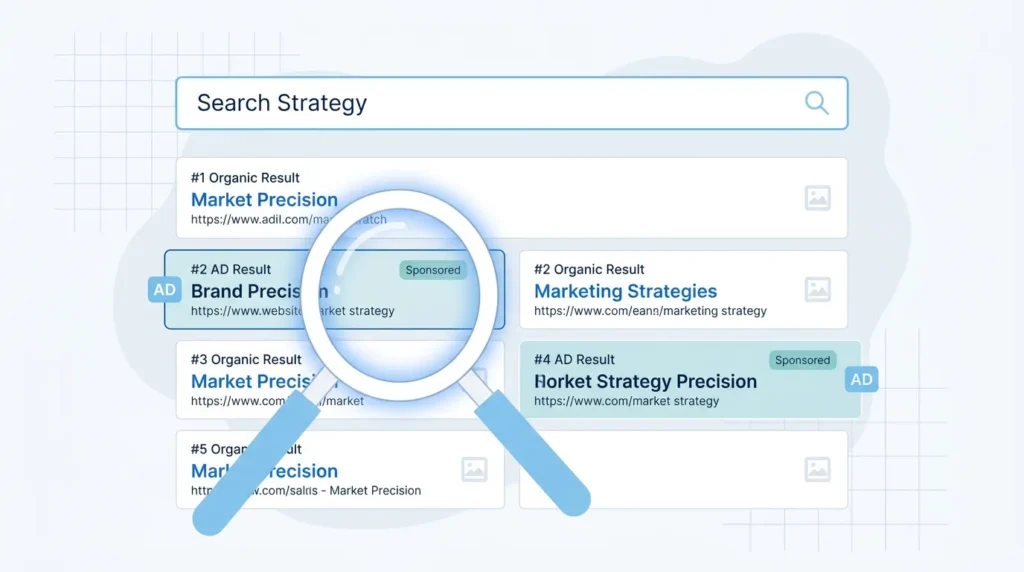
You search for a service or product. At that moment, you want your ad to be visible, exactly when intent is highest. That is what SEA is about: paid visibility in search results. Not “maybe someday,” but “now, the moment someone searches”.
In this hub page, we walk through the basics step by step, so you know what is happening technically and commercially. Then we translate that into practical choices for campaign structure, budget planning, and measurability. In short, we turn SEA into something you can steer, not something you “just leave running”.
What Is SEA and Why Do Companies Choose It?
SEA stands for Search Engine Advertising, in other words: paid ads that appear in response to searches. You usually pay per click (PPC), but the real steering wheel is not the click itself. The steering wheel is value, translated into conversions, appointments, sales, or another form of Cost Per Acquisition (CPA) or Cost Per Lead (CPL), depending on your goal.
Why do companies use SEA? Because it delivers speed. You can launch a campaign within days, while SEO usually takes months to gain traction. And because with keywords, you can capture intent that is already present in the user.
What You Often See in Practice (and What That Means)
You get data quickly: you know faster which search terms convert and which do not. That helps you distribute your budget more intelligently.
You steer on relevance: less “push” bidding, more making sure your ad and landing page match the searcher’s question.
You uncover gaps in your offer: if people click but do not convert, it is often not just an ad problem, but an offer, UX, or trust problem on the landing page.
How Does SEA Work Exactly? The Ad Auction in Plain English
Every time someone searches, an auction happens. Your ad only becomes eligible if your campaign and ad group are “eligible”. After that, the system decides which ad is shown and in what order.
Google explains that the auction looks at, among other things, matching (which ads fit the search query) and your position in the ad auction. Your quality matters, but so do factors at that exact moment. That matters, because it means you are not only looking at historical averages, but also at how well your ads match the specific search query. Google describes the auction process as a combination of ads that match and ranking based on quality and expected performance. (support.google.com)
Quality Score: Why “Good Enough Bidding” Is Often Not Enough
In Search campaigns, you often see “Quality Score” in the dashboard. The core of Quality Score is that your ads and landing page are more relevant and more useful for people searching for your keyword. Google says Quality Score is based on elements such as:
Ad relevance, how relevant your ad is to the search query
Expected CTR, the expected CTR based on past performance
Landing page experience, how relevant and useful your landing page is for visitors who click through
This can be found in the Google Ads help documentation. (support.google.com)
In practical terms: if you have a lot of budget but your landing page is “accidentally confusing”, you often still pay the price through lower efficiency. And yes, “a nice ad” usually does not make up for that. The searcher feels it, and so does the system.
Ad Rank and Auction-Time Factors
Besides quality, Ad Rank also plays a role. Google states that Ad Rank is calculated and that the system looks at context per auction, such as search terms, location, and which ad is shown. (support.google.com)
What does that mean for you? That optimization is not only about “higher bids” or “more budget”. It is about building a campaign that works per search intent, with a landing page that fits. Then your system will naturally auction more efficiently.
Which SEA Campaigns Usually Work Best, and for Which Use Cases?
You do not have to start with everything. You start with the question: which intent do you want to capture, and how fast do you want results?
When SEA Is Excellent for Direct Demand
You have a service with clear search intent (for example requesting a quote, price information, implementation, support). People often search with a purpose.
You can turn traffic into a measurable action (appointment, form, demo, purchase, call).
You can test quickly: ad copy and landing pages can be adjusted within days.
When You Need to Be Extra Critical
Your conversion path is complicated (many steps, long lead times, little trust at the start).
Your targeting is too broad. Then you attract searches that do not match your offer, and that hits your KPIs.
You do not measure properly. Without correct conversion tracking, you steer on signals that do not represent reality. That makes optimization much slower.
Campaign Structure You Can Actually Steer: Structure, Keywords, and Landing Page
Let’s make it practical. Below is a structure we use in many projects because it makes sense for both the ad platform and your own optimization work.
1) Start with Your Goals and Conversions
We always begin with measurement. Not because measurement is “nice to have”, but because otherwise you do not know which changes work.
Google describes conversion measurement and conversion tracking as measuring actions after interaction with your ads. (support.google.com)
So you need to decide in advance:
Which action counts as a conversion in your context?
Do you use CPA as Cost Per Acquisition or as Cost Per Action, and which meaning fits you?
Are you steering on CPL (Cost Per Lead) or on a real appointment or purchase?
2) Set Up Conversion Tracking Properly with Google Tag and Google Tag Manager
In practice, tracking and attribution are especially what make the difference between “we think it works” and “we know it works”. Google recommends using the right tags for conversion measurement. In Google Ads, conversion tracking is linked to web activity, where, for example, you can measure via Google Tag or through Google Tag Manager integrations. (business.google.com)
A tip we often give: make sure your conversions are consistent with your business process. So if a form only becomes a real Sales Qualified Lead (SQL) after qualification, then you should either:
work with a conversion that matches that qualification, or
at the very least do additional reporting on lead quality through your CRM.
3) Build Ad Groups Around Intent, Not Around Isolated Keywords
This is where SEA often wins or loses. If you have one ad group with very different search intents, your ad becomes less relevant and your landing page has to explain “everything at once”. That not only feels less convincing, it also leads to weaker quality signals.
So you structure ad groups by intent clusters. Think of:
“request pricing” intent
“comparison and choice” intent
“implementation and specifications” intent
Each cluster gets an ad message and a landing page that matches that intent.
4) Make Your Landing Page Measurably Better for the SEA Click
Quality Score explicitly mentions “landing page experience” as a component. (support.google.com)
Concretely, that means:
Make it clear within seconds what the visitor gets.
Make the CTA clear, without mystique (“request a quote” works better than a vague “more information”).
Avoid making the landing page a detour, such as “we send you to three other pages”.
Budget Planning and Optimization: How to Steer SEA Profitably Without Guesswork
Budget sounds simple, but in SEA, budget planning is really risk management. You distribute budget across campaigns that you can assess on KPIs.
Which KPIs You Really Need to Track
You do not need ten dashboards. We usually work with a small set of KPIs:
CTR (Click-Through Rate), to monitor ad relevance against intent
CVR (Conversion Rate), to see whether traffic takes the desired action
CPA or CPL, to compare costs with value
ROAS (Return on Ad Spend), if you have an e-commerce or direct revenue link
And yes, we mention ROAS and CPA next to each other on purpose, because not every company uses the same measurement base.
What Works as an Approach to Gather Data
A practical sequence we often use:
Let the campaign run until you have enough conversion data for decisions. Optimizing too early is a classic mistake, and not the fun kind.
Split by intent when you see that certain search terms get clicks but no conversions.
Improve landing pages if CVR is weak, even if CTR is fine.
Rebuild bid logic after your conversion tracking is correct and your landing pages are intent-driven.
Remember This: SEA Does Not Stand Alone from SEO
SEA and SEO often strengthen each other. SEA can capture demand while SEO grows. Conversely, SEO can show which topics really have traction, so you do not use SEA on “random” keywords.
Measure, Report, and Improve: How to Avoid Steering on Clicks Alone
The biggest pitfall in SEA is not that the ads are bad. The problem is often that the measurement is wrong, or that you optimize for a KPI that does not represent real business value.
Conversion Tracking That Fits Your Funnel
Google describes that website conversions measure which actions users take on your website after interacting with Google Ads. (support.google.com)
And you can measure conversions in different ways, including with tags and through Google Tag Manager. (support.google.com)
What we turn this into in practice:
If you use a form, measure the form as the primary conversion, and then improve qualification in CRM.
If you book a demo, measure “demo booked” as the conversion, not just the click to the contact page.
If you sell products, connect purchase conversions and make sure your measurement setup is complete.
Steer with a Test Plan, Not with Emotion
You optimize SEA with controlled tests. For example:
New ad copy variants per intent cluster
Landing page variants with a different value proposition
New keywords based on real search terms that already get clicks and fit well
We keep tests short and focused. And we record what we want to learn. That prevents “optimization” from becoming an endless round of changes.
The Difference Between SEA and SEO, in One Usable Summary
You were effectively asking for fundamentals, so let’s separate them clearly.
SEA makes you visible through paid ads. You buy placement in the ad auction, and you steer through Quality Score, bidding, and conversion tracking. (support.google.com)
SEO makes you visible through organic discoverability, which usually takes time but often becomes scalable. It is not a “click-close” route, but a “sustainable growth” route.
For many companies, the best strategy is a combination: SEA for speed, SEO for build-up. The art lies in aligning messaging and landing pages with intent, so you see the same core message consistently in both channels.
Your Next Step: What We Would Ask You Now
If you want to take a step today, our recommendation is simple and specific.
Write out your SEA goal in one sentence. For example: “We want to generate appointments against a target CPL” or “We want to qualify leads to SQL with an acceptable CPA.” Record which definition of CPA you use, so Cost Per Acquisition or Cost Per Action.
Check your conversion tracking for completeness and consistency. Google Ads measurement is about the right conversion actions and setup via tags or Google Tag Manager. (support.google.com)
Rebuild one intent cluster: one ad group, one set of keywords, one landing page that is precisely aligned with that intent. Then look at CTR and CVR, and only after that expand further.
After that, adjust budget and expansion based on what you learn. Not on hope. And not on gut feeling. On signals you can explain to your team, your management, and your future self, who also just wants to ask for clear data.
Conclusion
SEA is not a mystery. It is paid visibility in search results, with an auction where quality and intent meet. You win when you:
measure your conversions properly, so you know what works (support.google.com)
align your ad and landing page with intent, so Quality Score rises logically (support.google.com)
base your budget and optimization on KPIs that truly give direction, not on clicks alone
If you want, you can tell me what you offer, which action you want to use as a conversion (CPL, CPA or ROAS), and which countries or languages you target. Then we will translate this into a concrete launch plan for your first campaigns, including measurement setup and test sequence.
Book your free strategy call — 30 min, no strings attached
Cookies on this site
We use analytics cookies to see how the site is used. They are only placed if you agree. Refusing costs you nothing — the site works exactly the same. Privacy statement