

You want to generate sales leads, but you notice it often gets stuck at “we post something and run some ads”. Sounds familiar. Let’s be honest: leads don’t come on their own. You get leads when you align value, message and process precisely.
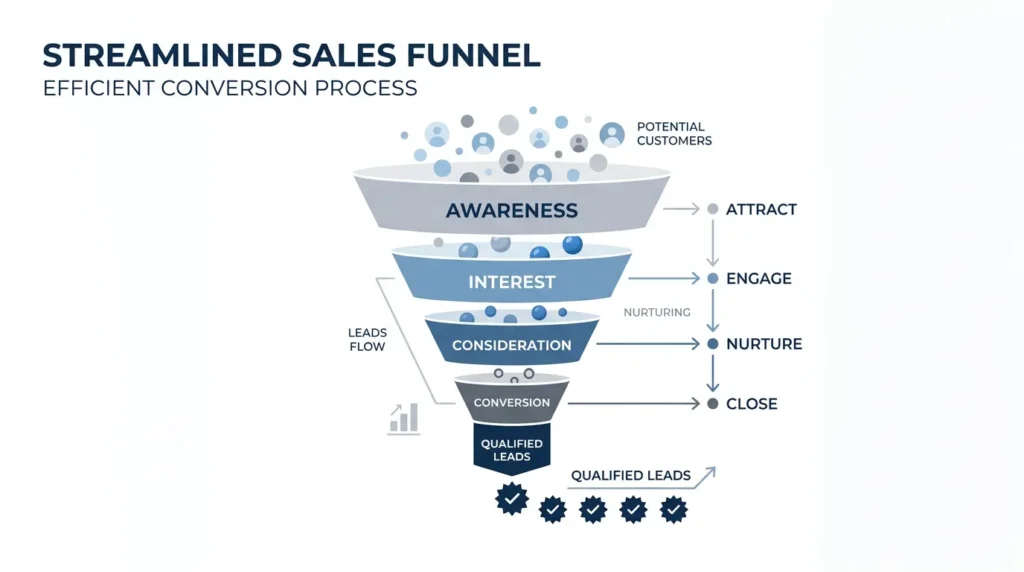
We always approach lead generation as a system. Not as a standalone campaign. That system consists of three blocks: (1) who you target, (2) where you send those people, (3) how you follow up until it becomes a Sales Qualified Lead. In this article I’ll walk you through what works, why it works, and what your next step is.
1) Start with ICP, otherwise you’ll get creative in the wrong direction
If you generate sales leads without a sharp target audience, you automatically get noise. You see that in high CPL (Cost Per Lead), a lot of time in intake, and few real sales opportunities. That’s why we always start with ICP, the Ideal Customer Profile.
What your ICP is, in commercial language
A useful ICP is not “companies in healthcare” or “B2B entrepreneurs”. It is a combination of characteristics that make someone likely to buy.
- Problem or trigger: what are they struggling with, or what sets them in motion?
- Buying context: what is the reason they are looking for help now?
- Decision environment: who decides, and through which route?
- Size and scope: does your offer fit the budget and capacity?
- Readiness: how often do they already contact suppliers?
Why this has a direct impact on your lead quality
Your marketing can be great. But if your ICP is too broad, your forms become a triage desk. Qualification gets expensive. Follow-up gets vague. And your sales team starts selling “hopefully”. That’s a waste of your time and your budget.
Practical next step
Pull up 10 recent conversations (or quotes). Mark which people really fit your offer. Write down 3 triggers and 3 characteristics per conversation. That becomes your ICP draft. After that we translate it into content, landing pages and qualification questions.
If you’d like to see this worked out as a plan, you can start here: B2B lead generation: plan, channels and conversion to SQL.
2) Choose channels based on intent, not on gut feeling
Generating sales leads through online marketing goes faster when you connect channels to intent. You need to catch people at the moment they want help, not only when they see “something interesting”.
Top, Middle, Bottom of the Funnel (TOFU, MOFU and BOFU) in plain language
- TOFU (Top of the Funnel): they have a problem, but are still searching for the right words.
- MOFU (Middle of the Funnel): they are comparing approaches or suppliers.
- BOFU (Bottom of the Funnel): they want quotes, demos, or a concrete proposal.
Your channel mix has to match your offer. A complex enterprise service usually performs poorly with pure TOFU. A simple service can move through earlier.
What often works well (and when)
These are choices we often see working in real sales journeys:
- SEO (Search Engine Optimization): if your audience structurally searches for a problem or solution, we build demand that you can later “harvest”. That takes time, but is often stable.
- SEA (Search Engine Advertising): if you want pipeline quickly, with a focus on BOFU terms and tight landing pages.
- PPC (Pay-Per-Click): useful to test immediately which message converts, especially for MOFU.
- Outbound online: when intent is scarce, outreach can be a supplement. But then your offer and targeting have to be sharp.
You can find a practical deep dive into SEA and how to use it smartly here: SEA: Search engine advertising explained and applied smartly.
Practical next step
Make a simple channel map:
- Which BOFU search intent do you want to capture?
- Which MOFU questions do we answer in content?
- Where can outbound help because input or timing is missing?
After that we determine the landing pages and the follow-up flow.
3) From click to lead to Sales Qualified Lead, this is how you build the route
Here is where it gets concrete. Many teams “generate leads” by putting up a form. But a lead is only valuable if you can qualify it. So we always design the route: from first interest, to a real appointment or demo, and then to Sales Qualified Lead (SQL).
The difference between visitor, lead, MQL, SQL and customer
- Lead: someone who shows commercial interest and leaves contact details or a real request.
- MQL (Marketing Qualified Lead): a lead that fits marketing criteria (such as topic, fit or action).
- SQL (Sales Qualified Lead): a lead that sales accepts because it meets sales criteria (such as timing, budget or concrete need).
- Customer: completed purchase or assignment.
If you don’t make this difference explicit, you’ll read your dashboard the wrong way and steer on traffic instead of sales opportunities. That’s a classic, and not in a good way.
Landing pages that actually convert
A landing page should have one primary action. Think: request a demo, ask for a quote, or book an intake. Beyond that, it comes down to proof and reducing friction.
What works in practice:
- Focused headline: who is this for, and what do we solve?
- Proof: examples, approach, scope, and what you do and do not do.
- Form with intent: not too short, not too long. Ask for the things sales needs.
- Clear promise: what happens after submission (timeline and process)?
If you want to build a complete route, also read: Generating online leads: strategy and a system that works.
Tracking and conversions: measure what you actually drive
You can only improve what you measure. In Google Analytics 4, conversion measurement works based on events. You mark relevant events as conversions, for example lead generation form submissions. Google describes this as event-based conversions. (support.google.com)
In addition, Google recommends looking at “recommended events” and key events for lead generation funnel events. (support.google.com) And if your tracking is not complete out of the box, you can use custom events. (support.google.com)
Practical advice that saves time: measure at least two levels. (1) form started, (2) form completed, and preferably (3) qualification reached or appointment scheduled. That way you avoid optimizing for people who were almost customers but dropped off.
Practical next step
Write out your conversion hierarchy on one page:
- Which event is “lead”?
- Which event turns it into “MQL”?
- Which event turns it into “SQL”?
After that we build dashboards and optimization on those definitions.
If you want to go from traffic to SQL with a system, then this is relevant: Online lead generation: from traffic to SQL with a system.
4) Follow-up is where deals are won or lost, so automate wisely
You can have the most beautiful landing page. If your follow-up is slow or inconsistent, leads slip away. Automation helps, as long as it supports your process and gives your sales team information to work with.
Why follow-up is so decisive
Online leads usually have no interest in waiting for “we’ll take another look later”. Fast and relevant follow-up increases the chance that you get an appointment. Not magic, just logical. If your process responds the same day, you are closer to the lead’s intent.
A simple follow-up flow you can run tomorrow
We often use a flow with three moments:
- Immediate confirmation: short email or message with what the lead can expect.
- Content-based follow-up: a message that matches the response details from the form.
- Sales action: call or proposal for an appointment if there is enough fit.
For planning and running a mailing campaign, you can use this as a guide: Mailing campaign: planning and execution for results.
Automation with boundaries
Automation here does not mean “let software do everything”. It means workflows that:
- store leads neatly in CRM (Customer Relationship Management),
- update statuses (MQL, SQL, appointment),
- pass on campaign and form data,
- trigger a next action based on qualification.
Important: for higher-impact decisions, a human remains the decision-maker. That’s not only proper, it also prevents mistakes in promises and follow-up priorities.
GDPR and consent, because you don’t want a “lead” you’re not allowed to use
Lead generation is about contact with people. That is why you need to properly arrange the legal basis on which you process personal data. In Europe, in many cases you need consent, or another valid basis. The European Commission explains that consent is needed when there is no other basis, and that opt-out is not the same as consent. (europa.eu)
The European Commission also names legitimate interests as a possible basis in specific situations, with conditions, and refers to rules around email marketing in connection with the ePrivacy Directive. (commission.europa.eu)
No panic, but discipline: your forms must be clear, your consent must be real, and your follow-up must match what your consent covers. This is not a “legal side note”, this is part of trustworthy lead generation.
Practical next step
Create a “follow-up matrix”:
- Which intake fields trigger which follow-up action?
- When does the lead go to sales, and when not?
- How long does it take before someone takes action?
If you want more focus on B2B processes to SQL, then this also fits: B2B lead generation: plan, channels and conversion to SQL.
5) Cold outreach as a supplement, not a replacement for your system
Yes, you can generate sales leads with outbound. But do it as a supplement. Not as a way to mask a weak system.
When cold outreach does make sense
- You sell a clear offer with a well-defined audience.
- You can personalize based on business context or trigger events.
- You have fast follow-up and a concrete “next step” offer.
What you need to arrange for quality
Cold outreach usually does not fail because of the channel. It fails because of:
- lists that are too broad, which creates irritation instead of interest,
- messaging that is too vague, which means you do not open a conversation,
- a follow-up that does not match the question someone asks.
If you are considering outsourcing this, check: Outsourcing cold outreach: is it worth the investment?.
And for cold mailing, this guide is useful: Cold mailing: effective email outreach (2026).
6) Optimize on the right KPIs, otherwise you’re steering by illusion
You want to steer, not guess. But then you do need to choose the right KPIs.
A KPI set that supports sales lead generation
We often start with this set:
- CPL (Cost Per Lead): what does it cost to get a real lead?
- CVR (Conversion Rate): from click to lead, and from lead to appointment.
- Response time: how quickly does follow-up go out?
- SQL share: how many leads become Sales Qualified Leads?
- Sales quality feedback: what does sales say about fit and timing?
For SEA and budgets: look at costs, but also at intent
You can measure costs, but you also want to know why something is expensive or cheap. For example, BOFU clicks are often more expensive, but convert better into an SQL. That is why it is important to connect campaigns to landing pages and qualification.
If you want to know more about advertising costs, this is a good start: Google Ads costs: what do you really pay?.
Practical next step
Take your current funnel. Add this behind it:
- where people drop off,
- which page or step causes that,
- which hypothesis you test to improve it.
No 20 tests at once. Pick the one that can have the biggest impact.
For anyone mainly thinking in B2C, this can help: Generating leads in B2C: proven online strategies.
Conclusion: sales lead generation is a process, not a lucky break
If you do it well, sales lead generation becomes predictable. Not perfect, but manageable. You get there by:
- making your ICP sharp,
- choosing channels based on intent,
- designing the path from lead to SQL with landing pages, tracking and qualification,
- automating follow-up with a human in control,
- optimizing on KPIs that measure sales quality.
Our recommendation for the next step: write down your conversion hierarchy today (lead, MQL, SQL) and connect it to your landing pages and events. Only then should you scale. That is the fastest way to prevent your budget from going up in smoke while you could have used it differently.
