
 Written by
Daniel van Hek
Search Clicks·September 30, 2026
12 min read
Written by
Daniel van Hek
Search Clicks·September 30, 2026
12 min read
Grab your coffee. You do not want just another “nice website.” You want a lead generation site that turns online marketing and online sales into measurable commercial conversations. That means attracting the right visitor, convincing that visitor, and structuring follow-up so interest turns into a meeting.
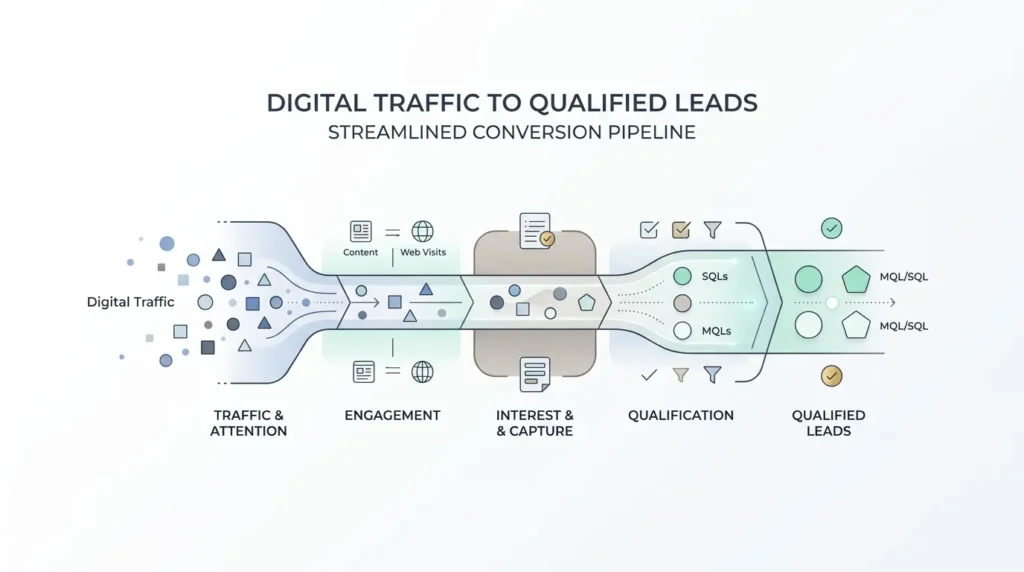
In this article, we walk through the system step by step. We keep it practical. We explain what works, why it works, and what you should adjust first tomorrow. We also use some real, reliable conversion benchmarks so you do not have to rely on gut feeling. And yes, we do that without vague marketing talk, because in the end that is not what convinces your pipeline.
A lead generation site is not “a website with a few forms.” It is a traffic and conversion machine with a clear route to commercial value.
We distinguish three levels, because each step requires different guidance:
This matters because otherwise you optimize for traffic, while your business runs on meetings and deals.
A visitor on your website, a click on a button, or a paused video showing up in your analytics is valuable for diagnosis. But it only becomes Lead Generation when you actually collect contact details or a concrete commercial enquiry.
Benchmarks help, but your situation is always unique. A good average reference for landing pages is around 6,6% for example, based on the median in a benchmark analysis with a large dataset. (unbounce.com) But you will notice that B2B, your offer, your audience and your ad copy influence this heavily.
Use that benchmark mainly as a sanity check. If you are clearly below the range, that is usually a sign of mismatch, too much friction, or weak follow-up.
Your site only becomes a lead generation site if the route is right. And route means: who are you bringing in, where are you sending them, and what promise do you make at each step.
Your Ideal Customer Profile (ICP) is not a list of “interests.” It is a practical profile that later shows up in filters, qualification questions and sales decisions. Think of things like:
Why this works: when your ICP is sharp, you can make your landing pages and your ads consistent. That consistency lowers doubt, and doubt costs conversions.
“We do lead generation” is not an intent. “Lead generation system that sells” is, because it implies a concrete result and often a concrete problem.
So you need landing pages that help the visitor choose. Usually three clusters work well:
You do not have to cram every type of content into every page. Choose one primary CTA per page. That makes testing easier, and your data tells you faster what works.
In practice, the best lead generation sites follow a route like this:
If one step is missing or vague, conversion starts leaking. It is like a leaking faucet: you only notice it when the water meter keeps running.
Let us make this concrete. These are the parts I see as “minimum viable” for a lead generation site that seriously helps build pipeline.
One of the most effective CRO principles is simple message match. If the ad promises something your landing page does not deliver, friction appears.
Practical approach:
You can also test variants. For example, one variant with a short form and one with extra qualification questions. The trade-off is always: shorter form gives more volume, more questions give better quality. That is not “better or worse,” that is a choice for your sales process.
Unbounce, for example, describes that optimizing the number of fields by industry can affect conversion. (get.unbounce.com)
A lead generation site does not have to try to do everything. If sales has to pick up everything, speed drops and the pipeline gets stuck.
What usually works:
For B2B, one strong extra step is often valuable: qualifying through a short question that touches your ICP. For example: “Which situation fits you best?” with 3 to 5 options.
No lead generation system without reliable tracking. You want to know not only how many form submissions there are, but also where the quality comes from.
In Google Analytics 4 (GA4), you measure conversions from events. Google explains that a conversion is created based on a Google Analytics event and that this provides a consistent way to measure important actions. (support.google.com)
In practice, this means:
Tip from practice: you always want to distinguish between “lead” and “meeting.” Otherwise you optimize for the wrong KPI.
You do not test because it is fun. You test because you have assumptions.
Use this CRO test plan:
If you only measure landing page conversion, you miss quality. Then you end up optimizing “success” that sales does not feel.
Your lead generation site is the starting point. The real win often comes in the follow-up. A lead that is picked up too late suddenly becomes “low intent.” That is a shame, because you already paid for attention.
You need to decide in advance what happens after:
For B2B, a combination usually works best:
Why this works: you reduce time to contact, preserve context, and use the information the lead already gave.
Be concrete about criteria. For example:
Trade-off: strict qualification lowers the number of MQLs, but often increases sales conversion. If you solve this differently, you get many leads with little sales momentum.
Automation here means: software and workflows that optimize online marketing and online sales. Think of automatic lead capture, enrichment, qualification, email follow-up, appointment booking and synchronization in CRM.
Important boundary: automation must not make budget changes or contractual decisions without human approval. This is about managing risk and quality.
A practical rule of thumb I also follow myself: automate the tasks that are repeatable, and let sales decide where context and conversation topics matter.
If you want to see this as a system, it helps to work it out step by step. We also have an article about that, focused on the path from traffic to SQL:
Online lead generation: from traffic to SQL with a system
A lead generation site needs traffic. But the right mix depends on your stage, your audience and your sales cycle.
Search Engine Optimization (SEO) builds slowly, but can become very stable. Search Engine Advertising (SEA) can deliver volume much faster, as long as your landing page and follow-up are right.
What I often see: companies start with SEA because they want to learn fast. After that, they use SEO to reduce the cost per new lead over the long term.
If you want SEA explained clearly, this is a useful baseline:
SEA: Search engine advertising explained and used smartly
You can run an ad that gets clicks, but if your landing page is weak, performance disappears. That is why we see SEA and CRO as one system.
Concretely:
You want to understand what you pay for attention, and what that delivers in leads. For many teams, that feels like “marketing costs” instead of data you can actually steer.
If you want more control over ad costs, this article is a good place to start:
Google Ad Costs: What Are You Really Paying?
A simple decision rule we often use:
No theory without execution. Below is a setup you can build in sprints.
When this works, you get data you can trust. That is half the battle.
If you do that well, your lead generation changes from “generating intake” to “turning intake into opportunities.”
If you want to connect your full lead generation approach to execution, these internal articles are useful:
And if you are also considering outbound routes, make sure you look at it smartly from a financial and process perspective:
Outsourcing Cold Outreach: Is It Worth the Investment?
For teams with a B2C proposition, the intent and follow-up logic are often different. This can help you refine your approach:
Generating Leads B2C: proven online strategies
If you take one thing away, let it be this: a lead generation site is a system, not a page. You win through consistency between ad or search intent, landing page, conversion mechanism and follow-up. And you learn fastest by defining your KPIs at the level of lead quality and progression to SQL.
Next step you can take this week: choose one primary intent for your ICP, build or improve one landing page, and set up GA4 tracking so you measure lead and meeting separately. That is a small change with big diagnostic value. After that, you iterate, not guess.
If you also want to think about collaboration and execution, this article can help you select the right partner or internal approach:
Choosing an SEO agency: what to look for and why
And if you want to structure your entire online marketing organization around lead generation, start here:
Online Marketing Company: Services and Specializations
Good, time to build. And if you notice that your site delivers leads but no SQL, you already know exactly where the next fix is: the route after the form. That is often where you win the most, without doubling your budget.
Book a free strategy call and discover how many leads we can generate for your business. No obligations — just a concrete growth plan.
Book your free strategy call → Book your free strategy call — 30 min, no strings attached