

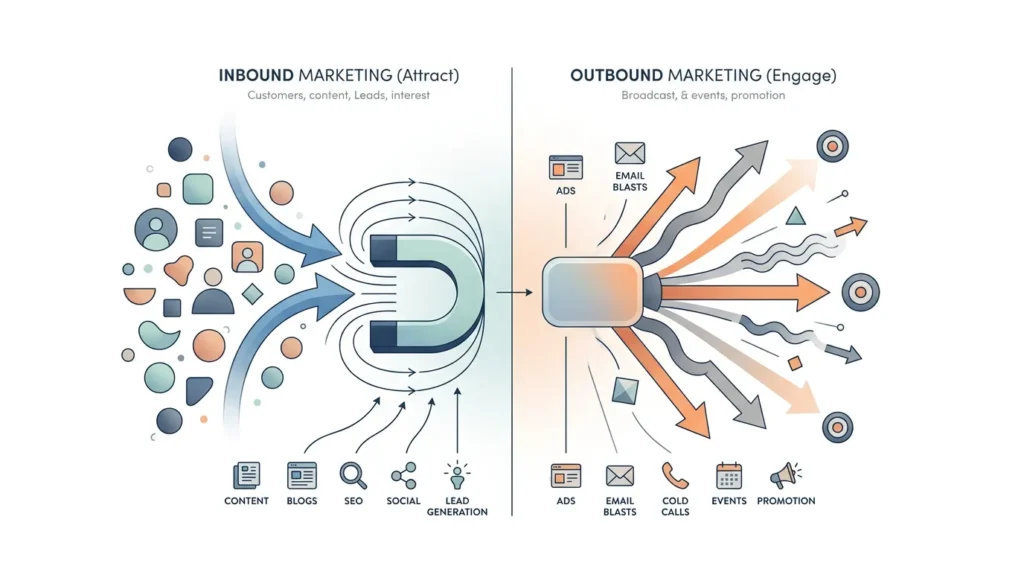
Imagine marketing and sales as two ways to find customers. One is like being a retailer who displays valuable items so people come in on their own. The other is like actively going out into the street with a message that fits exactly with what people are already looking for at that moment.
That is, in broad terms, inbound and outbound marketing. You do not have to choose. What matters most is understanding what each approach does best, why that works for online behaviour, and how to combine them without spreading your attention too thin. Grab your coffee, we are making this practical.
What is inbound marketing, and why does it work online?
Inbound marketing is an approach where you attract your audience by offering content and experiences that match their needs. You then help them move toward a purchase decision, and you make the relationship strong enough for them to come back or recommend you.
In practice, you often see a cyclical structure with steps such as Attract, Engage and Delight. This helps because, as a brand, you respond to different moments in the buying process, not just to “why would they call you”. (hubspot.com)
What you use inbound for
- Catching search intent: people are already searching. With Search Engine Optimization (Search Engine Optimization), you can ride that traffic organically.
- Guiding decision-making: content helps with comparing, selecting and validating.
- Building trust: consistent, useful information makes it easier to say “yes”.
What makes inbound less strong
Inbound is usually slower in the first days or weeks. It depends on distribution, content quality, discoverability and conversion on your website. So if you need orders tomorrow, inbound on its own is often not enough.
What usually works well with inbound
In my experience, inbound success comes down to three things you can test:
- A sharp topic for each piece of content, tied to a concrete problem or choice.
- A clear path to a contact moment (for example a quote request or appointment), with relevant CTA’s (Call to Action).
- Fast follow-up with interested people, so momentum does not disappear.
If you are using inbound through SEO and you want to make it truly actionable, then this is a useful route from “we are going to publish content” to “we are running a system”: Implement SEO Online: Practical Step-by-Step Plan.
What is outbound marketing, and why does it work for targeted online attention?
Outbound marketing is reaching out to prospects with a relevant offer, usually based on a predefined target audience. Instead of waiting for people to find you, you go to them.
Online outbound often means targeted ads, cold email outreach, retargeting and other ways of actively initiating contact moments.
What you use outbound for
- Creating volume quickly: when you need measurable results within weeks, not months.
- Testing targeted segments: you can quickly run different message and audience variants.
- Cutting through noise: outbound works best when your audience is sharp and your offer matches the stage people are in.
What makes outbound less strong
Outbound can become expensive or inefficient if you:
- do not know where your prospects are in the process,
- do not have a strong landing page or follow-up,
- target too broadly without segmentation.
In short: outbound punishes weakness in your targeting and conversion path harder than inbound.
What usually works well with outbound
Outbound often becomes profitable when you run it as a measurable experiment, not as “we always send the same email”. Think in cycles:
- Audience and intent: who are they, and where are they in terms of need?
- Value proposition and proof: why should someone take this seriously?
- Conversion path: how do you get from interest to appointment or request?
- Follow-up: speed and relevance in the first 24 to 48 hours.
If you are using outbound through Search Engine Advertising (Search Engine Advertising) and you want a budget that matches your goals, use this as a starting point: SEA Budget Setting: how much to invest in Google Ads?.
The real difference is not in channels, but in the question: who starts the interaction?
This is where the coffee metaphor comes back. The key question is: who initiates the contact moment?
Inbound: the audience comes to you
You capture intent that already exists. Your content and website make it logical to click further, fill in a form or schedule an appointment.
That is why inbound works well with:
- SEO (Search Engine Optimization) and content that matches search queries,
- retention and follow-up that bring people back later,
- useful information that makes their internal discussion easier.
Outbound: you start the interaction
You actively bring your offer to attention. That means you need to do especially well what inbound often gets “automatically”: trust and relevance at the moment you ask for attention.
That is why outbound works well with:
- segmentation and personalisation based on behaviour or characteristics,
- clear value and a conversion path that moves straight ahead,
- fast follow-up and tight performance monitoring.
Practical rule of thumb
If you mainly see doubts among prospects, inbound is often your best employee. If you mainly see a lack of inflow in your pipeline, outbound is often your fastest lever. And if you see both, you need to combine them.
How to combine inbound and outbound marketing for maximum impact
Now for the part where most teams get stuck. They place channels next to each other, but not after each other. The solution is: turn it into one route.
Route 1: inbound as the signal, outbound as the accelerator
This is a smart combination for many B2B and also for B2C, depending on your sales cycle.
- Inbound signal: someone lands through SEO or content, or fills in a form.
- Quick qualification: in your CRM (Customer Relationship Management), you determine whether this is a Marketing Qualified Lead (Marketing Qualified Lead) or whether you still need to educate them.
- Outbound acceleration: you use ads or outreach to push the same person, or a similar segment, further towards an appointment.
Why this works: you avoid outbound “hunting” blindly. You activate outbound on people who have already shown interest.
Route 2: outbound for demand, inbound for credibility
In this route, you start with reach and attention, but you use inbound to clear the hurdle toward a decision.
- Outbound demand: you bring people in through ads or outreach.
- Inbound trust: you lead them to content that addresses their doubts, for example comparisons, implementation, cases or FAQ.
- Conversion and follow-up: your route ends in a concrete request or appointment, with measurable follow-up.
Why this works: attention without content is an expensive hobby. Attention with content increases the chance that people keep going.
Route 3: full-funnel retargeting without irritation
Your retargeting should not just say “we are still here”. It should say “this is exactly relevant to what you just did”.
Example of segmentation you can apply without drifting into jargon:
- visitors who viewed a specific service page,
- visitors who viewed a pricing or request page,
- visitors who clicked but did not fill in a form.
After that, you connect the message to a matching answer piece, for example a short explainer page or an appointment route.
Measurement is not a detail, it is your steering wheel (SEA, SEO and conversions)
If you combine inbound and outbound, you also need to measure how they strengthen each other. Otherwise you optimise separate pieces and do not build a real machine.
Which KPI’s (Key Performance Indicator) you use depends on your phase
- TOFU (Top, Middle, en Bottom of the Funnel): focus on reach and relevant traffic to problem-based pages.
- MOFU (Top, Middle, en Bottom of the Funnel): focus on conversion to interest points, such as a demo request or download.
- BOFU (Top, Middle, en Bottom of the Funnel): focus on appointment and becoming a customer, through your CRM.
Conversion tracking for ads, so you do not optimise blindly
If you work with Search Engine Advertising and you want your measurements to be accurate, pay attention to your conversion setup. Google describes best practices for Enhanced Conversions, intended to improve conversion measurement and better match data with logged-in Google data, including the use of different conversion sources such as Google Analytics 4 (Google Analytics 4) and Google Ads. (support.google.com)
I am not saying this to overwhelm you with tracking details. The point is simple: if your conversions are not reliable, your optimisation is a guess.
Aligning SEO and SEA, not optimising them separately
A common mistake is giving SEO one separate plan and SEA another. But for your customer, it is one journey. That is why you want to:
- align landing pages with intent,
- make ad messages match the first page someone sees,
- use content as a supporting layer at moments of doubt.
If your team is looking for help combining SEO and SEA into one growth strategy, then this route often fits the way teams organise their execution: Google optimisation agency: SEO and SEA for growth.
Maintaining your SEA (continuous improvement)
SEA is not set-and-forget. You optimise search terms, bids, budgets and especially conversion performance.
Use this as a practical basis for ongoing optimisation: SEA Optimisation: continuously improve campaign marketing.
What is your next step? A 30-day combination plan
We are keeping this deliberately achievable. No big bang. Just a clear sequence.
Week 1: sharpen your routes and definitions
- Define your ICP (Ideal Customer Profile): who is truly relevant for your offer?
- Define your qualification in your CRM: what is a Marketing Qualified Lead (Marketing Qualified Lead) and what is a Sales Qualified Lead (Sales Qualified Lead)?
- Choose one inbound route and one outbound route, not three. Focus almost always wins.
Week 2: set up conversion points and connect everything
- Check your conversion tracking for your main goals.
- Create one landing page per route with a CTA (Call to Action) that matches the intent.
- Set up follow-up so that you respond to interest within the first 24 to 48 hours.
Week 3: run campaigns as experiments
- Inbound: publish or optimise content around one core problem.
- Outbound: test two segments and two messages, and keep one element constant.
- Use measurable goals, such as CVR (Conversion Rate) on landing pages and the share of MQL to SQL.
Week 4: learn, scale what works, stop what does not
This is where things often go wrong. Teams keep running because “it is already going”. You make decisions based on data.
- Scale the route that flows best toward Sales Qualified Lead.
- Improve the weakest link, often the conversion path or the first follow-up.
- Let your SEO and SEA support each other, for example by aligning ad landing pages with the content that strengthens your inbound.
If you are starting with SEA specifically, a step-by-step setup can save you a lot of time: Set Up an SEA Campaign: strategy to execution (step by step).
And if you want inbound to work especially well locally, it pays to process your local intent carefully: Local SEO agency: how to get more local leads.
For B2C (Business-to-Consumer) lead generation, the setup is often slightly different, but the combination idea stays the same. This article helps you make digital channels measurable: B2C lead generation: strategy, channels and measurable system.
Conclusion: inbound and outbound are not rivals, but parts of one buying journey
Inbound and outbound marketing differ in how the contact moment starts. Inbound waits for intent. Outbound creates attention and brings your message to the right people.
The win lies in the combination:
- use inbound to build trust and proof,
- use outbound to create pace when you need inflow,
- measure conversion and follow-up so you are not optimising by feel.
If you have to make one decision today: choose one inbound route and one outbound accelerator, and connect them in your CRM flow. Then “marketing” suddenly becomes a journey you steer, instead of a collection of separate activities. (And you finally get control, without your team living in spreadsheets for days.)
Finally, if you want to zoom out to online lead generation as a system, start here: Generate online leads: use digital channels smartly.
And if you decide to hire expertise, focus on strategy, execution and selection criteria, not vague promises: Choose an SEA Marketing Agency: strategy and execution and Choose an SEA Marketing Agency: selection criteria.
