

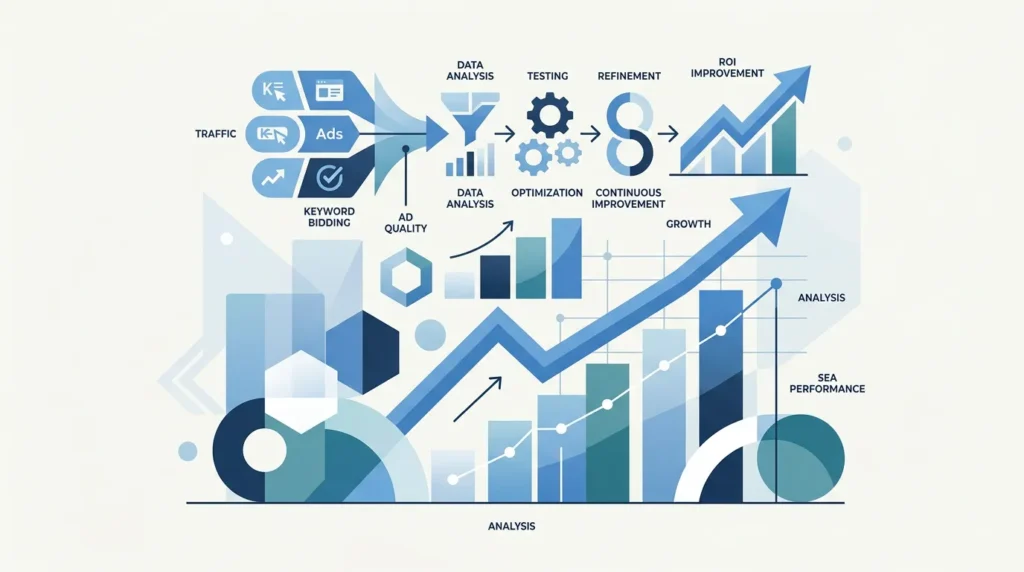
If you take SEA optimization seriously, it’s not about “one trick.” It’s about a system that keeps learning. You feed in data, and we adjust based on the behavior of real users and conversions. That way, your campaign becomes more efficient over time, without having to gamble with your budget every week.
In this article, we’ll walk you through the key building blocks. We explain what works, why it works, and what your next step is. No fluff, just a practical step-by-step approach you can put into action tomorrow. Grab a coffee, we’re going to make it concrete.
1) SEA optimization starts with the basics: tracking and goals
You can only optimize what you measure. In SEA, that’s often the difference between “we run ads” and “we drive results.” That’s why the first step is always the same: make sure conversions are correct and your goals match your business.
Define your conversions logically
Which event is genuinely valuable for you?
- Cost Per Acquisition (CPA): if you want to optimize for cost per acquisition, the acquisition has to exist as a conversion. (CPA means Cost Per Acquisition here.)
- ROAS: if you want to optimize for return, your conversions also need to have a value. (ROAS means Return on Ad Spend.)
Google Ads Smart Bidding can work with different objectives, such as Target CPA or Target ROAS. But it only works well if conversion tracking is reliable. Google explicitly states that Smart Bidding relies on conversion data. (support.google.com)
Check your conversion tag setup
A common mistake is double counting or conflicting tags. Google notes that when you use multiple tracking methods, you need to watch out for conflicts, and recommends consolidating where possible. (support.google.com)
Practical next step: have your conversions audited once with a Tag Assistant check (or your internal testing process). Also check whether the same conversion is accidentally firing twice.
Choose a measurable north star
For SEA optimization, you want one primary KPI, supported by 2 to 4 secondary ones. Think of:
- KPI: conversions or conversion value
- Supporting: Cost Per Lead (CPL) or CPA, and CVR (Conversion Rate)
- Supporting: quality signals and landing page performance
Note: traffic, clicks, and impressions are not a lead in themselves. A lead is a person or business with real commercial intent. In SEA, that usually means: a request, quote request, contact moment, or another conversion that moves your funnel forward.
2) Quality Score: why it affects your ad costs
You can approach SEA optimization like campaign and ad engineering. Quality Score is your thermostat in that process. Not because your score always has to be perfect, but because it helps determine how often your ad appears in the right spot at the right price.
What makes up Quality Score?
Google says that Quality Score in Search campaigns is linked to three components:
- Expected clickthrough rate (CTR): the likelihood that your ad will be clicked when it is shown
- Ad relevance: how relevant your ad is to the search query
- Landing page experience: how relevant and useful your landing page is for people who click (support.google.com)
That’s exactly why SEA optimization is not just about bids. Your ad and your landing page need to match the intent behind the keyword.
The practical upside: more chance of better positions with less waste
In practice, you often see this pattern:
- When expected CTR goes up, your visibility for relevant keywords improves.
- When landing page experience gets better, the mismatch between click and intent drops, which helps conversion performance.
- When ad relevance improves, you attract fewer wrong users and save budget on click noise.
Trade-off you need to accept: this requires discipline in structure. You can’t expect one generic landing page to work for every keyword, especially with broader matching. That’s not a disaster; that’s marketing engineering. (And yes, it takes time to do it properly.)
What works to improve Quality Score
- Align search term and keyword intent: check which queries your ads are actually triggering. Put irrelevant search terms under control with negative keywords.
- Ad copy specificity: write ads around problem, solution, and context. Not “we do everything.”
- Landing page fit: make sure the landing page confirms the ad promise within the first few seconds.
- Use Quality Score diagnostics: Google offers a Quality Score diagnostic tool to show where improvement is needed. Use it as a starting point, not the finish line. (support.google.com)
3) Smart bidding and budget management: from manual work to guided learning
Bidding is the part many teams stay stuck in manually for too long. Not because manual is wrong, but because SEA optimization moves faster when you can use machine learning based on real conversion data.
Smart Bidding: when Target CPA or Target ROAS makes sense
Google Ads Smart Bidding automates bids within a goal. Think of:
- Target CPA (CPA means Cost Per Acquisition here)
- Target ROAS (ROAS means Return on Ad Spend)
- Other Smart Bidding variants such as Maximize conversions
Google explains that Smart Bidding works with conversion data and that strategies are aimed at reaching your objective. (support.google.com)
What you need to set up before making the switch
If you switch too early, you’ll get learning-curve disruptions. That’s why our approach is usually:
- Make sure conversion tracking and conversion values are in place (if you want value-based bidding).
- Keep your conversions consistent (same definitions, no questionable events).
- Roll out changes in phases so algorithms can adjust.
Google also stresses for Target ROAS that conversion tracking and conversion value setup are required for value-based goals. (support.google.com)
Budget that doesn’t swing for no reason
SEA optimization is sensitive to abrupt budget changes. If your budget shifts sharply every few days, you make it harder for bidding systems to learn consistently. Budget management is therefore not just financial; it’s optimization behavior.
Practical next step: choose one place to steer. For example:
- First focus on quality and conversion performance.
- Only then make structural changes to bidding strategies and budget levels.
That way you avoid optimizing one variable while three others are moving. Plain, but true.
4) A/B testing and CRO for SEA: improve conversions, not just clicks
When people think about SEA optimization, they often think of ad copy first. That makes sense, but it’s not enough. The biggest lever is often the move from click to action. CRO (Conversion Rate Optimization) is therefore part of SEA optimization, not something separate.
What test plan actually works?
You want tests that don’t break intent. That’s why we usually test:
- Message match: does the ad promise come back on the landing page?
- Form friction: is the form too long, too vague, or asking for information you don’t need?
- Proof: is there concrete proof that the solution works in your context?
- CTA clarity: is the CTA (Call to Action) clear and logical for the right audience?
Note: CRO testing is not a “make it prettier” project. It’s a hypothesis. For example: “If we adapt the first section to the main problem from the ad, CVR will increase because visitors will recognize faster that we understand their question.” That’s testable.
Testing with a measurable success criterion
A good A/B test has:
- One primary metric (for example CVR or CPA)
- A secondary guardrail (for example lead quality, or conversion to the next step)
- A timeline that isn’t too short
If your CPA improves but lead quality drops, it’s not a win. In sales and lead generation, you want commercial relevance, not just volume.
Practical CRO improvements you can make quickly
- Tighten the hero section: state the solution and target audience within 5 seconds.
- Restructure the form: ask only for what you really need to qualify the request.
- CTA per campaign: align the CTA with the TOFU, MOFU or BOFU stage (Top, Middle, Bottom of the Funnel).
- Add trust assets: make it concrete and relevant, not generic.
5) Reporting and optimization rhythm: make it a process
Many teams “optimize” only when something goes wrong. SEA optimization works better when you build a rhythm. Not to overwhelm yourself with dashboards, but to learn quickly where your budget is leaking.
Which signals to check weekly
We keep it simple. Every week we look at:
- Search terms: new queries, and adjustments to negative keywords
- CVR and CPA: whether they’re going down or up, and in which segments
- Ad variants: which messages are winning, which ones are losing traction
- Landing page performance: especially for campaigns with clear intent
Use diagnostics, not just averages
Averages hide problems. Your account might look fine on paper, but a specific campaign or audience could be draining budget. That’s why we look at performance by:
- Campaign
- Ad group
- Search intent (proxy via search terms and match type)
- Geography and device (only when it’s meaningful)
Follow a “test, learn, scale” cycle
A reliable optimization process looks like this:
- Diagnose: where is budget leaking, where is conversion being held back?
- Hypothesis: what will you change and why?
- Test: implement in a controlled way.
- Learn: evaluate against the primary KPI and guardrails.
- Scale: only scale what has proven better in your context.
That sounds like common sense. It is. The trick is actually sticking with it.
If you want to start with the basics of search engine advertising and how campaigns are structured, this internal article is a good fit to begin with: SEA: What Is Search Engine Advertising and How Does It Work?.
Conclusion: SEA optimization as a continuous improvement process
SEA optimization is not a one-time cleanup. It’s a continuous improvement process with three core layers:
- Foundation: conversion tracking is correct, goals are clear, and measurement definitions are consistent.
- Quality: Quality Score rises through better expected CTR, relevant ads and landing page experience. (support.google.com)
- Conversion: CRO and testing make clicks profitable, not just measurable.
Our advice for your next step is simple and actionable:
- Audit your conversion tracking and check for conflicts. (support.google.com)
- Use Quality Score diagnostics to improve landing page and ad fit in a focused way. (support.google.com)
- Start with one controlled A/B test on the landing page, using CVR or CPA as the primary KPI.
- Only then adjust bidding strategy and budget structurally, so Smart Bidding can learn from reliable data. (support.google.com)
No magic button. Just a system that works because it matches how users behave, how search engines assess quality, and how bidding systems use conversions. And yes, that means you get better week after week instead of only once in a while.
