

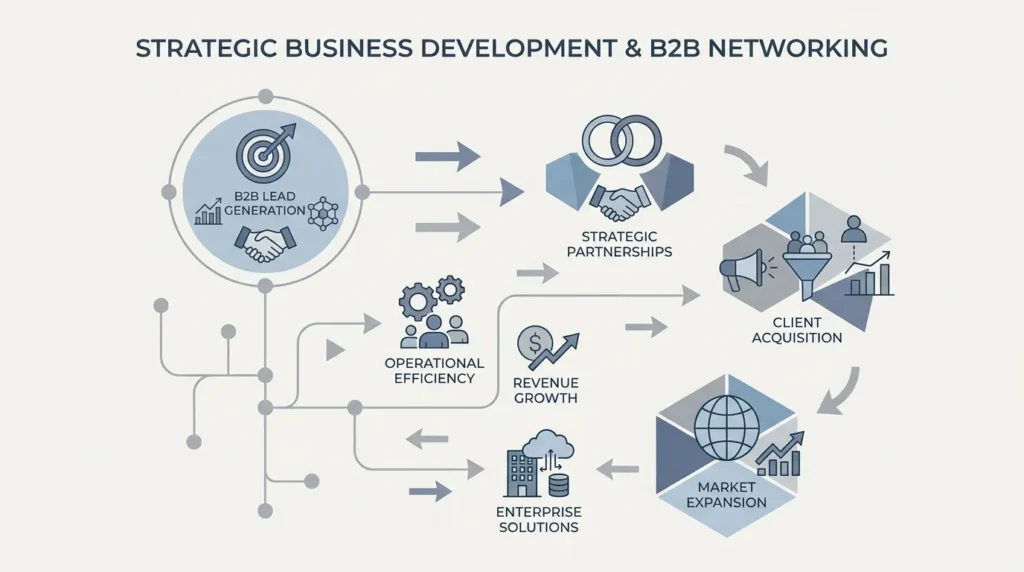
Let’s be direct. B2B lead generation often feels like two separate worlds: marketing wants more requests, sales wants better conversations, and both sides feel the other “doesn’t get the funnel.” For us, it always comes down to one thing: you build a system that gets the right people to take the right next step at the right moment. Not more traffic. Not more forms. But more commercial conversations that actually fit.
In this article, I’ll walk you through it step by step. We combine inbound and outbound. We get tracking set up properly. And we make sure your lead quality improves, without burning your budget on clicks that go nowhere.
Start with direction: ICP, offer and conversion goal
If you want to generate leads, you first need answers to three questions. Without that, you end up with “leads” that aren’t worth your time. That’s an expensive hobby.
1) Define your ICP with commercial signals
An ICP (Ideal Customer Profile) is not a pretty marketing list. It’s a working document for decisions, such as: which companies get priority, which use cases we cover, and which persona converts.
Make your ICP measurable. Use signals such as:
- Role and seniority (who decides or influences)
- Technical or process knowledge (who immediately understands the problem)
- Setup characteristics (for example tooling, team size, maturity on the topic)
- Timing indicators (for example expansion plans, migrations, new budget)
Practical tip: also write down who you don’t target. That will save you thousands of euros in mismatched leads later.
2) Connect your offer to a concrete conversion moment
Your offer needs one primary next step. So not “get in touch” if what you really want is a demo. Not “download” if what you really want is a conversation.
Examples of conversion goals in B2B (pick one as your primary):
- Request a demo
- Contact form with company details
- Book an intake call
- Download with qualification (for example with work email and a required company field)
Why does this work? Because your campaign, landing page and CRM follow-up all push toward the same moment. You avoid marketing measuring “a download” while sales sees “no real intent” a week later.
3) Choose your lead definition: lead, MQL and SQL
Your internal terms need to be correct. Otherwise you optimise for noise. In B2B we usually use:
- Lead: contact or company that may have commercial interest
- MQL (Marketing Qualified Lead): lead that marketing qualifies based on ICP and intent
- SQL (Sales Qualified Lead): lead that sales qualifies and is ready for a commercial next step
Trade-off: if you make MQL and SQL too strict, you get less volume. Too loose, and you get lots of volume and poor conversations. You’ll optimise this later, but you start with a clear range.
Tracking that works: conversions as steering data
You can’t optimise intelligently if you don’t know exactly what a “good lead” is. In Google Analytics 4, conversions are tied to key events (Google uses that term instead of “conversions”). Google explains how to set up key events to measure important actions. (support.google.com)
What you should measure for B2B lead generation
For B2B, I recommend this measurement model:
- Key event 1: primary request (demo, intake, contact)
- Key event 2: micro-action showing intent (for example form start, work email confirmation, or second step in a multi-step form)
- Offline event: sales status in CRM (for example SQL yes/no, or opportunity created)
GA4 offers standard key event rate metrics and you can link them to channel analysis and campaigns. (support.google.com)
Why this matters for optimisation
If you only measure “form submitted,” you optimise for volume. If you fine-tune key events for intent and include your CRM results, you optimise for lead quality. That’s the difference between “lots of leads” and “good conversations”.
Mini reality check: tracking is never perfect. Ad blockers, cookie restrictions and offline time between request and sales qualification create deviations. That’s why you should always use a margin in your reporting and look at trends per cohort, not just day by day.
Practical step
Make a measurement map for your website:
- Which page leads to which key event?
- Which campaigns send traffic to that page?
- Which CRM fields determine MQL and SQL?
Once you have this clear, every next test becomes faster and less guesswork.
SEO and content: attract demand that is already moving toward buying
SEO for B2B lead generation is not a sprint. But it is one of the most cost-efficient ways to build reliable inflow over time. Think search intent that points to a problem, a solution or an evaluation phase.
Which content works in B2B lead generation
Your content should match TOFU, MOFU and BOFU, but you don’t need to label every piece with a funnel stage. Above all, your content should answer what the searcher is trying to do:
- Problem searcher: why is this important, what are the consequences?
- Comparer: how does it work, what are the options, what’s the difference in approach?
- Buyer candidate: can this work for us, what implementation is needed, what does it cost and what does it deliver?
Practical approach: build 1 “money page” per use case, and support it with 3 to 6 targeted supporting pages (for example processes, integrations, cases, approach, FAQ).
Using Google Search Console for smart iterations
Start with your existing data. In Google Search Console, look for queries you already appear for, but where your CTR lags or positions just miss out. Then improve:
- Title and meta description for higher relevance and CTR
- The landing page structure so the main question is answered within the first section
- Internal links to the money page from supporting articles
Why this works: your page doesn’t always need to be “new.” Often it’s about aligning intent with what your page promises.
Internal linking building block
If your lead generation is serious, every content creator should know where the lead is supposed to go. Use internal links as signposts. That way you build a content path toward conversion instead of scattered articles without a destination.
If you want to tackle this more broadly, this route is a useful starting point: Lead Generation: Complete Strategy for More Customers.
SEA and PPC: learn fast, but only if conversions are truly right
SEA and PPC are ideal for gathering input quickly. You see what works faster. But if your tracking and targeting aren’t right, you’re mostly buying frustration. Let’s take a pragmatic approach.
What we target in B2B
In B2B, three types of targeting usually work best:
- Search intent: people searching for a solution and evaluating (commercial intent)
- Problem variants: keywords around the problem, not just the product
- Use case: specific use cases with clear context
Be careful with overly broad generic keywords. You’ll get clicks without real intent. That lowers your Cost Per Lead (CPL) and hurts your sales qualification.
Landing page: same promise, same next step
With PPC, consistency is king. Your ad promises something. Your landing page needs to confirm that within seconds. Then comes the next step.
A strong B2B landing page usually has:
- Short hero with a clear value proposition and audience
- Relevant social proof, without overdoing it
- Process or implementation overview (what happens after the request?)
- FAQ that removes objections
- Form with fields that qualify, not just collect data
Trade-off: more fields can raise your CPL or lower conversion. But if sales turns that into better SQL, it’s often still a win. Optimise this with A/B tests and look at SQL per lead, not just form per session.
Focus on CPL and lead quality, not clicks
In your reporting, you can absolutely start with CPL. In the PPC world, CPL is often used as a measure of the cost of a conversion to a lead. (wordstream.com)
But the bigger question is: how many of those leads eventually become SQL? If you don’t measure this, you’re optimising blind.
Next step in SEA
Start with conversion tracking and build your first campaigns around one primary key event. Then add variants (use cases, landing page variants, ad copy) and iterate.
If you still need to decide how much to invest, read this: SEA Budget Setting: How Much to Invest in Google Ads?.
And if you need support with execution, this is relevant: Choosing an SEA Agency: Expertise and Services.
Outbound and account-based: tap leads the market hasn’t searched for yet
Inbound works, but B2B often has a “waiting mode.” People aren’t always actively searching. That’s where outbound and account-based lead generation come in. Not as spam. As a focused conversation.
Outbound that isn’t annoying
Your outbound needs to meet one criterion: relevance. That means your message connects to a company or process context. Think:
- Recent initiative at the company (almost always visible through public signals)
- A use case that fits the team and maturity
- A short, useful question or observation, not a long story
Work with clear sequencing: first message, follow-up, and a final “breakup” message. That prevents your pipeline from filling up with ghosting.
Account-based approach: focus on the right accounts
With account-based marketing, you care less about “reach” and more about “penetration.” You decide which accounts get priority and build a multi-touch journey.
A practical way to start:
- Create a list of 50 to 200 ICP accounts
- Identify 3 to 5 relevant roles per account
- Design 2 to 3 content and outreach variants for different roles
- Measure response and qualification in CRM, and rebuild based on what works
Trade-off: this takes more preparation per account. But if the deal value is higher, it often pays off.
Automation as a tool, not an autopilot
When we talk about automation in lead generation, we mean software that speeds up your processes: processing intake forms, enriching leads, routing in CRM, follow-up sequences, and reporting. This is valuable as long as a human decides the direction at important steps.
That keeps you in control. And your system stays reliable.
Increase lead quality: from request to SQL
The difference between “lead” and “SQL” is often not your marketing. It’s your qualification and your response time.
Make your form qualifying
Let your form include fields that really help you assess intent and fit:
- Company details (size, industry)
- Role and responsibility
- Use case choice (pick one or two)
- What is their goal within 90 to 180 days (more context, less noise)
Note: too many fields reduce conversion. That’s why it’s smart to test on MQL percentage, not just form conversion.
Speed-to-lead: respond while it’s hot
If someone has just made a request, their problem is often fresh. Your follow-up then needs to be logical and fast. Even if you can’t hit “instant” timing, you want the first response within a short window.
Practical tip: use a confirmation email with a clear next step. And immediately send relevant assets that match the use case.
CRM follow-up with clear criteria
Your CRM (Customer Relationship Management) is your source of truth. Agree which fields sales must send back, such as:
- SQL yes/no
- Reason for qualification or rejection
- Next meeting date
- Deal probability or stage (as long as your team uses this consistently)
This creates a feedback loop. And we can optimise campaigns based on real revenue, not just form fills.
Automate reporting, not your judgement
Reporting can be automatic. Judgement stays human. You want your dashboards to be clear for marketing and sales, so you know where the bottleneck is. Is it traffic, landing page, form, follow-up, or qualification?
If you want to start specifically with Google Ads and set up tracking properly, check this guide: Google Advertising: Getting Started with Google Ads.
A workable plan for the next 30 to 60 days
No theory without execution. Here’s a plan your team can actually run.
Week 1 to 2: foundation
- Finalise ICP and define MQL and SQL criteria
- Set up key events for your primary request and micro-intent in Google Analytics 4 (GA4) (support.google.com)
- Check whether your landing page promises what your campaign promotes
Week 3 to 4: campaign and content tests
- Launch SEA/PPC around 1 to 3 use cases and 1 primary conversion goal
- Publish or optimise 1 money page per use case, with supporting internal links
- Test form fields based on MQL and SQL, not just form conversion
Week 5 to 8: optimise for lead quality
- Check which sources deliver SQL, and pause what only brings in leads
- Improve landing page sections causing the biggest drop-off
- Refine outbound messages based on response and conversations that actually start
Conclusion: B2B lead generation is a process, not a trick
When we bring it back to the core: B2B lead generation works when you do three things well at the same time. You focus on the right ICP. You measure key events and follow-up correctly. And you build a next step that sales understands.
Be honest with yourself: if your tracking isn’t right, you’re optimising on the wrong signals. And if your lead definition is messy, you get arguments instead of improvements.
Our best next step for you? Choose one use case, one conversion goal and one measurement model. Build your first campaign and landing page around that. And use the next 30 to 60 days to learn which leads truly become SQL. Then your next iterations will be faster. And your system more reliable. Just like coffee that’s been left too long, only in the right direction.
