
 Written by
Daniel van Hek
Search Clicks·October 26, 2026
12 min read
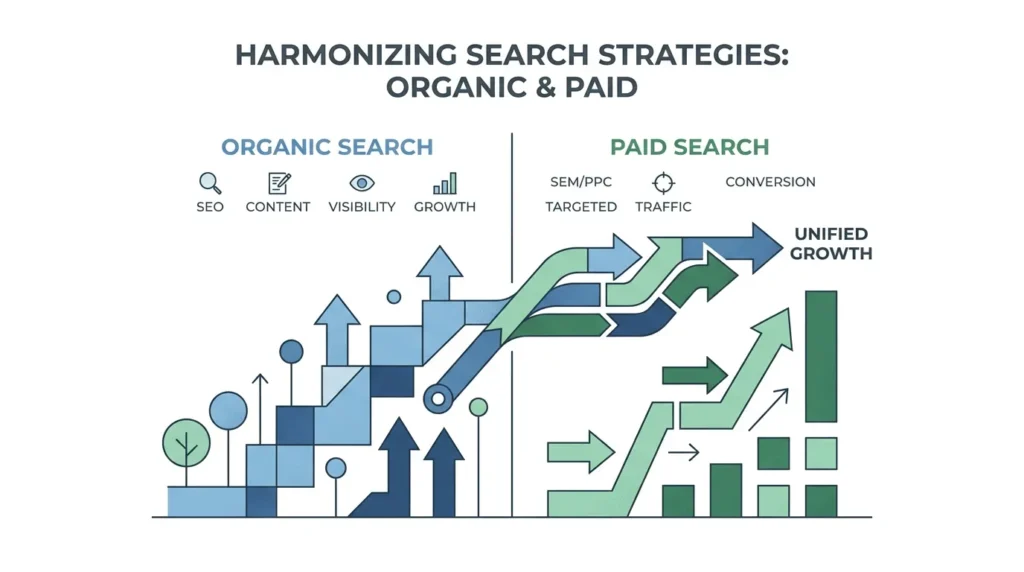
Grab a coffee. We’ll make this practical. SEO and SEA are both ways to get visibility in search engines. The difference is in time and control.
SEO (Search Engine Optimization) builds lasting discoverability. You optimise your website so pages become relevant for search queries. That takes time, but the results can keep going for a long time.
SEA (Search Engine Advertising) buys visibility. You run ads in an auction and usually pay per click (PPC, Pay-Per-Click). You can quickly generate volume and test. But it stops as soon as your budget stops, and you have to keep optimising.
For the keyword you’re asking about, “seo sea”, the core question is often the same: when do you choose SEO, when SEA, and when do you use them together? We answer that below, with an approach you can put into action right away.
SEO comes down to three things: technical setup, content and authority (in the sense of trust and relevance). You help search engines understand what your pages are about, and you help visitors find the answer quickly.
In practice, SEO success rarely shows up as a single spike. It’s more often an upward trend in organic visibility, plus more high-quality visits to pages you really want to convert.
One detail we often come across in audits: if your pages aren’t indexed properly, you can optimise all you want. In Search Console, you can use reports such as the Sitemaps report to see how your sitemaps are processed. (support.google.com)
SEA is about paid ads that match search intent. You choose keywords (or themes), write ad copy, and send clicks to a landing page that fits what people are searching for.
Why does this work? Because search queries are an intent signal. In a sense, you buy the chance to be relevant at that exact moment.
You measure SEA success at campaign level and at keyword and ad level. Think of CTR (Click-Through Rate) as a behavioural indicator, and conversions on your website as the outcome indicator.
Note that there is also a quality element. In Google Ads, systems work with Quality Score and Ad Rank. Google explains that Quality Score includes expected CTR, ad relevance and landing page experience, among other things. (support.google.com)
Google also explains that Ad Rank is based on your bid and auction-time quality, which can include expected CTR, ad relevance and landing page experience. (support.google.com)
What that means for your execution: if you run SEA and CTR is low, or the landing page doesn’t deliver on your promise, you usually end up with higher costs and less efficient ads. That’s not “bad luck”, that’s structure.
Whether you use SEO or SEA, you ultimately want leads and customers. In a business context, Lead Generation means generating potential customers through online marketing and online sales activities.
Your route usually looks like this:
You only really learn what works when you measure conversions properly. In Google Analytics 4 (GA4), the way conversions and key events are measured is an important point. Google explains that there were differences and that conversions in GA4 form a consistent measurement path between GA4 and Google Ads, via events. (support.google.com)
SEO is often the right choice when you:
SEO is also smart if you want your cost per click to come down over time. Not because SEO is “free”, but because ad costs don’t remain the engine.
SEA is often the fastest route if you:
Important: SEA is not just “set it and hope”. It’s a continuous optimisation process. You want your ad, landing page and conversion tracking aligned. Quality factors such as expected CTR and landing page experience play a role here. (support.google.com)
Here comes the coffee joke with a serious core: SEO and SEA keep each other honest. SEO forces you to back up the message. SEA forces you to prove that people really click through and convert.
In practice, you see a strong pattern:
This is not a magic formula. It’s a learning loop. If you organise that loop well, “seo sea” becomes a working system instead of two separate cannons.
We’ll give you an approach your team can understand and execute without a weeks-long Excel ritual.
Make an overview of your most important customer questions. Segmenting by intent works better than segmenting by internal departments.
For each intent type, determine:
This prevents SEA from sending traffic to pages that don’t really match the promise. That often costs you quality in the auction, because landing page experience and ad relevance play a role. (support.google.com)
Start SEA with a set of campaigns that’s narrow enough to learn from. You don’t need to switch everything on straight away.
What we focus on:
Then translate that into SEO:
Trade-off: if your SEO isn’t ready yet, you may spend less time on deep technical content. But you can still set up the content layers you’ll deepen later.
SEA performs better when your landing pages are strong. SEO helps you give those pages a foundation: clear topic, clear structure and better discoverability.
We don’t just look at “rankings” here. We look at behaviour. If a landing page answers what someone is looking for better, you’ll see that reflected in conversions and in the quality signals that can improve your SEA account.
Google explains, for example, that Quality Score looks at expected CTR, ad relevance and landing page experience, among other factors. (support.google.com)
That doesn’t guarantee every optimisation will immediately lower costs. But it does give you a logical control model.
This is where many teams trip up. You can optimise campaigns on the wrong metrics and fool yourself in the process.
In GA4, the distinction between conversions and key events matters, and Google explains how conversions from GA4 events can be measured consistently with Google Ads. (support.google.com)
Our recommendation:
If you do this well, “seo sea” stops being a debate. It becomes a dashboard conversation.
You don’t have to wait for a full rebuild. Below is a practical plan. Use it as is, or adapt it to your situation.
If Search Console shows that indexing is lagging, start with the technical side. With sitemaps and indexing reports, you can uncover issues. (support.google.com)
Here, don’t set CTR as your only goal. Also set a goal for conversion actions, so you’re not just winning traffic, but also commercial signals.
Trade-off: this is not the time for a complete new site. This is the time for targeted improvements that support both SEO and SEA.
If you do this well, you’ll have a direction that makes sense after two weeks. Then you scale. Not blindly, but based on evidence.
If your SEA ad promises something your SEO page doesn’t explain, your conversion rate will drop. And quality signals in SEA can worsen when landing page experience doesn’t match. (support.google.com)
Solution: one message per intent type, one landing page per promise.
A visitor is not a lead. A lead is a person or company with real commercial interest, usually with contact details or a concrete request.
Solution: define conversions as commercial actions and work out that link in your measurement. GA4 and Google Ads conversion tracking must be consistent. (support.google.com)
CTR tells you something about attractiveness. Rankings tell you something about relevance. But your funnel ends with sales results. That means you always also need to look at conversion and lead qualification.
Solution: steer on a small set of KPIs that actually move the business (for example lead per campaign, appointment per campaign, and conversion from MQL to SQL). KPI here is literally your steering metric.
You don’t have to sort everything out at once. But when you work on “seo sea”, you usually also want the edges right, such as ad structure, agency choice, lead generation and tracking.
We use these links as practical background. The core strategy remains: connect intent to landing pages and learn from data.
To sum it up briefly, this is the working truth:
Our next step recommendation is simple and action-focused: choose 5 to 8 intent types, build one SEA test set around those intents, link them to landing pages that fulfil the promise, and use the results to prioritise your SEO backlog.
Then you no longer have separate activities. You get a system. And honestly, that not only feels better, it works better too.
Book a free strategy call and discover how many leads we can generate for your business. No obligations — just a concrete growth plan.
Book your free strategy call → Book your free strategy call — 30 min, no strings attached