
 Written by
Daniel van Hek
Search Clicks·October 27, 2026
10 min read
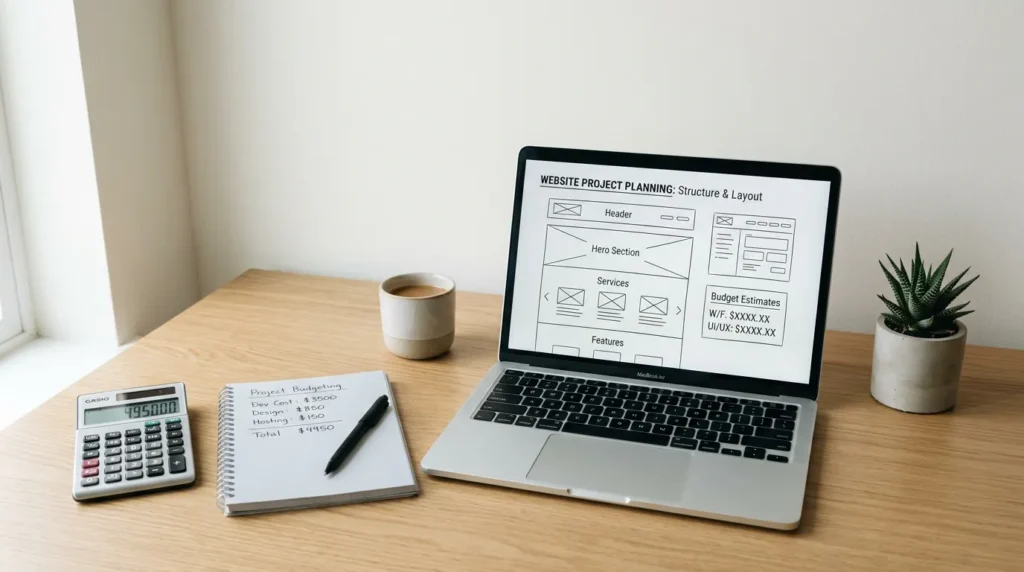
You’re looking for a website price. That makes sense. But a website isn’t a carton of milk with a barcode. What we keep seeing in practice is that the “price” is really a summary of three things: how much custom work you need, how quickly you want to go live, and how much work you want to leave to an agency, including marketing and sales readiness.
In the Netherlands, 2026 ranges are generally described as spanning from entry-level to full growth site budgets. Market sources, for example, say that websites in 2026 can start at a few hundred euros and rise to tens of thousands of euros, depending on size and customization. (websteen.nl) We use that as a guide, not as an exact forecast for your project.
What you can do instead (and where we help) is break the cost into work packages. Then the question becomes: “What exactly am I paying for?” and “Does this help with online marketing and online sales?”
When you compare quotes side by side, you often see the same words: design, development, content, SEO, hosting. But the actual content differs. That’s why we use a cost check based on the real building blocks.
Scope is usually the biggest price driver. Don’t just think about the number of pages. Think about the type of pages and features:
The more of these elements you want, the higher the development cost. But be careful: scope without a marketing and conversion setup can end up expensive without delivering returns.
Template websites are often cheaper and faster. Custom work costs more, but can be useful if you need to stand out in usability, content presentation, or conversion flows.
Market sources indicate that prices vary widely because a website is custom work, and agencies also work with hourly rates, with ranges depending on seniority and approach. (websteen.nl)
We usually recommend this practical choice: pick a base that can go live quickly, and reserve custom work for the exact places where your audience needs to click, understand, and decide.
Many quotes list “texts” as part of the project. In practice, you want to know what that means:
For online sales, this matters. Your website should not only attract visitors through Search Engine Optimization (SEO), but also make the step to an inquiry or appointment smooth.
Technology sounds dry, but it determines whether your online marketing efforts can actually pay off. You want your website to:
For SEO, we always use data from Google Search Console (GSC) to understand how often pages appear and how many clicks follow. Google explains how Search Console measures clicks and impressions in performance reports. (support.google.com)
Note: more traffic is not a guarantee of more leads. That’s why we connect SEO and conversion improvement, not just rankings.
A website is not “done” when it goes live. You usually need further development based on data and marketing goals.
Many providers mention service packages for maintenance or further development, and that often sits outside the build price. (dyjo.nl) That’s why your quote should also include a maintenance path: what is done, when, and what does it cost?
Okay, now for the part you came here for. Below you’ll see market ranges that agencies and knowledge bases in the Netherlands mention. Treat this as a budgeting guide, not a fixed price. Quotes can come in higher or lower depending on scope and quality requirements.
For a standard business site (think 5 to 10 pages), ranges are often mentioned at a few thousand euros. (airdigital.nl)
For more pages, multiple landing pages, and extra features, you’ll often move into a higher price bracket. (appset.nl)
If your website is set up from the start for Lead Generation with a measurement plan, smart routes, and follow-up logic, you’ll often see higher costs. Not because it is harder to build, but because it takes more design and optimization work.
In market indications, you’ll see that prices for professional sites can broadly reach the higher segment, for example when there is more customization or additional elements. (websteen.nl)
In e-commerce, the price structure shifts toward catalog management, product logic, integrations, and operational setup. Some sources mention ranges that are significantly higher when the project type becomes more complex. (appset.nl)
If e-commerce is your goal, we first look at what needs to happen from the moment someone shows product interest. Only then do we move to design and technology.
This is the part we often call “the real value check.” Because the cheapest website looks attractive until you realize you can’t steer with data, or your conversion flow doesn’t work properly.
For online sales, we don’t just want “more traffic.” We want more inquiries, quotes, or appointments. That’s why we define conversion goals in advance:
In practice, we agree on which metrics you want to see in your reporting, including Conversion Rate (CVR) at page or flow level.
Measurability is not a side issue. Without a measurement plan, optimization becomes guesswork.
For that, we use Google Search Console (GSC) among other tools for SEO insights. Google explains how Search Console uses clicks, impressions, and position information in performance reports. (support.google.com)
And for ad-driven acquisition (for example Search Engine Advertising), we want to connect conversions to campaign elements. That way, you know which pages and which offer really contribute to inquiries.
Many companies start with SEO because it seems like “free traffic.” But if you want appointments quickly, Search Engine Advertising (SEA) may be needed to accelerate demand. The combination does require discipline, otherwise you pay for traffic that does not convert.
If you want, also read this: SEO and SEA: differences, benefits, and when to use both. We use the same logic in website development: the website must be both SEO-friendly and strong enough for ad landing pages.
Not every inquiry is a real Sales Qualified Lead (SQL). That’s why we design your website so visitors “self-select” earlier. We do that with:
That’s often where more gain lies than in extra pages. And yes, sometimes that’s less sexy than a new design. But commercially, it wins more often.
A good quote for “having a website built” includes a next layer:
Also ask how they handle changes. For example: extra pages, extra integrations, or adjustments based on performance.
Take this list with you. Not to be distrustful, but to get to a solid decision faster.
If you are focused on online acquisition with campaigns, it also helps to understand how Ads and account logic work. Useful in that context: Ads and AdWords: Ads AdWords explained and used smartly.
If you take one step today, make it this one: request two quotes with the same scope. So the same page content, the same lead flow, and the same measurement plan. Then you compare apples with apples, not apples with pears.
After that, we do something we call “translating value.” We look at which elements directly contribute to online marketing and online sales optimization, for example:
Want to improve follow-up with email and automation too? That can have a big impact after launch. For example, read: Email marketing strategy: from list to conversion and Marketing and sales automation, from lead to reporting. (And yes, automation is only useful if it makes your lead flow smarter, not if it looks like a hobby project to your agency.)
And if you’re still deciding which partner fits: How to choose the best online marketing agency: do it the right way. We always look at execution, transparency, and how they measure what works.
In short: the cost of having a website built depends on scope, customization, content, and measurability, plus further development after launch. Use price ranges as a starting point, but decide based on a comparable quote, a clear lead flow, and a measurement plan that truly supports online sales.
If you want, you can share your current quote (or your brief). We’ll turn it into a score for scope, risks, and opportunities. No magic, just clarity.
Book a free strategy call and discover how many leads we can generate for your business. No obligations — just a concrete growth plan.
Book your free strategy call → Book your free strategy call — 30 min, no strings attached