

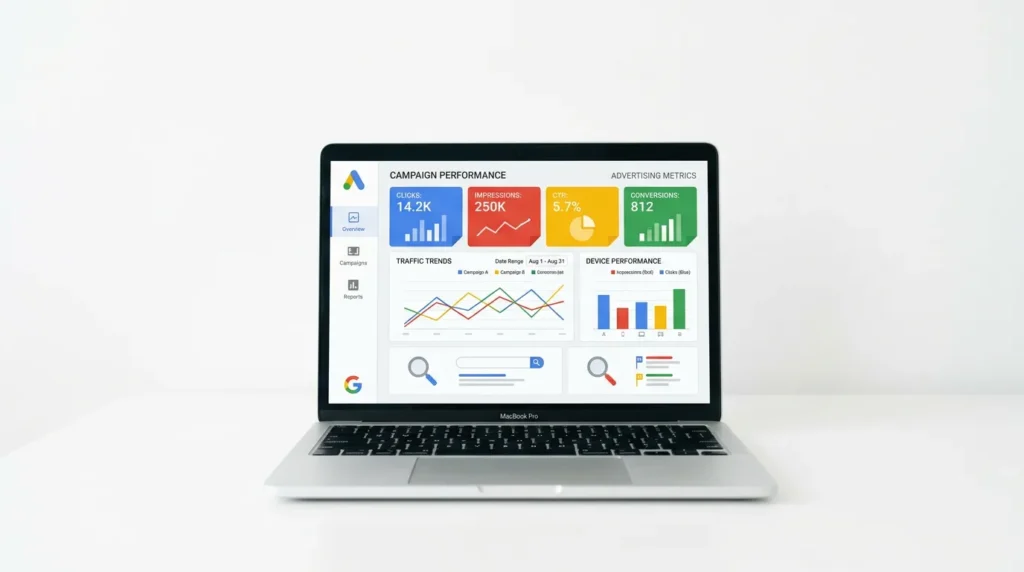
Imagine this: you switch on ads at the exact moment people are already searching for what you offer. That is the core of Google Ads. But in practice, I often see the same things go wrong: conversions aren’t measured properly, campaigns are too broad, the landing page and ad promise different things, and budgets disappear into “click leaks”.
In this article, we’ll walk you through an approach we’ve seen work across multiple accounts. Not with magic theory, but with decisions you can make today. We’ll explain what works, why it works, and what your next step should be. And yes, we’ll keep it honest: Google Ads is not a “turn it on and profit follows” button. It’s a system. A system you need to feed wisely.
What is Google Ads, and when is it really the right choice?
Google Ads is an advertising system that lets you show ads in search results and on other Google placements. Its value lies in intent. People are actively searching, or they’re already at a stage where they respond to relevant signals.
We mostly see Google Ads fit goals such as:
- Lead generation (for example requests, demos, quotes)
- E-commerce (purchases and product conversions)
- Website traffic with measurable results (not “we got lots of clicks”, but “we got results”)
But it’s also fair to name the limits. If your landing page is slow or doesn’t inspire trust, you’ll often pay more per click and optimization becomes harder. On top of that, a lot depends on your measurement setup. Without conversion tracking, you optimize toward a vague goal, and that feels like cooking without knowing whether you’ve added salt.
The choice between “more clicks” and “more results”
A common mistake is optimizing campaigns around click behavior. Clicks are not the same as value. That’s why we usually start with two questions:
- Which action on your website truly counts as success? (lead, purchase, or another conversion)
- How do we track quality, so we’re not just buying volume?
Building campaigns that don’t leak: structure, intent and message
Good Google Ads accounts don’t feel “complicated”. They feel logical. So we build structure first, then refinement.
Step 1: Build your campaign structure around intent
Use what you know about your market. If there are different types of searchers, we separate them. Think for example of:
- Searchers who already know what they want (product or service + context)
- Searchers who are still exploring (comparison, explanation, “what is”)
- Searchers with a problem (complaint or challenge, solution-related)
Why this works: your ad copy and your landing page can then match the visitor’s expectation much better. And Google explicitly says that landing page experience and relevance play a role in factors such as Quality Score. (support.google.com)
Step 2: Write ad copy as a promise your landing page can deliver on
Almost every conversion leak we see comes down to mismatch. The ad pulls in “A”, the landing page gives “B”. That can be because of different information, different product details, or an unclear call to action. The result is simple: visitors drop off, and Google “learns” from signals that do not represent your real goal.
Step 3: Make sure your display URL and landing page match
Google refers to rules around landing pages and destination requirements. One point you can act on immediately: the domain of the landing page and the display URL must match. (support.google.com) And more broadly, policy revolves around destination quality and user experience. (transparency.google)
Measuring conversions you can trust: the foundation for everything
If you want to get one thing right in Google Ads today, make it conversion tracking. Without reliable conversion data, you optimize on noise. With reliable data, you can steer bidding strategies and budgets as if you had a helmsman, not as if you were driving through fog by feel.
Which conversions count?
Work with conversions that truly represent your goal. Think of:
- Form submissions (with quality)
- Purchase transactions
- Appointment confirmations
- Important micro-conversions (only if they later correlate with real value)
Google explains that you have different ways to track conversions, and that conversion tracking helps you measure and optimize. (support.google.com)
Install the Google Tag, with attention to data quality
Google recommends using the Google tag for conversion tracking for more accurate measurement. (support.google.com) This is not “just technical tidiness”. Bad implementation means you miss conversions or count them twice, and that makes every optimization less reliable.
Next step: test your conversions like a QA specialist
We usually do this check before scaling budget:
- Test a full conversion flow (from click to success page or success event)
- Validate that the right conversion action is being counted
- Check whether your landing page and tracking introduce blockers (for example by loading scripts later)
Limits you need to accept: attribution and privacy rules change the way data comes in. That means you always need to keep looking at trends, not just one “perfect” scenario.
Bidding and budget planning: what to automate, and what not to
Automation in Google Ads is powerful, but not magical. We use it as an accelerator, not as a replacement for strategy.
Automatic bidding on conversions, with a goal
Google describes Smart Bidding as automated bidding strategies that optimize for conversions or conversion value, with “auction-time bidding”. (support.google.com) That matters: the system optimizes per auction, not just on an average.
If you are steering toward a goal, you want that goal to be sharp. For many accounts, we choose one of these directions:
- tCPA if you want to control cost per acquisition
- tROAS if you want to control revenue value per ad spend
Google explains how Target ROAS works and that it tries to keep conversion value per cost toward the target. (support.google.com)
Budget planning with Performance Planner
Sometimes it’s hard to know what happens when you raise budget or tighten bidding goals. That’s what Performance Planner is for. Google positions it as a tool you can use to plan and see how bidding and budget changes may affect metrics. (support.google.com)
Important detail: Performance Planner does not make changes in your account until you change them yourself. (support.google.com) That makes it a safe framework for internal alignment.
Next step: create a budget plan per campaign group
We usually advise breaking your budget question into parts:
- Campaign groups with proven conversion performance
- Campaign groups that are still learning (limited data)
- New expansions (with their own goal and realistic expectations)
Trade-off you have to accept: if you raise budget too quickly, the system may need to learn again first. Then you don’t always get immediate “linear” growth.
Quality, landing page and policy: where campaigns win or lose
You can have a perfect account, but if your user experience is off, you pay for it twice. Google explicitly says that landing page experience and relevance are part of the factors that influence Quality Score, for example. (support.google.com)
What works on your landing page (practical, no theory)
We usually look at five points:
- Relevance: does the headline match the ad promise?
- Speed: does it load fast enough, especially on mobile?
- Clarity: within 5 to 10 seconds, do you understand what’s being offered?
- Friction: is the form unnecessarily long or confusing?
- Trust: proof, explanation, terms, and contact options
Ad policies, so you don’t get “surprised”
Google has policies and enforcement frameworks for Google Ads. It’s not a sexy topic, but it saves you pain. For example, Google mentions rules around destination requirements, such as the display URL and landing page needing to support each other, and that some restrictions relate to visibility or user experience. (transparency.google)
Next step: build a monthly quality scan into your routine
If we give customers one routine, it’s this: every month you check:
- Main search terms, with emphasis on intent and quality
- CTR and conversion rate per campaign group
- Landing page updates, and whether they still match the ad copy
- Policy issues or warnings in your account
This is boring. That is exactly why it works.
Optimizing without breaking things: a practical test-and-improve cycle
Many teams optimize by changing everything every day. Then it feels like driving a car while constantly grabbing the wheel again. Smart optimization means: small changes, measurable impact, and enough data to draw conclusions.
What we optimize first
Here is our order, because it usually gives the biggest leverage:
- Conversion tracking (only do this if you still don’t trust it 100 percent)
- Campaign intent and ad load (alignment between search term, ad and landing page)
- Bidding goal and budget boundaries (so automation steers toward a clear goal)
- Landing page improvements (more conversions per visit)
What to watch in data and performance
Google itself says that recommendations and optimizations can be limited for campaigns with few conversions, because performance can be unpredictable. (support.google.com) This is an important insight. If you have little data, don’t make micro-level changes. First build toward minimum stable signals.
Next step: choose one KPI per campaign group
We ask you to choose one primary KPI per campaign group. For lead campaigns, that’s often cost per lead or conversion quality. For e-commerce, that’s often tROAS or a target around conversion value.
If you try to steer too many KPIs at once, you end up with discussions instead of decisions. And that is what marketing budget is for, not endless dashboards.
Frequently asked questions about Google Ads (short, but sharp)
How do I know which conversions I should measure?
Choose conversions that truly move your business forward, and that you can validate. Google explains that there are different ways to track conversions. (support.google.com) If you measure micro-conversions, make sure you can later see whether they relate to real value.
Why does Google say landing page experience matters?
Google links landing page experience to factors that influence Quality Score, among other things. (support.google.com) The idea: a click should not feel like a detour.
Can I use budget planning and forecasts without automatic changes?
Yes. Performance Planner helps you create plans and forecasts, but no changes are applied automatically. (support.google.com)
Do I need to automate everything?
Not in our approach. We automate where the data allows it, and we keep watch where strategy is needed. Smart bidding works based on conversions. Smart Bidding uses Google AI to optimize toward conversions or conversion value per auction. (support.google.com)
Make Google Ads part of your overall growth, not a standalone experiment
You can see Google Ads as the part of your marketing mix that turns intent into results. But it works best when it comes together with what is already there: content, SEO and conversion optimization.
If you want to broaden into strategy, execution and growth, then this fits well with our explanation of SEO in Practice: Strategy, Execution and Growth. And if you look at broader search ecosystems and AI-driven discovery, then GEO (Generative Engine Optimization): Hub for AI Search Engines can help you reuse your learnings.
In addition, I often see that lead follow-up is just as important as the ad itself. That is where Email Marketing: Complete Strategy Guide (B2B and B2C) helps you make your conversion path logical.
If your team is looking for growth and wants to make processes more efficient, Automating: Making Processes More Efficient, Hub Brief often fits well with the way you organize bidding and testing cycles.
Conclusion: your next step with Google Ads
If we put everything together, the core of Google Ads is simple: you pay for attention, but you win on relevance and measurability. Once you measure conversions reliably, structure campaigns logically around intent, and set your bidding goal and budget boundaries smartly, optimization becomes a process instead of a gamble.
Our suggested next step for you is:
- Check whether your conversion tracking is correct, and test one complete conversion flow.
- Create or restructure campaign groups around intent, so ad and landing page carry the same promise.
- Use Performance Planner to discuss budget impact and adjustments before you scale. (support.google.com)
- Then optimize in small steps, with one primary KPI per campaign group.
And if you notice you want to roll out too quickly without the foundation in place, that is not “your fault”. It’s simply how PPC works. We just make it more honest, more measurable and easier to manage.
A small bonus with a bit of realism: if you can’t trust your conversions right now, it’s hard to choose “the best bidding strategy”. So start with measurement and consistency. Only then optimize. That is less exciting than dashboards, but it often saves months of wasted ad spend.
Finally, if you want help with setup, execution or making a plan, you can also look at Hiring an SEO Specialist: What to Watch For and apply that mindset to Google Ads. There too, it’s about the same things: clear goals, measurability and realistic execution. And for a broader growth focus with attention to 2026 trends, SEO in 2026: Practical Guide for Growth with Focus is a strong addition to your strategic framework.
Note: this article is a strategy and execution guide. It does not offer guarantees about results or rankings. Performance in Google Ads always depends on your market, competition, landing page and data quality.
