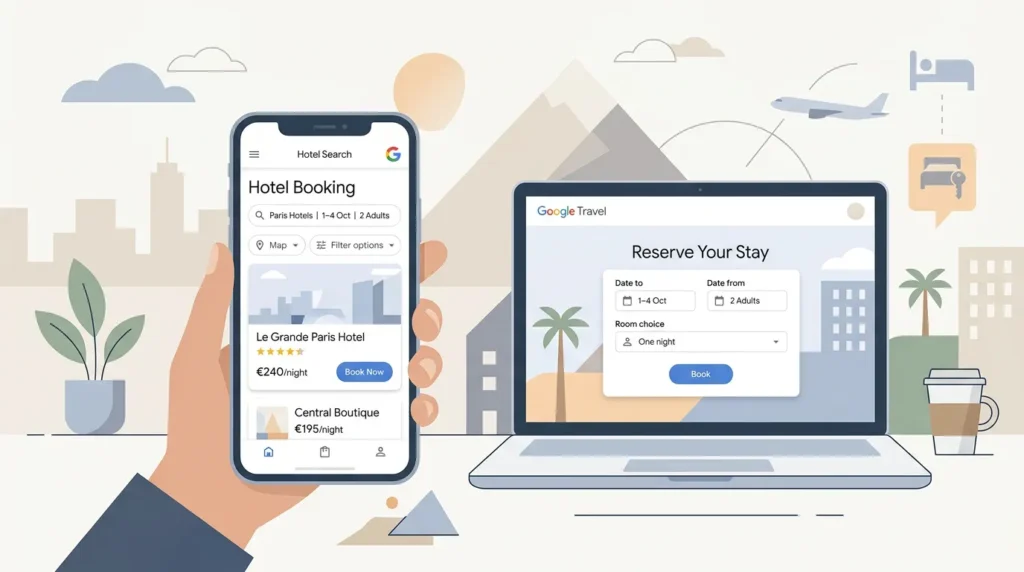
Google Hotel Ads: Booking Hotels via Google. A Practical Guide
Written byDaniel van HekSearch Clicks·August 13, 2026
11 min read
All right, let’s keep it professional and practical. Google Hotel Ads is not a “enter a postal code and hope it works” channel. It’s a system where Google can show real-time availability and prices for specific travel dates, and you need to make sure your booking data and tracking are in order. If that works, it becomes a strong machine for direct bookings. If it doesn’t, you get neatly paid clicks and less neatly frustrated reports. (Been there.)
In this article, we’ll walk you through it step by step. We explain how to set things up sensibly, which settings make the difference, and what the next step is once you’re live. We focus on online marketing and online sales optimization for hotels and accommodations.
What are Google Hotel Ads, and why are price and availability so important?
Google Hotel Ads uses a hotel feed and connections so Google can show real-time information during searches, such as prices and availability for specific travel dates. That’s exactly why this channel works differently from “normal” Search campaigns. You’re not only advertising on keywords. You’re also providing the right inventory and pricing logic for the dates the guest chooses.
Google states that Hotel Ads work with a hotel campaign in Google Ads and that you define the campaign settings such as budget and bidding strategy, linked to a Hotel Ads Center account ID. (developers.google.com)
Why you should focus on this
Relevance by date: a guest searches “Friday to Sunday” or “weekend in September”. If your price and availability aren’t right for those dates, interest won’t turn into a booking.
Competition in the auction: Google states that ranking depends on bids and competition. If your bid isn’t competitive enough, your ad may rank lower or may not appear at all. (support.google.com)
Measurement is control: once conversion measurement (booking or a relevant travel conversion) is set up properly, Google can optimize for valuable actions. (support.google.com)
The basics you need to get right first (because otherwise you’re optimizing on sand)
You can build very polished campaigns. But if these three foundations aren’t right, optimization gets difficult. We call them “foundations” on purpose, because in practice you almost always get the time back you invest in them.
1) Set up the hotel campaign in Google Ads properly (structure that makes sense)
Google Hotel Ads requires the right campaign level and connection. In Google Ads API documentation, Hotel Ads are described as a set of tasks that starts with creating a Hotel campaign, with budget and bidding strategy and a Hotel Ads Center account ID. (developers.google.com)
Practical advice
Don’t start with 30 variations right away. Start with a logical set of properties and room types that you can actually control.
Segmentation is good, but not at the expense of data. Too much splitting gives you too few signals per segment.
2) Measure conversions that match bookings
This is the biggest difference between “we see traffic” and “we optimize for bookings”. Google describes that conversion measurement helps you understand how effectively ads lead to valuable actions after interaction, such as bookings. (business.google.com)
Google also states that for Hotel ads you set up conversion measurement, and that Google booked hotel data is used to enable campaign performance tracking. (support.google.com)
What you need to do concretely
Define what a “successful action” is for you. Is it a confirmed booking, or another travel conversion? We recommend measuring as close as possible to the actual booking, because otherwise optimization drifts away from your business goal.
Make sure your website and tracking setup are consistent with the hotel booking flow. Google also warns against removing or moving conversion tracking code during an active campaign. (support.google.com)
Use a test period and check whether conversions in Google Ads match your booking admin. Not 100 percent by definition, but close and without “structural gaps”.
3) Understand commissions and the feedback loop (so you’re not surprised)
Hotel Ads can work with commissions per stay, depending on how your system is set up. Google documents how commissions (per stay) bidding works, including the importance of status updates and timing toward billing. (support.google.com)
Why this matters for optimization
If booking statuses are fed back later or incompletely, the bidding model gets less timely feedback.
That leads to “odd” performance patterns you won’t fix by simply changing your budget.
Campaign setup for Google Hotel Ads: what works in practice
Your goal is clear: more direct bookings at an acceptable cost per action. But your tactic has to fit your operation: seasonal peaks, minimum rates, last-minute dynamics and available inventory.
Start with property and date relevance, not random search terms
Google Hotel Ads is primarily driven by dates and inventory. That means your focus is on:
Which properties you offer for which markets and periods.
How your prices behave in the feed compared with availability.
Whether your offer is attractive enough for the intent the guest has at that moment.
Bidding strategy: steer with limits, not emotion
I’ll be honest: bidding in hotel advertising isn’t an exact rulebook. But there is a healthy way to steer.
Use bidding strategy settings that fit your inventory and margin. Google describes bidding strategy as part of the hotel campaign setup. (developers.google.com)
Work with budget limits so you don’t end up in an auction where you only win on volume and lose on margin.
Ad group choices and ad position: understand what you influence
Google also describes ad group options within Hotel Ads, and in the broader travel ecosystem you can, for example, see Travel Promotion Ads in parts of Google Hotel Search and Google Maps. (support.google.com)
For you, that means: don’t just look at “did the campaign run”, but also at where the guest enters and how that affects conversions. Not every click is equal, and you only see that once tracking and reporting are right.
Flywheel: combine Hotel Ads with a strong landing and booking experience
Even if Google matches you well, a slow or confusing booking flow can destroy conversions. Think about:
Speed and mobile user experience.
Clear price and cancellation terms.
A direct path to booking, without unnecessary detours.
Measurement and optimization: from data to better bookings
Now comes the part where many hotel accounts accidentally box themselves in. They optimize for what’s visible, not for what’s valuable.
Choose KPIs that really steer bookings
You have a few KPIs you should keep checking side by side. Which ones you use depends on your definition of success.
Cost per Acquisition or Cost per Action (CPA): specify here what “action” means, for example confirmed booking. (So CPA is not one universal number.)
Conversion Rate (CVR): bookings divided by relevant sessions that are actually in the same intent.
Return on Ad Spend (ROAS): use this if you can connect actual booking value to attribution.
Click-Through Rate (CTR): useful for creative and matching checks, but not as the end goal.
Google describes in general terms that conversion measurement helps you see which actions after ad interaction are valuable. (business.google.com)
Attribution and conversion windows: accept the limits, and design around them
Hotel intent often has a longer timeline, especially for weekend trips and multi-day holidays. That’s why attribution isn’t perfect. Not because nobody is doing it properly, but because user path behavior is complex.
Practical trade-off
You can optimize based on the data the platform sees.
You can report based on bookings in your own systems.
The trick is to bring those two as close together as possible, with consistent conversion measurement.
Optimizations you can already make next week
This is where your team moves fast without chaos.
Check conversion status and data quality: check whether bookings flow through properly and whether your conversion measurement stays active. Google advises not to move or remove conversion tracking during the campaign. (support.google.com)
Analyze by property and period: seasonal demand varies. What works in peak season is not automatically the same in spring or autumn.
Reassess your price and availability logic: if your CVR lags, it’s often not “the ad copy”, but the match between intent and offer (price per date, availability, terms).
Work with controlled experiments: change one important factor at a time (for example bidding strategy or budget limits), so you understand the effect.
If you also want to translate this into broader full-funnel online marketing, you can read this targeted guide: Inbound Marketeer: Role, Skills and Responsibilities, especially if you also need to feed intent through content or remarketing.
Common mistakes with Google Hotel Ads and how to avoid them smartly
Let’s be dry but honest. There are a few mistakes I see most often with hotels that are just starting or reorganizing internally.
Mistake 1: Measuring as if it were a normal website conversion
Hotel conversions are specific. Google describes conversion measurement for Hotel ads, including setup and implementation steps and the importance of correct tracking. (support.google.com)
Fix: validate your definition of “acquisition” against your booking admin and make the process repeatable.
Mistake 2: Optimizing on visible click metrics
CTR and click volume can rise while bookings lag behind. That happens because intent and offer can mismatch. Then you’re steering on the wrong thing.
Fix: always look at CVR and CPA together with CTR, and only draw conclusions once your conversions are stable.
Mistake 3: Splitting campaigns or ad groups too aggressively
If you create too many segments, the data per segment becomes too small. Then the system learns less, and your reporting starts to fluctuate more than it guides you.
Fix: start with a simple design, optimize it, and only add segmentation later when you have enough conversion data.
Mistake 4: Underestimating commission rules
Google documents how commissions per stay bidding works and emphasizes reconciliation and timely status updates for feedback toward bidding and billing. (support.google.com)
Fix: create an internal monthly reconciliation checklist so you don’t end up with overdue corrections.
The next step: a concrete 7-day plan for your Google Hotel Ads
If you’re already live today, or if you’re almost live, use this as your roadmap. We’re keeping it intentionally practical so you don’t spend another three weeks “researching”.
Day 1: Lock down the measurement definition
Write down what your “acquisition” is in Google Ads, meaning whether it’s Cost per Acquisition or Cost per Action, and what the action actually means.
Check whether conversion measurement for Hotel ads is set up correctly. (support.google.com)
Day 2: Check data quality
Compare a small period with your own booking admin.
Check whether conversions haven’t “stalled”. Google advises not to move tracking during the campaign. (support.google.com)
Day 3: Review the campaign structure
Are properties grouped in a logical way?
Is there enough budget to win the auction, not just to “be on”?
Day 4: Tune bidding and budget limits intelligently
Choose a bidding strategy that fits your margins and inventory logic.
Remember: if your bid isn’t competitive, you can rank lower or not appear. (support.google.com)
Day 5: Optimize the booking flow where it hurts
Mobile first, speed and clarity.
Price and terms clearly visible, so the guest doesn’t drop off halfway through.
Day 6: KPI dashboard for hotel sales
Record your KPIs side by side: CPA, CVR, ROAS (if possible), and CTR as diagnostics.
Day 7: First experiment round
Make one change, measure the effect, and write down the lesson. That way we build improvement week by week instead of random tweaks.
In conclusion: Google Hotel Ads works as long as you treat it like a sales machine
Google Hotel Ads is strong when you have three things in order: real-time availability is correct, conversion measurement captures what matters to you, and you optimize on KPIs that belong to bookings. (business.google.com)
So our recommendation is simple. Tighten up your foundations first, then run a controlled optimization round, and turn “data” into a real decision-maker. Not to fill your calendar, but to make your margin and availability perform better.
And yes, sometimes it’s work. But that’s the point of marketing, isn’t it? Someone has to do the details, otherwise the market will do them for you. Usually in a way you won’t appreciate.
Book your free strategy call — 30 min, no strings attached
Cookies on this site
We use analytics cookies to see how the site is used. They are only placed if you agree. Refusing costs you nothing — the site works exactly the same. Privacy statement