
 Written by
Daniel van Hek
Search Clicks·August 18, 2026
11 min read
Written by
Daniel van Hek
Search Clicks·August 18, 2026
11 min read
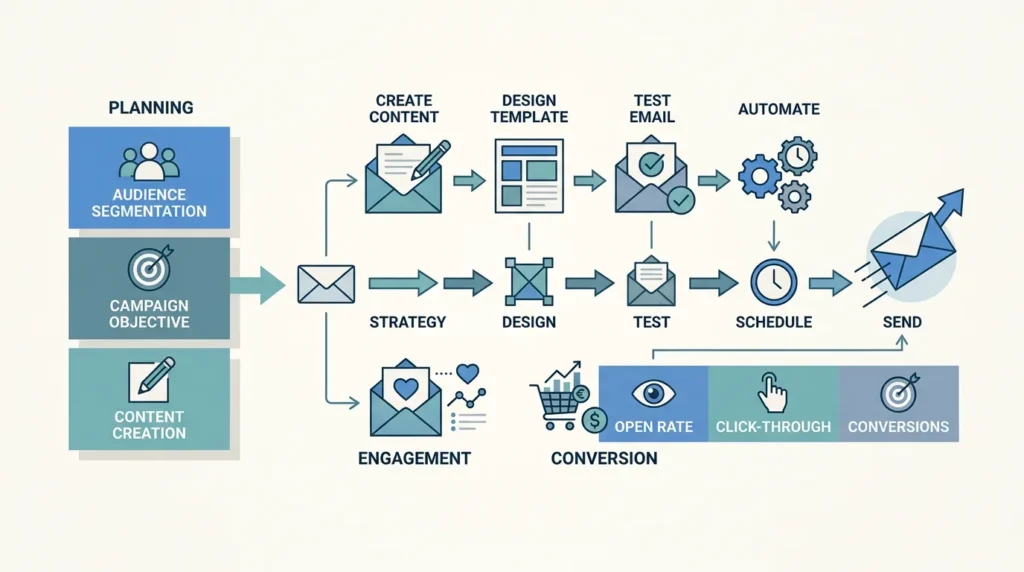
Grab a cup of coffee. Let’s be honest: an email marketing strategy is only truly valuable if it affects your pipeline. Not because we want “pretty campaigns.” But because the right message at the right time reaches the right people, moves them forward, and saves your internal team time.
In this article, I’ll give you a strategy we use in practice, with a clear line from planning to execution. You’ll get segmentation that makes sense, personalization that doesn’t get cringe, deliverability that doesn’t get in the way, and a measurement plan that helps you make decisions. Short, concrete, and without marketing jargon for the sake of it.
Most email marketing teams start with topics, designers, and timing. That’s understandable. It feels productive. But strategy starts before that. We always begin with three blocks:
Choose one primary goal per campaign. Think of:
Why this works: your subject line, CTA (Call to Action), and message structure stay consistent. If your goal is “more sales,” you’ll automatically end up with a mix of messages, and therefore no clear conversion path.
Use your ICP (Ideal Customer Profile) as a starting point. And make it more specific than just an industry. Think of criteria you can capture in your data:
Note: if your audience data isn’t reliable, personalization quickly turns into noise. In that case, segmentation based on behavior is often better than segmentation based on vague characteristics.
For each offer, write a message angle you can repeat across multiple emails. Example structure (not copy-paste text, but a thinking framework):
This prevents every campaign from having to be “different” to stand out. Instead, you build recognition, and recognition lowers friction.
Segmentation is the engine. Personalization is the steering wheel. But if you can’t explain why your segments exist, you’ll eventually be measuring by gut feeling. That rarely works.
We usually build segments based on one of these three logics:
Why this works: your message aligns with what someone already knows or still doesn’t know. That lowers the mental load in their head and increases the chance they’ll click through to an action that fits their situation.
Don’t personalize only the name. That’s often obvious and thin. We use personalization for:
Practical rule: personalization should change something about the value proposition, not just the tone.
Trade-off: the finer your segments, the higher the content pressure and the harder it becomes to test. So you don’t want 30 segments just because you can. You want 5 to 10 segments you can support and measure. Then you optimize.
You can have the best message. If your deliverability is poor, you lose impact. You also end up paying indirectly more for ad spend, because you create fewer organic and email-driven touchpoints.
Google recommends that senders set up SPF, DKIM, and DMARC for better deliverability. (support.google.com)
What that means in practice:
If you don’t have this properly arranged, sometimes “legitimate” emails still land less well or even get rejected. And then you end up trying to fix it afterwards with subject lines. That’s too late.
ISPs look at behavior and reputation. Mailchimp, for example, explains that managing your audience and engagement helps maintain deliverability, with attention to factors like unwanted behavior and unsubscribes. (mailchimp.com)
In practice, we use this kind of list discipline:
Important: reactivation is not a magic trick. If someone never responds, you need to accept that and adjust your volume.
For commercial email in the US, the CAN-SPAM Act applies. The FTC emphasizes, among other things, that your message includes clear identification, must provide an opt-out mechanism, and must also include a valid physical postal address. (ftc.gov)
Practical point: add a working unsubscribe link in your footer and make sure your unsubscribes are handled properly within the timeframe the law requires. (We keep this technically linked to your CRM and your email tool, so it doesn’t become “manual work.”)
Now we’re getting to the real part. Email marketing strategy usually doesn’t fail because of creativity. It fails because of structure, rhythm, and testing discipline. So we build a framework: fixed cadence, clear variables, and a test you can win.
We often work with 3 layers of emails:
Why this works: you combine predictability (lifecycle and batch) with relevance (triggers). And you reduce the number of “random actions” that no one can tie back to impact.
We use a simple flow:
Note: emails that are too long seem informative, but they often increase the chance that someone misses your core point. In online sales, you want the reader to quickly understand what you add to their situation.
Test one variable at a time whenever possible. Otherwise, you won’t know what the real cause was.
Practical test categories:
Don’t measure opens only. Opens are often a less reliable KPI for intent. Prefer clicks to pages that contribute to online sales, and conversion on your landing page.
If you use automation, do it with purpose and control. Automation should:
And stay human where it matters. Automated systems should not make budget decisions or contractual commitments. In email, that is less direct, but governance in your processes remains important.
Your strategy isn’t complete until it can be managed. That’s why we create a measurement plan that supports your weekly rhythm.
Use KPIs that match your goal:
If you use email alongside Search Engine Optimization and Search Engine Advertising, label which channel led to which step. That prevents channel noise.
For online marketing and sales optimization, you want reliable tracking. Without getting too technical:
If you work with Google Analytics 4, also check your event naming and conversion configuration. (I’m saying this as someone who has seen it happen more than once: a great campaign, but the conversion event wasn’t marked as a conversion.)
Make a report of no more than one A4 page per week. Include:
This makes it a control tool. Not a museum piece.
We keep seeing the same patterns. Here are the most costly ones, along with a grounded correction.
Result: everyone gets a kind-of-vague message. Clicks and conversion drop.
Fix: start with 5 segments based on intent or funnel stage. Expand once you know the data is correct.
Result: it feels automated. People disengage.
Fix: personalize the value, for example which part of your offer is relevant to their situation.
Result: you optimize for something that doesn’t always reflect intent.
Fix: optimize for CTR to the right step and for CVR on your landing page.
Result: legal and reputation risks, plus extra escalation in deliverability.
Fix: build compliance into your templates. CAN-SPAM requires, among other things, an opt-out option and a valid physical postal address. (ftc.gov)
Result: you don’t learn which messaging really addresses objections in conversations.
Fix: agree on what sales feeds back to marketing (for example, the top 3 objections per segment). Then adapt your email content accordingly.
All right, enough theory. This is a plan your team can execute. Not perfect, but realistic.
If you want to connect this more broadly to your overall online sales and content approach, it also fits well with an Inbound Marketing Strategy: From Awareness to Conversion. Email then isn’t a separate channel, but a link in your journey.
And if you need an overarching approach from planning to execution, then the Email Marketing: Complete Strategy Guide is a logical next step.
A strong plan doesn’t feel like a standalone campaign. It feels like a system you can improve. You start with clear goals and a sharp offer. Then you build segments you can justify. You get deliverability in order with SPF, DKIM, and DMARC, as Google recommends. (support.google.com) You keep compliance standard in your templates. (ftc.gov)
After that, you apply personalization to value, not just to the name. You test one thing at a time. You measure with KPIs that actually contribute to online sales, with attention to CVR and click behavior. And you build a feedback loop between marketing and sales.
Next step: choose one lifecycle route for one segment, create the trigger that fits the signal, and launch your first test within 7 days. That gives you a learning experience quickly. And honestly, learning fast is better than arguing for a long time about the perfect subject line.
Book a free strategy call and discover how many leads we can generate for your business. No obligations — just a concrete growth plan.
Book your free strategy call → Book your free strategy call — 30 min, no strings attached