

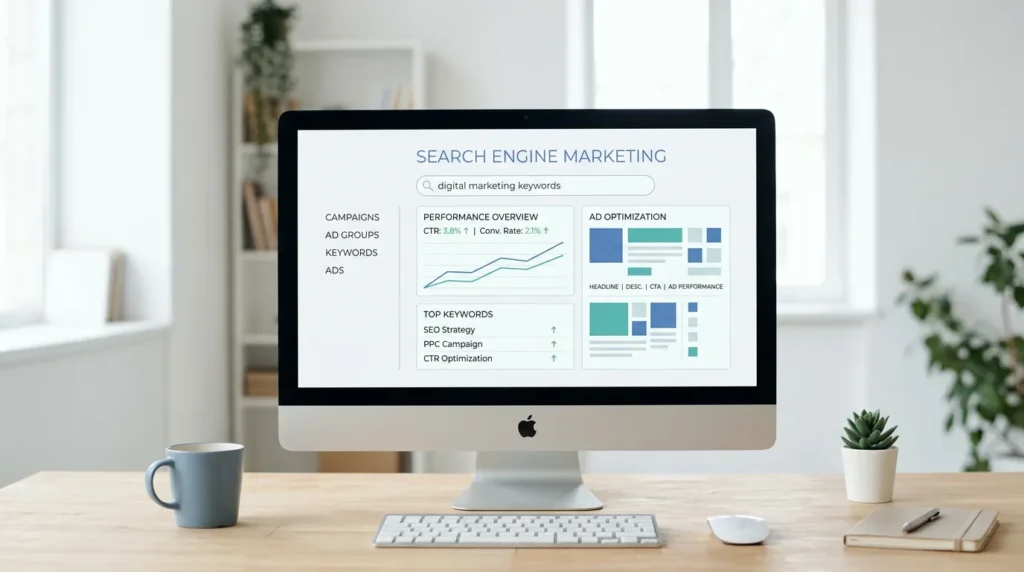
Imagine this: you want to attract new customers via Google Ads, but you don’t want to guess. You want your Search campaigns to be built logically, you want to know what triggers you in the search results, and you want to make your conversions truly measurable. That is exactly what “google ads sea” is about in practice: Search Engine Advertising that you can steer based on behavior, not gut feeling.
We’re going to tackle this together the way we do on client projects too. Short, concrete, and with trade-offs so you don’t get any surprises later. And yes, we’ll keep it scannable. If you only have 30 seconds later, you should still know what you need to do tomorrow.
What “google ads sea” really means, and why it feels different from SEO
With Search Engine Advertising (SEA), you buy visibility on keywords. For every search query, the system decides whether your ad “qualifies.” That depends on your targeting, your bidding logic, and also on your ad and landing page eligibility. In Google Ads, that matching is explained based on keyword matching and different eligibility checks. (support.google.com)
Where Search Engine Optimization (SEO) works through long-term discoverability, SEA works through direct answer delivery. That often feels faster, and that makes SEA attractive. But it takes discipline:
- You need to know which searches you do want and which ones you should exclude.
- Your conversion tracking has to be right, otherwise you optimize noise.
- Your ads and landing page need to serve the same intent.
Campaign structure: build Search campaigns around intent, not gut feeling
If you want to avoid SEA chaos, start with structure. On paper, that sounds boring. In practice, it saves weeks of debugging.
1) Segment by intent and offer
Your goal: send the same search intent to the same message and the same landing page. That often means dividing campaigns by:
- Core service or product (what people search for directly)
- Comparative intent (people making choices)
- Problem intent (people looking for a solution)
Within each campaign, use ad groups for an even more specific “cluster” of intent. That makes optimization easier later.
2) Keyword match types, clear for yourself (and for your team)
Keyword match types determine how closely a search query has to resemble your keyword. Google describes that behavior through broad, phrase, and exact match and how syntax and meaning play a role. (support.google.com)
Practical guideline (recommendation, not a rule):
- Exact match when your intent is very tight and your margins are small enough to keep your budget on “right.”
- Phrase match when you want to cover the core while still catching variations.
- Broad match if you still need market room to collect data, but then with an active policy on search terms and exclusions.
Trade-off: broad match often delivers more volume, but it requires extra attention in the Search Terms analyses. Otherwise you pay for search behavior that does not lead to your customer base.
3) Ad formats that help with variation
Responsive Search Ads work asset-based. Google provides best practices for building these ads, such as adding multiple unique assets and building a varied asset library. (support.google.com)
Why this works: you create a greater chance that your message matches the query and the user’s context. We often see this help clickability and relevance, provided your landing page is coherent.
Creatives and landing pages: don’t let intent stop at the click
You can write a perfect ad. If the landing page doesn’t match, SEA gets expensive. The click is not the endpoint. Conversion is the endpoint.
Ad copy that sells without shouting
Use one simple rule: one primary proposition per ad group. Don’t use your keywords as “ghost words,” but as substantive support for what you claim.
A good set for your Responsive Search Ads usually consists of:
- Headlines that name the problem or promise the outcome
- Headlines that specify who it is for (ICP, ideal customer profile)
- Description with concrete removal of friction (process, turnaround time, working method)
Landing page: make the next step obvious
We do this practically. Your landing page has only one job: guide the visitor to the desired action. That sounds cliché, but in SEA it is often the difference between a campaign that can scale and one that stays stuck.
Checks we almost always include:
- Recognition: is your proposition clearly at the top within 5 seconds?
- Proof: do you have examples, features, working method, or results (within ethical and factual boundaries)?
- Design: is the page scannable, with short sections and a clear CTA (call to action)?
- Flow: is the next step logical, with as little friction as possible?
Tracking setup: conversions are your compass
If you measure conversions incorrectly, you optimize the wrong thing. And then your budget turns into a lottery.
Google Ads uses Cost per action (CPA) as the metric for costs around conversions. Google defines CPA as the total cost of receiving the required actions through customers. (support.google.com) And Google also describes the calculation of average CPA, based on total cost divided by the number of conversions. (support.google.com)
Note: in your organization, CPA may mean “Cost per Acquisition” or “Cost per Action.” Here, we mean: CPA as cost per defined conversion action. So make sure your conversion actions are truly commerce-worthy.
Bidding and optimization: steer on data, not on hope
Now that structure and creatives are in order, we get to the part where many teams get stuck: bidding and optimization.
What you need to choose first: optimization goal and conversions
Before you think about bidding, you need answers to:
- Which conversion really counts as success for your business?
- Do you have enough conversion data to let bidding logic learn?
- Is your conversion “honest,” or are you also measuring micro-actions that do not lead to sales?
Practical tip: if you have multiple conversion actions, work with logical levels. A micro-action can be useful for early optimization, but for scaling you ultimately want to steer on commerce value. That is often where we see the most gain.
How to make SEA scalable, step by step
This is the approach we prefer to follow in the first 2 to 6 weeks (depending on your conversion volume):
- Week 1, sharpen things up: dig through search terms, add negative keywords, and flag landing page issues.
- Week 2, asset strength: increase variation in Responsive Search Ads, add assets, and revise copy based on query intent.
- Week 3 to 4, reclassify intent: if certain clusters consistently do not convert, move traffic to other ad groups or adjust your match types.
- Week 5 to 6, scale with control: only scale where your conversion quality is okay, meaning where your CPA stays within acceptable ranges.
Trade-off: scaling faster without protecting conversion quality can inflate your CPA. It feels like you’re “growing,” but you’re mainly building costs.
CTR is not the end goal, but it is a signal
CTR (Click-Through Rate) says something about ad relevance. But it does not automatically say anything about conversion. Treat it as a signal, not a scorecard for success.
In practice, we usually work in two rounds: first we improve relevance, then we improve the landing page. That prevents your team from optimizing for CTR while conversion stays flat.
Reporting and KPIs: what you need to monitor (and what you can ignore)
Reporting is where good SEA teams stand out. Not because they have more numbers, but because they ask the right questions.
Which KPI (Key Performance Indicator) you need
We usually choose KPI’s in a logical chain:
- CTR: ad relevance per intent cluster
- Conversions: output from campaign to defined action
- CPA: cost per conversion action
- CVR: conversion at landing page level, where possible
Note: this depends on your tracking level. Ideally, you connect campaign to landing page and to CRM follow-up, so you know whether leads are actually sales-worthy. If you only measure “form submits,” you can still be profitable, but you may not see what happens after the submit.
Next step: we make your SEA measurable end-to-end
If we have to choose one concrete next step, it is this: set up your conversion tracking and landing page metrics properly, so your CPA is truly about commerce value. Google explains what CPA is and how it is calculated, but the interpretation is up to you. (support.google.com)
Want extra context on how to connect this to broader online success? Here are a few relevant internal pieces that often help with the connection between channels:
- Sea Google Ads: How to Make Search Campaigns Sharp
- Seo online: from visibility to measurable leads
- Web development that sells: from website to leads
Connecting lead generation to SEA: from click to appointment to customer
SEA is often the starting point of your lead generation, but your commercial machine only really starts when the follow-up is right. We see this in both B2B and B2C: the quality of your follow-up determines whether SEA “works” or leaks.
What you define as a lead, and what you do not define
In lead generation, we mean a person or organization with genuine commercial interest. A website visitor is therefore not a lead. A request, contact moment, or a recognizable commercial enquiry usually is.
That is why we ideally connect SEA to CRM and to the lead qualification process. If you do that, your optimization gets better. Then you are not steering on “pretty clicks,” but on real commercial intent.
B2B and B2C often require a different flow
B2B often requires more context and a longer route to a Sales Qualified Lead. B2C can be faster, but often requires conversion through speed and ease of use.
If you want to go deeper into these differences, these internal articles fit your execution well:
- B2B lead generation: Attracting business customers, Brief
- B2C lead generation: Converting consumers, step by step
- Outbound Marketing: Proactively approaching customers
Automation that really helps, without unnecessary risks
Automation here means: software and workflows that optimize your online marketing and sales, for example for lead capture, support for lead qualification, follow-ups, appointment scheduling, and CRM synchronization. Not to reprogram campaigns without human oversight.
A realistic use case: you connect an SEA conversion to a follow-up flow, with wait times that match your sales cycle. That increases the chance that your leads get contacted in time. Time is almost always a factor here. But again, we do not promise “automatic” success. We design processes that perform better because they are faster and more consistent.
If you want to think this through properly from both a technical and process perspective, also look at:
- OpenAI API for marketing, sales and lead generation
- Online lead generation: use digital channels more effectively
Quick checklist, so you can take action today
If you want to work on your SEA tomorrow, use this checklist. Short, but effective.
- Have you divided campaigns by intent clusters, not by separate keywords?
- Are you using match types consciously, with negative keywords and search terms review as a fixed routine?
- Are your Responsive Search Ads built with enough variation in assets, as Google recommends?
- Is your landing page consistent with the ad intent, with a clear CTA and a low-friction form or follow-up mechanism?
- Are you measuring conversions correctly, and are you steering on CPA as the cost per defined action?
Conclusion: this is how you make “google ads sea” predictable and controllable
SEA does not have to be a black box. If you structure your Search campaigns intelligently around intent, manage your match types consciously, and make your ads and landing pages carry the same message, you get a system you can improve instead of only “monitor.”
Our most important practical next step is end-to-end measurability: make sure your conversions and CPA (cost per defined action) are correct, so your optimization is truly about success. Google describes CPA and average CPA through conversions and costs, but you translate that into what counts as a real outcome for your business. (support.google.com)
And if you then notice that SEA still isn’t scaling, that is usually not “bad luck.” It is almost always a structure, intent, or tracking problem. Fix that, and you get control back. Even if it is only that, you know why your budget is moving. That alone feels surprisingly reassuring, like a good coffee on Sunday evening.
