

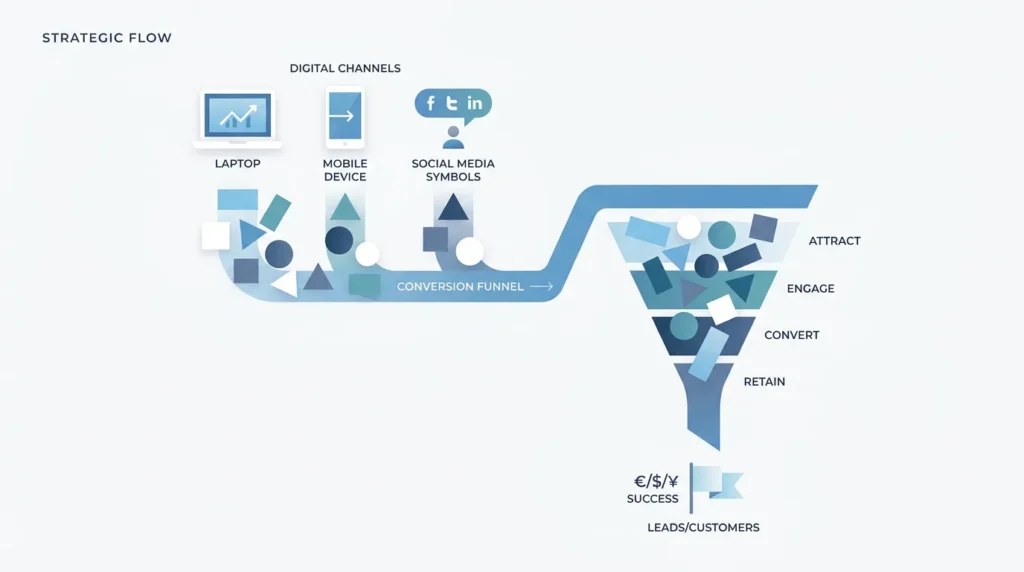
Let’s be honest: online lead generation often sounds like something you do “on the side.” One ad here, one form there, done. In practice, it works differently. Success sits in a chain that has to make sense, from first impression to the moment a contact actually shows commercial interest.
In this article, we’ll walk through a practical approach that we’ve seen work in many B2B and B2C projects. We’ll focus on what online prospects do, why they drop off, and how you fix that with website optimization, landing pages, forms, chatbots and conversion rate optimization (CRO).
And yes, you’ll also see a few trade-offs. You can’t make everything perfect at once, but you can make choices that are measurable. That way, you know where your time and budget pay off.
Start online lead generation with one clear goal and a measurable path
If you take online lead generation seriously, you first want to answer one question: what behavior counts as a real lead?
That matters, because this is where things often go wrong. Visits, clicks, impressions and followers are not leads. A lead is a person or company showing possible commercial interest, for example through a contact request, quote request, demo request or meeting request, where you get enough contact details to follow up.
Define your micro conversions, but measure your end point
We recommend using two levels:
- End point: the moment you receive a lead (for example, form submission or meeting request).
- Micro actions: supporting actions such as opening a pricing page, downloading a whitepaper, or starting a chat.
Why? Micro actions help you find problems in the path. But you only really optimize once your end point improves consistently.
Tracking has to speak the same language as your sales process
If lead generation works, you also need to be able to explain what happens after the lead. That’s why it’s essential that you measure:
- How many leads you get per channel and campaign (and whether those leads actually have sales value).
- How quickly you follow up after a lead.
- How many leads move on to a Sales Qualified Lead (SQL) or meeting.
In Google Analytics 4 (Google Analytics 4), the measurement model revolves around events, and a conversion is an important event that you mark as a conversion. Google describes this as a consistent way to measure important actions. (support.google.com)
Don’t track rankings blindly, track conversions
SEO and Search Engine Advertising (SEA) are tools. Your goal is lead generation. That means that with SEO you also think about indexability and discoverability, but above all about landing page performance.
For indexing, it helps to know what Google shows in Search Console. The URL Inspection tool shows whether a page is eligible to appear in search results and what status picture Google sees. Google also states that “URL is on Google” means it can appear in search results, but that this is not guaranteed. (support.google.com)
Website optimization: turn your site into a lead machine, not a brochure
We often see the same pattern. The website looks great, the copy is tidy, but the path to a lead is unclear. Or the site sends visitors to generic contact pages where nobody quite knows what happens next.
Website optimization for lead generation is therefore mainly about reducing choices and building trust in the places that matter.
Work with a clear information hierarchy
If someone is still exploring, that person has three questions:
- Am I in the right place?
- What exactly do I get?
- Can I get started quickly, without hassle?
Your homepage and core pages need to answer those questions right away. Not after five scrolls.
Spot friction, not just conversion
Friction is what slows your visitors down mentally. Often it’s a form that’s too long, unclear wording, or privacy concerns. You’ll see friction show up in low form completion or few appointments.
In CRO literature, friction is often linked to things like too many form fields and an unclear offer. That makes sense, because users weigh effort against value. Research on landing pages and conversion behavior also points to a connection between more information on marketing web pages and the decision to leave an email address, where extra complexity can work against you. (arxiv.org)
We turn this into a practical rule: make it so simple that someone can say yes without first planning a meeting.
Build conversion-focused paths to specific goals
A website that converts has a few fixed paths. For example:
- Exploration to a landing page for a specific problem.
- Case study to a request form with a concrete next step.
- Service page to an appointment CTA (Call to Action) that fits the offer.
The mistake is to make everything run through one generic contact page. That often creates a lot of noise and very few high-quality leads.
Landing pages and forms: where online lead generation really happens
Landing pages are your real conversion tool. Not your ads, not your blog. The landing page is where visitors decide.
That’s why optimization comes down to three topics: message matching, form friction, and proof.
Message matching: use the same wording on the landing page
If someone arrives from an ad or an organic search with a specific intent, you want the landing page to confirm that immediately. So:
- The headline says what the visitor is looking for.
- The subheadline says what the result is.
- The first CTA is the next step, not a detour.
That way, you avoid making your visitor guess first.
Forms: fewer fields, better fields
Form friction is one of the biggest conversion killers. In practical terms, there are two ways to handle it.
- Reduce the number of fields to what you need for follow-up.
- Use multiple steps if you still need more information, so the visitor doesn’t have to give everything at once.
In landing page best practices, multiple steps and reducing friction are often mentioned as conversion-improving approaches. (unbounce.com)
The same idea also appears in CRO best practices: reduce friction and don’t make forms too heavy. (unbounce.com)
Make form submission predictable
Visitors want to know what happens after they submit. So:
- Show a short confirmation and state the expected turnaround time.
- Give a clear answer to the question: “What now?”
- Mention privacy and build trust.
Watch the technical side: errors cost trust
Incomplete tracking, error messages, or a form that doesn’t work on mobile immediately reduce the chance of a lead. That sounds obvious, but in practice it still happens, especially after updates.
Chatbots, conversation and follow-up: optimizing conversion with speed
A chatbot is not a gimmick. It’s a tool for two things:
- Answering questions at the moment someone hesitates.
- Speeding up the request by collecting targeted information.
The gain isn’t in “more chatters.” The gain is in more leads with less hassle.
Use chatbots for qualification, not endless conversations
You want the chatbot to get to a core decision quickly, for example:
- Does this offer fit the visitor?
- What type of request is it?
- When does the visitor want to start?
After that, route them to a form, a booking flow, or your sales team. Otherwise, the chatbot becomes an information museum.
Plan your follow-up, or your lead is 24 hours too late
Even if your landing page works well, your lead quality can still drop because follow-up is too slow. That’s why follow-up is part of the online lead generation chain.
Practical advice we often use:
- Send the lead a confirmation within a short time.
- Make sure marketing and sales use the same definition of MQL (Marketing Qualified Lead) and SQL (Sales Qualified Lead).
- Work with priority based on intent signals, such as request type or specific interest pages.
Automation has to keep you in control
Automation in lead generation means workflows and software that make intake, qualification, follow-up and reporting faster and more consistent.
Let’s keep it very concrete:
- Automatic lead capture and CRM update.
- Automatic routing to the right contact person.
- Automatic follow-up messages based on behavior.
But, and this is important, automation should not make budget changes or contractual commitments without human approval. You want speed, not chaos.
SEO and SEA in one system: connecting visibility with conversion
You can make a landing page perfect and still miss the mark if traffic doesn’t match intent. That’s why we connect SEO and Search Engine Advertising (SEA) to the same landing page logic and the same conversion goals.
SEO: optimize for intent, and check indexability
SEO is Search Engine Optimization, focused on organic visibility. For lead generation, that means you:
- Create pages around real questions and problems.
- Use landing pages that fit that intent.
- Check whether your pages are indexed and can appear in search results.
With Search Console, you can use URL Inspection to inspect a page and see a status picture about index eligibility. Google also explains that live inspection and index status can differ, so use your tools with nuance. (support.google.com)
SEA: focus on Cost Per Lead (CPL) and conversion quality
Search Engine Advertising (SEA) is paid traffic. Your optimization starts with traffic, but it ends with lead quality.
In practical terms, you want to measure three layers:
- CPL, where CPL stands for Cost Per Lead (what you pay per lead).
- Conversion Rate (CVR) on your landing page, where CVR stands for Conversion Rate.
- Flow-through to appointment or SQL.
Without flow-through, you’re mostly measuring cost, not return.
Use one KPI set per phase
KPI is Key Performance Indicator. You want to avoid letting one KPI decide everything.
A healthy set usually looks like this:
- TOFU (Top, Middle, and Bottom of the Funnel) phase: focus on click and engagement quality, not just volume.
- MOFU: focus on landing page CVR.
- BOFU (Bottom of the Funnel): focus on lead quality, appointments and SQL.
CRO roadmap for online lead generation: what to optimize first
Now we’re moving into execution. CRO, Conversion Rate Optimization, is basically a set of experiments to increase your CVR. But you don’t want to guess.
Step 1: audit your conversion paths with a friction lens
Start with the places where visitors experience mental friction. Typical candidates:
- Unclear headline and offer mismatch.
- Form with too many fields or unclear labels.
- Not enough proof, such as client cases or use cases.
- Slow load time or errors on mobile.
Landing page best practices emphasize lowering friction, including through form and page structure. (unbounce.com)
Step 2: experiment with the form, not everything at once
The quickest gains often come from form changes. For example:
- Reorder fields so less sensitive information comes first.
- Remove fields you don’t need for the first follow-up.
- Use microcopy to explain why you’re asking for a field.
The trade-off is clear: fewer fields often means less data, but better conversion. So you decide which data sales later adds in the follow-up call or through a next step.
Step 3: improve your proof and your “next step”
People want certainty. So add:
- What happens after submission?
- How quickly do you respond?
- Who is this for and who is it not for?
This lowers uncertainty and therefore friction.
Step 4: measure consistently and test your tracking
If your conversions aren’t right, you’re optimizing noise. In GA4, you can link conversions to events. Google explains that a conversion comes from an event and offers a consistent way to measure important actions. (support.google.com)
That’s why you should also plan a short test procedure:
- Create one test lead.
- Then check in GA4 whether the conversion event comes through correctly.
- Finally, check whether CRM and lead follow-up mark the same lead.
Common mistakes in online lead generation, and how to avoid them
- No fixed lead definition, which makes your dashboards inaccurate and teams work past each other.
- Wrong landing page match for ads or SEO, which keeps your CVR low.
- Too heavy a form, which makes prospects drop off before they meet your sales team.
- Tracking without checking, which means optimization is based on the wrong data.
- Optimizing only for volume, while lead quality determines the return.
Next step: turn your lead generation into a 2-week plan
If you start today, you want something you can test within two weeks. Not a yearly plan. Not a PowerPoint deck without action.
Week 1: make your basics measurable and your landing pages sharper
- Redefine lead, MQL and SQL, and document those definitions for marketing and sales.
- Rebuild one landing page around one intent, with a clear offer and a predictable next step.
- Simplify your form. Fewer fields, better labels, clear confirmation.
- Test conversion tracking in GA4 and check whether CRM updates are correct.
Week 2: launch, measure, and optimize based on friction
- Send SEA and SEO traffic to that landing page, with consistent messaging.
- Monitor landing page CVR and Cost Per Lead (CPL).
- If leads drop but CVR rises, look for qualification mismatch and adjust qualification through a chatbot or follow-up questions.
If you also want to sharpen the strategic side of your overall lead generation, it helps to use this as a framework: Lead Generation: Complete Strategy for More Customers. We like to use that kind of strategic structure alongside the CRO and execution tasks you see here.
Conclusion: online lead generation is a conversion chain, not a separate action
Online lead generation works when you build a chain. Website optimization pulls people toward the right intent. Landing pages handle message matching and proof. Forms reduce friction. Chatbots speed up qualification. And tracking gives you an honest picture of what works.
Keep it small, but do it properly. Make one landing page focused. Simplify your form. Check tracking. Then optimize based on CVR, CPL and lead quality.
Once you build that rhythm, you gain control. Not because you got “lucky,” but because you keep learning from behavior. That’s the only way online lead generation becomes truly sustainable.
