
 Written by
Daniel van Hek
Search Clicks·September 13, 2026
11 min read
Written by
Daniel van Hek
Search Clicks·September 13, 2026
11 min read
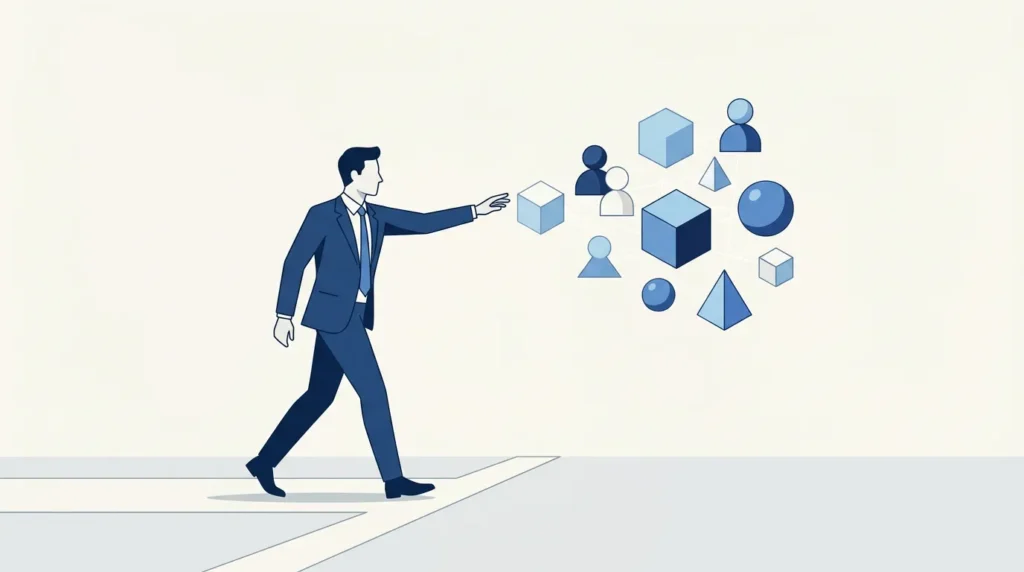
Outbound marketing means: you proactively approach people or companies, usually before they are looking for you. This happens through channels such as e-mail, LinkedIn messages, phone outreach or targeted campaigns that do not wait for an inbound signal.
If you are thinking: “Does cold outreach only work if you get lucky?” Then you are probably still doing outbound the wrong way. Because outbound does work, as long as you treat it like a system, not a one-off action. You choose the right audience, you adapt the message to their context, and you measure what happens all the way to the next step in your sales process.
In other words: you make outbound predictable. And that is exactly why we combine outbound marketing with other channels. Not because it always wins, but because it fills the gaps that inbound leaves behind.
Let’s make it clear. Inbound works when someone has already shown interest, for example by searching, consuming content or starting a request. Outbound works when you still need to spark that interest, or when you want to actively feed a specific use case with relevant prospects.
One realistic limitation: you measure outbound in steps. You do not assess replies only, but also the quality of responses, appointments and the flow through to Marketing Qualified Lead (MQL) and Sales Qualified Lead (SQL). If you do not do that, you optimise for volume instead of commercial results.
This is the part where most teams get stuck. They start with copy and tools. We start with strategy. Because messaging follows audience, and channel follows goal.
Your ICP is your starting point. Write it out as a short checklist. What company size, sector, role, priorities and context make your offer logical? And which “trigger” makes your prospect potentially receptive? Think of a decision that is often made periodically, or a changing situation that creates an opening.
This approach matters because outbound is direct marketing, and you need to be able to justify your effort. In a legal context, it often comes down to consent or legitimate interests as a basis, depending on your situation and how you handle privacy and electronic marketing rules. The British Information Commissioner’s Office (ICO) explains these considerations for Business-to-Business marketing and discusses when you can rely on legitimate interests, but only with a documented balancing test and compliance with electronic marketing rules. (ico.org.uk)
Practical point: make your “trigger” your content brief too. Without a trigger, your message becomes a generic sales pitch.
An outbound sequence is a set of contact moments with a logical structure. Not because it sounds “nice”, but because attention is scarce. You build from awareness to relevance to a concrete next step.
A common mistake: using the same call-to-action (CTA) in every message. That creates friction and low response. Better: change the goal at each step.
Personalisation does not have to mean you quote someone’s hobbies. It means: you show that you understand what their context needs. In practice, we see that teams that build account- or context-specific references in a logical way often get better response than teams that only do “name + company”. In research we come across online, differences in response and personalisation level are described. Note: these are averages and vary by market, list quality and offer. (crodaily.com)
How do you make it scalable? Use a template with fixed blocks:
If your e-mail does not reach the inbox, you can forget the best copy in the world. Deliverability is about reputation, formatting, domain consistency and the way you send. You can have an outbound machine, but if inbox placement is poor, you get a silent failure loop.
Also make sure you comply with e-mail marketing rules. The Federal Trade Commission (FTC), for example, states that marketing e-mails must include a clear opt-out. (search.ftc.gov)
Trade-off: strict filtering on privacy and opt-outs can shrink your audience. But it reduces risk and often also improves deliverability, because you send less “noise”.
Alright, now we build. Think in metrics, not in hope.
An outbound campaign is only as good as the quality of the list and the validation. We usually do three checks:
If you do not do this, you get replies that sound “interesting” but never become SQL. And then you end up optimising for the wrong KPI.
Outbound can run through multiple channels. Choose per phase.
Practical advice: start with one “main channel” and one “supporting channel”. Not everything at once. That way you can learn what works and why.
Most teams are poor at follow-up. They send several messages, but once there is a reply, rhythm disappears. For inbound, speed is often important too, and that shows up in best practices around lead response and measuring time to the first conversation. (help.close.com)
For outbound, that is just as relevant. When someone has just replied, the barrier is lower than if you wait a week.
What we do:
A meeting CTA only works if you keep it simple:
And if there is no match, you want to close it honestly too. That may sound blunt, but it increases trust and reduces friction in the long term.
You cannot improve outbound if you do not know where it is leaking. But you can also get lost if you measure everything. So we choose deliberately.
Pay attention to the definition: a “lead” for us is a person or company with possible commercial interest, so you need contact details or a real commercial enquiry. Website traffic, impressions, clicks and social engagement are therefore not leads on their own.
Your KPI’s should answer the following question: what will you steer next week? For example:
You can also translate e-mail campaigns into financial terms, but be careful with assumptions. Outbound costs are often in man-hours. We make that visible through a simple structure: time per sequence and revenue per SQL or appointment.
We usually test:
We test less often:
That is not conservatism. It is so your results remain interpretable.
Outbound is rarely your whole strategy. The strength lies in combination. They complement each other.
SEO (Search Engine Optimization) often builds trust and prevents your outbound from sounding only like a sales pitch. Use your SEO content to make your outbound message more concrete: there is a reason to believe your approach.
Practical tip: do not link to “your homepage”. Link to a piece of content that answers a specific question, so your prospect can take a next step if the timing is better.
SEA (Search Engine Advertising) is useful for capturing intent or supporting retargeting. And CRO (Conversion Rate Optimization) helps improve conversions on landing pages. The connection is simple: outbound creates conversations and early understanding, while SEO and SEA help you with intent and visibility, and CRO makes sure your pages do not leak visitors.
When an outbound prospect comes in, your CRM and your follow-up need to deliver the same quality as with inbound. Otherwise you get a mismatch. You can solve this by synchronising your qualification rules and nurture flows with your outbound sequences.
If you want to tackle this more broadly, then a more comprehensive Lead Generation strategy fits outbound well. For example, you can look at Lead Generation: Complete Strategy for More Customers, because there you can see the full chain from acquisition to qualification and conversion.
And if you really want to get started with cold outreach, then Cold Outreach: Reaching Out to Unknown Prospects is a useful bridge from theory to approach. Think about how you build outreach based on context instead of bulk.
You do not have to wait until everything is perfect. This is an executable plan that we often use in practice to build good momentum.
A bit dry: outbound marketing does not punish you because you make mistakes, it punishes you because you repeat the same mistake for too long.
Outbound marketing works when you see it as a system: audience, trigger, sequence, deliverability, follow-up and measurement. If one of those parts is weak, you get noise. If you build everything tightly, you get predictable conversations and a better understanding of your commercial opportunities.
We recommend starting with one clear ICP segment, one main channel, and a sequence that helps your prospect move forward step by step. Combine that with SEO, SEA and CRO so your credibility and conversion do not fall behind.
If you take one step today: write down your trigger in one sentence. If you cannot make that sharp, outbound becomes a love letter to the wrong inbox. And that is a waste of your time.
Book a free strategy call and discover how many leads we can generate for your business. No obligations — just a concrete growth plan.
Book your free strategy call → Book your free strategy call — 30 min, no strings attached