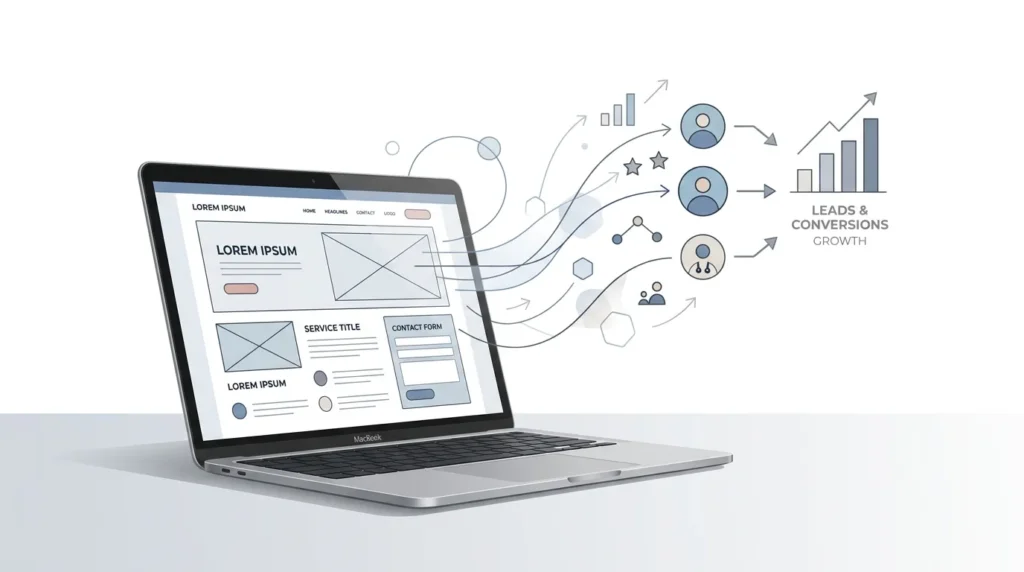
Web development that converts: from website to leads
Written byDaniel van HekSearch Clicks·September 10, 2026
12 min read
Let’s be honest. A website is no longer just “something that sits online.” It’s a sales channel, a lead engine and often your first introduction to new customers. And that requires more than tidy pages. With webdevelopment, we therefore build a digital foundation that works for both users and measurable results.
In this article, I’ll walk you through the practical choices we keep seeing in projects. What you need to build. Why it works. And what the next step is, so you don’t just go live, but also generate better leads through your website.
What webdevelopment means for online marketing and sales
If you approach it well, webdevelopment helps you do three things at the same time:
Your marketing message stays consistent at every moment, from first click to enquiry.
Your website is measurable, so you know which parts add value.
Your conversion keeps getting a little better, because you can optimise in a focused way.
In practice, this shows up in four areas. Technology, findability, conversion and tracking. These are not separate projects. They reinforce one another, and if one is weak, the rest often underperform too. That is usually not because marketing is bad. It is often because the website is not pulling its weight.
The experience we often see in projects
We talk to many teams that are “already doing SEO” or “already running campaigns”, yet results still lag behind. Usually the cause is not some magical ranking factor. It’s a combination of:
Conversions are not measured correctly or not triggered at the right moment.
Pages load slowly or render awkwardly, causing users to drop off.
Content structure is not aligned with intent, so visitors have no reason to take the next step.
Forms and landing pages are not built with friction in mind.
That’s why, in webdevelopment, we almost always start with the question: what is the path from visitor to lead, step by step? Only then do we build the technology around it.
The technical foundation that drives marketing results
Let’s make it practical. The technical choices you make in webdevelopment determine whether your marketing investment turns into enquiries, bookings or contact. You can think of this as the infrastructure of your funnel.
1) Make sure search engines and users see the same page
Search Engine Optimization (Search Engine Optimization) is not only about copy. It is also about what Google tries to index. A common mistake is that http and https, or versions with and without www, are not handled properly.
Google explains that when duplicate variants are available, the HTTPS version may be preferred for indexing. And that you can see in Search Console why an HTTPS version may not be indexed. This is exactly the kind of detail webdevelopment can solve. (support.google.com)
Trade-off: this requires discipline in your settings. But the gain is big: less confusion, less waste, and a clearer path to the right URLs.
2) Use a measurable event structure for conversions
Without good tracking, you are optimising in the dark. We often see forms working fine, but in Analytics it is not clear what a real conversion is. In Google Analytics 4 (Google Analytics 4), this revolves around key events, meaning events that really matter to you.
Google explains how to use events and key events, and that they are useful for different B2B scenarios, even when conversions have offline follow-up steps. (support.google.com)
Next step: define your conversion first. Is it a completed form, a quote request, a demo request, or an appointment that has actually been scheduled? Then mark only that step as a key event. That keeps your reporting trustworthy.
3) Keep ownership and management simple with Search Console
This sounds administrative, but it matters for marketing. If you do not have correct ownership and access, you cannot reliably manage indexing and issues in Search Console. Google explains that you must verify ownership before you can view data, and that a Domain property often works through DNS verification. (support.google.com)
Why it works: you can act faster when a page is not indexing or when technical issues appear. That prevents SEA or content work from sitting on a broken foundation.
SEO in webdevelopment: what you need to build for visibility
SEO (Search Engine Optimization) works best when webdevelopment makes it possible. Not when SEO comes “later”. That is why we look at three parts: content structure, technical indexability and reliability in the content.
Content structure that matches intent
We build pages around a clear promise. Not around a random set of keywords. In webdevelopment, we translate that promise into:
A logical heading structure, so your page is easy to scan.
Internal links that guide visitors to the next step.
A CTA at the right moment, not hidden at the bottom of a page nobody is still reading.
Google emphasises that ranking systems are designed to prioritise helpful, reliable content made for people, not to manipulate rankings. (developers.google.com)
Practical translation: if your pages contain a lot of information but do not answer the visitor’s question, technology alone won’t help. It will, however, help the text land better.
Technical indexability, without the clutter
A page that loads too slowly or renders unpredictably can perform less well. That is why we build with performance in mind, but without getting lost in theatrics. For us, performance is a means, not an end.
What we do consistently:
Server-side rendering or a strategy that makes content consistently available.
Clean URLs and canonicals where needed.
Correct status codes, redirects and protocol consistency (http versus https). (support.google.com)
Use webdevelopment to connect SEO and CRO
SEO brings traffic. CRO (Conversion Rate Optimization) makes sure those visitors become leads. In webdevelopment, we connect the two by building landing pages as a conversion tool, not as a brochure.
If you want to speed up that process, an approach that brings SEO and marketing together fits your situation well. For example, you can take a look at Marketing SEO: How SEO and marketing come together.
SEA, landing pages and webdevelopment that perform measurably
Now for the other half of the story. Search Engine Advertising (Search Engine Advertising) can generate traffic quickly, but if your landing page is weak, you are paying for drop-off. Webdevelopment makes your landing pages not just prettier, but also smarter and more measurable.
Match the ad promise with the page content
This is where many teams go wrong. They set up SEA campaigns, but send traffic to a generic homepage or a landing page without a clear match. You then get high click-through, but low conversion. And that kills your efficiency.
What works:
Create landing pages per service or intent.
Repeat the core promise verbatim, in simple language.
Show within the first screen what someone gets and what the next step is.
That sounds basic, but it is exactly the difference between “visit” and “enquiry”.
Tracking that is right from click to key event
We run SEA on conversions. So you need to measure conversions properly too. In Google Analytics 4, key events work as measurable goals. Google explains how to use key events and how events are set up as conversions. (support.google.com)
Next step: create a simple mapping:
Which ad group drives which intent?
Which landing page belongs to it?
Which action is your conversion (key event)?
Which form fields are “minimum” for a real lead, and which are optional?
If you only make this mapping after launch, it often costs weeks of repair work. Better to set it up in advance.
An example of what we steer towards in webdevelopment
In B2B web projects, we regularly see that the form is the problem. Not because forms are “bad”. But because they are too long, or because users do not have clarity after submitting about what happens next.
Webdevelopment helps here with:
Validation that shows errors immediately, without frustration.
Accessible error messages.
A thank-you screen with a follow-up step and expectations.
Trade-off: more fields can improve lead quality, fewer fields can improve volume. You choose what fits your sales process. That is why marketing and sales need to define the form together.
Conversion and optimisation: CRO as part of webdevelopment
Now that we are building for traffic, the logical next step is optimisation. Not with random tweaks. With a process.
Start with a measurement plan, not a facelift
We always begin with these questions:
Where do people drop off, on page X or at step Y of the form?
Which pages generate no key events, even though they get traffic?
Which landing pages have high engagement but low conversion?
Google Search Central is clear that reliable, helpful content for people comes first. (developers.google.com) That is why we optimise the content and UX first, not just the technical layer.
Which CRO improvements you can make
Here are changes we often include in webdevelopment because they have a direct effect on conversion:
CTAs: make them consistent and aligned with intent.
Forms: reduce friction, but protect lead quality.
Social proof: use cases and results you can back up, without exaggeration.
Internal links: guide to the next step, not to “read more” if the goal is an enquiry.
Automation for lead follow-up (only if it measurably helps)
If your website generates leads, follow-up needs to be fast and consistent. That is where automation comes in. But with an important caveat: automation should optimise your online marketing and sales activities, with visible impact, and not just “add extra software”.
How we approach it: from strategy to execution in webdevelopment
Okay, enough theory. If you were to start a webdevelopment project tomorrow for online marketing and sales optimisation, this is a route that usually works well.
Step 1: Define your commercial goals and conversions
Make choices you can measure. For example:
Which key events count as conversions in Google Analytics 4?
Which steps lead to a Sales Qualified Lead?
Important: a “lead” is only a lead when real commercial interest or contact information has been obtained through online activities. Otherwise, you are measuring traffic and behaviour, not a lead.
Step 2: Build landing pages that match intent
Use templates for consistency, but personalise where it matters. In webdevelopment, that means:
Step 3: Set up tracking properly and verify your data
In Search Console, you need to verify ownership before you get reliable insights and can steer properly. Google explains this process, including verification through a Domain property and DNS records. (support.google.com)
Next step: after launch, check within a few days whether your key events and page indexing data appear. If you do not see data, it may also mean that Google has not yet properly seen your site, or that your URL variants are not correct.
Step 4: Optimise based on behaviour, not opinions
We choose improvements based on what we see:
which pages bring traffic but no key events
where drop-offs happen
which CTAs work within a specific intent
Dry humour, because it really is true: “gut feeling” is fine for coffee, not for CRO.
Frequently asked questions about webdevelopment and online growth
Is webdevelopment the same as building a website?
Not exactly. Building a website is often about delivery. Webdevelopment for online growth is about building a system that supports marketing and sales. That also means measuring, optimising and iterating.
Do we definitely need a technical project to improve leads?
Not always. Sometimes the problem is mainly content or offer. But if your tracking, pages or conversion paths are not right, every campaign stays expensive.
Where does linkbuilding fit within webdevelopment?
Linkbuilding (from external signals) is not part of webdevelopment. But webdevelopment does determine how well your site captures the value of those links. Think landing pages, content structure and conversion. If you want to work this out, Hiring a Linkbuilding Agency: What You Need to Watch For can help with the framework, so your technical and content choices do not fall behind.
When does local matter?
If your customers search locally, Local SEO (Local SEO) can make a big difference. Then you also want to direct webdevelopment toward local signals and landing pages. See for example Local SEO Agency: Improve Local Visibility.
Conclusion: webdevelopment is your silent seller
If you do webdevelopment well, it feels like an experienced salesperson is on your website. Not loud. But consistent. Your message is right. Your page is fast enough. Your conversions are measured. And you can optimise in a targeted way.
The next step I recommend is simple:
Describe your route from visitor to lead in steps.
Define which step is a key event in Google Analytics 4 (Google Analytics 4) and test it.
Check in Search Console whether your ownership and indexing insights are correct. (support.google.com)
Build or improve landing pages based on intent, and then optimise based on behaviour.
If you connect that to a clear approach to SEO and conversion, your website becomes more than just “online”. It becomes a channel where your marketing and sales both win.
And if you are thinking in a combination of SEO and Search Engine Advertising (Search Engine Advertising), then an integrated strategy is often the starting point, for example as outlined in Google optimisation agency: SEO and SEA expertise.
Book your free strategy call — 30 min, no strings attached
Cookies on this site
We use analytics cookies to see how the site is used. They are only placed if you agree. Refusing costs you nothing — the site works exactly the same. Privacy statement