
 Written by
Daniel van Hek
Search Clicks·September 8, 2026
10 min read
Written by
Daniel van Hek
Search Clicks·September 8, 2026
10 min read
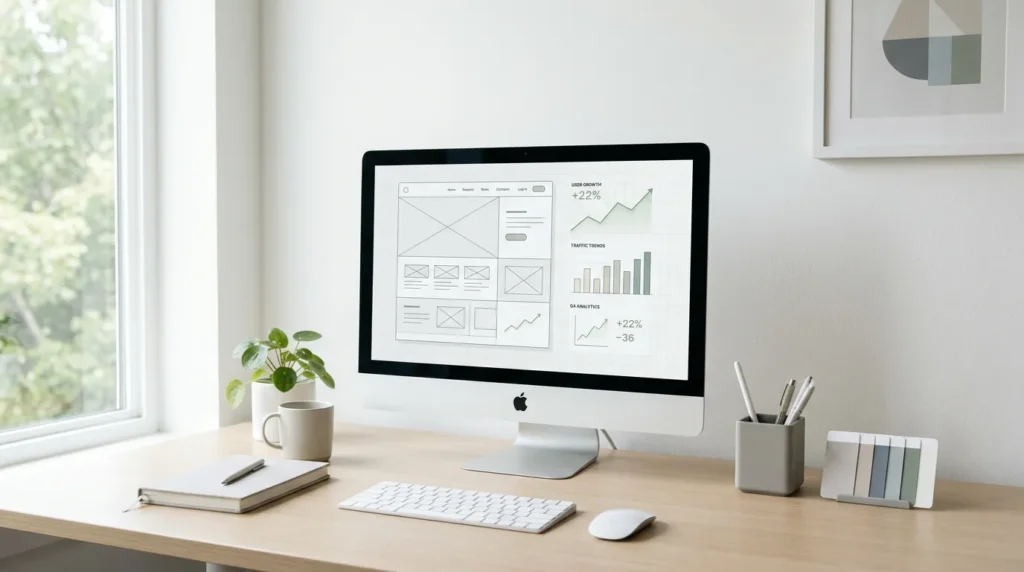
Grab a coffee with me. Let’s be honest: many sites look good, but do far too little for revenue. A webdesign bedrijf therefore should not only deliver design. It should help online marketing and online sales land in your website.
Our starting point is simple. You pay for choices that affect behavior. Not for pixels.
That is the strategy behind our approach. We do not design for a portfolio. We design for measurable conversion.
You can recognize a strong partner by three things: preparation before the build, discipline during the build, and data awareness after launch. Below are the points we ourselves pay attention to, because in practice they make the difference.
We usually ask you first: where do your real customers come from today? What kind of question sits behind their search behavior? Which page is generating requests now, and which is not?
Then we translate that into a structure that fits intent.
A web design agency that only offers “design” often misses the logic that shapes your conversions.
Google says clearly that helpful, trustworthy content and a page that search engines can understand well are important. (developers.google.com)
But what does that mean for web design? You see it in templates such as:
If a partner promises “SEO” without page architecture, then later it often becomes patchwork.
For SEO, Google Search Console (abbreviated GSC) is essential for seeing how you perform in Google Search. The Performance report shows, among other things, clicks, impressions, average CTR and average position. (support.google.com)
Note: CTR is based on (clicks ÷ impressions). (support.google.com)
In practical terms this means:
Good web design partners feed those insights straight back into page updates.
Performance is not a “nice to have.” It affects how quickly people can see and click. Core Web Vitals are the three metrics Google uses for user experience: LCP, INP and CLS. (pagespeedinsights.dev)
Our view: you do not need to make every page perfect. You do want to solve bottlenecks on templates that bring in the most money, for example your service landing pages and contact routes.
Here comes the “coffee talk” version. This is how we usually handle a web design project that supports online marketing and online sales.
We do not frame the goal vaguely as “more requests.” We make it concrete.
Tip: if you do not know what your conversion is, measure first. Otherwise you optimize by feeling, and that is an expensive hobby.
We create a sitemap that supports intent. Not only for search engines, but also for the visitor who wants to quickly know whether you fit.
If you already have a lot of content, we do a content audit. We then determine what should move to the right page, what can be combined, and what is better removed. That prevents thin or overlapping pages.
Want to understand the broader SEO marketing connection? Then also read: SEO Marketing: How SEO and Marketing Work Together.
We do not design to look “beautiful”, but to make choices easy.
Pay attention to trade-offs. Faster conversion can sometimes mean giving marketing less freedom. But if the goal is conversion, then that is usually the right trade-off.
If tracking comes “later”, you miss the best learning moments. We set up early:
And yes, we use GSC to read SEO behavior. The performance report helps you see which pages and queries have clicks and impressions, including average CTR and average position. (support.google.com)
We mainly test where money leaks away.
Then we do CRO. No endless experiments. We start with the most logical hypotheses based on data.
You do not need a calculator. You do need to know where the budget goes. In web design, you usually see these cost items, roughly:
If you are looking specifically at WordPress webdesign, then guideline prices help because choices often depend on scope. For example: how many templates, how much content migration, and whether integrations are needed. If you want to make that concrete, look at: WordPress Website Cost: Price Ranges and Smart Choices.
We are not dogmatic. WordPress can work very well if you:
If you want a practical approach and checklist, this is a good start: WordPress website design for growth: approach and checklist.
Honest limitations: WordPress requires maintenance. That is not a problem, but do plan it into your overall project.
A web design agency can improve your website, but your commercial growth also depends on the way you handle traffic after the click. Think about:
SEA means Search Engine Advertising. And if you use SEA, you want your landing pages to connect exactly to the promise in your ads. Otherwise you get many clicks and few appointments. That is frustrating, and expensive, because you pay per click.
Automation should make your work lighter, not pretend smartly that you have lost overview. We use automation for:
If you want to get started concretely with that, then this link fits well: Process Automation for Online Marketing and Sales.
And if you mainly want to sharpen the workflow structure, this also helps: Process Automation: Optimizing Workflows for Growth.
Here is the list you can literally tick off during a conversation with a web design agency. If they do not convince you on certain points, then you know where the risks are.
A web design project often stops at the site. But real growth in SEO also depends on authority and findability across multiple pages. Think about internal links, but also external signals. If you want to discuss external link quality with a partner, then this is a useful foundation: Linkbuilding agency hire: what to look for.
And if you want to broaden it to internet marketing and partner selection, look here: Online marketing agency: how to choose the right partner and Online marketing agency: how to choose the right partner.
Be honest with yourself, though: building links is not a button you switch on in days. It is work, with patience and a solid content base on your own site.
If you are looking for a webdesign bedrijf, do not just look for “a beautiful website”. Look for a partner that includes online marketing and online sales optimization in the build.
In short, it comes down to these four points:
Next practical step: make a short list of 5 pages that need to generate the most money (service pages and your most important landing pages). Ask your web design partner how they structure those pages for SEO, conversion and tracking. If they can explain that clearly, then you are probably in good hands.
And if you also want to support outbound, then this route fits your sales process too: Cold Outreach: How to Approach Unknown Prospects. That can be part of the same commercial machine, as long as your website makes the proof and the request route consistent.
Book a free strategy call and discover how many leads we can generate for your business. No obligations — just a concrete growth plan.
Book your free strategy call → Book your free strategy call — 30 min, no strings attached