
 Written by
Daniel van Hek
Search Clicks·September 6, 2026
11 min read
Written by
Daniel van Hek
Search Clicks·September 6, 2026
11 min read
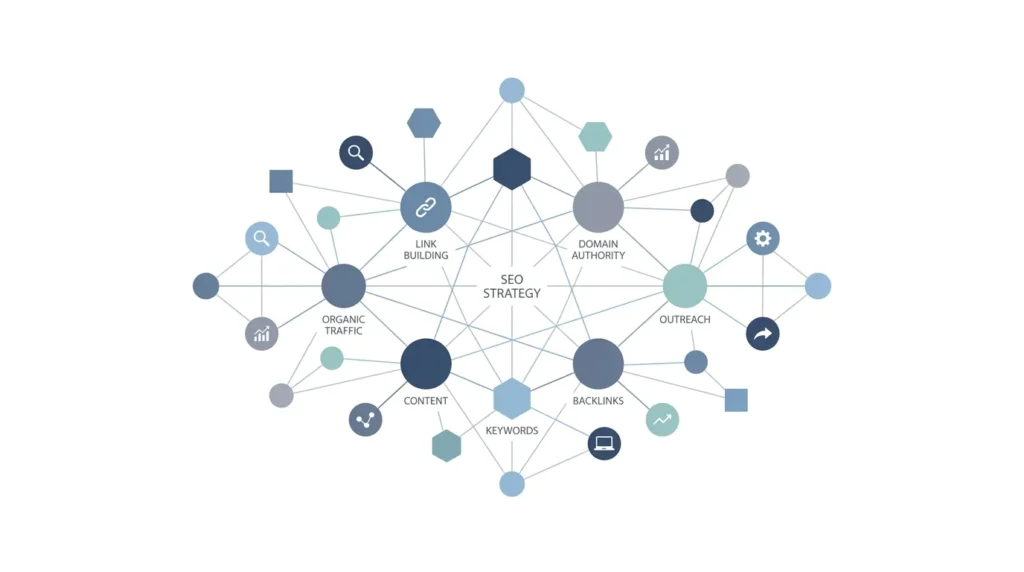
Imagine you have a shop. You can print hundreds of flyers and scatter them everywhere, but nobody believes your story. Online works the same way. Links are a signal of trust, relevance, and reputation for Google and your audience. That’s why many businesses turn to a linkbuilding agency as an accelerator.
But let’s be honest: not every agency delivers what it promises. And some methods can also hurt your SEO, especially if they come close to link spam or manipulation. Google defines “link spam” as creating links with the primary purpose of manipulating search rankings, and it goes further with “link schemes”. (developers.google.com)
In this article, I’ll walk you through it as if we were sitting at the same table. We’ll look at what linkbuilding actually is in practice, how to recognize quality, how to cover the risks, and which questions to ask before you hire a linkbuilding agency. No fluff, just a plan you can execute.
A linkbuilding agency helps businesses earn high-quality backlinks. That sounds simple. The execution is not.
In practice, it comes down to three things:
Why does this matter? Because Google does not only look at “how many links.” It looks at quality, context, and consistency with how people share and reference information. The way Google assesses the quality and relevance of results is based on multiple signals, including how other sites refer to content. (google.com)
If you’re going to hire an agency, don’t optimize for “1000 backlinks.” Optimize for measurable and verifiable output. Think about:
Google also provides explicit guidelines about links, including qualifying links when they contain sponsored or paid elements. (developers.google.com)
Useful to know: not every “paid” placement is automatically wrong, but it does need to be marked correctly and must not be intended to manipulate rankings. (developers.google.com)
This is where it gets interesting. Quality is not just a word. You can test it.
A good link comes from a context where your topic makes sense. If a gardening site suddenly publishes a page about a SaaS tool, it feels fake. You can spot that by asking:
Google says ranking systems prioritize content that is useful and trustworthy and not made to manipulate search rankings. (developers.google.com)
A link is stronger when the placement makes sense editorially. Then you’ll see:
Google warns about spam practices, including link spam. If links are created primarily for ranking, that is a problem. (developers.google.com)
A natural link profile feels varied. That does not mean you should throw everything at the wall. It means you can see that:
That is also one of the reasons we always look at pattern formation in linkbuilding. One-sidedness is suspicious, no matter how polished the agency sounds.
Good agencies are direct about that. They explain what they pay, where the money goes, and which markings are needed. Google says that links created in a paid or sponsored way must be qualified (for example through the correct link attributes). (developers.google.com)
What you want to avoid is vagueness. If an agency tells you “we work 100 percent safely” without details about how they qualify links, that’s a red flag. That is not a guarantee, that is a marketing line.
Okay, you’re about to get proposals. This is the list we use when we want to quickly understand whether an agency has control over quality, risk, and execution.
You do not want “we’re going to do outreach.” You want the real picture:
An agency that can explain a process can also spot mistakes. That is mature work.
Link types matter because not every type carries the same risks. A good agency also tells you what they deliberately do not do. Ask for example:
Google’s spam policy clearly states that link spam is about manipulation. (developers.google.com)
You want reporting that lets you check things. At a minimum:
If reporting is only “total number of backlinks,” then you’re buying sand. You can’t adjust course, and adjusting course is where SEO gains are made or lost.
You do not need to be a technical wizard to understand this. Ask:
Google says the disavow tool can be misused and cause harm, and it cites examples such as links via paid links or link schemes. (support.google.com)
Important: we do not advise seeing disavow as a first resort. Use it only with care and with an understanding of the impact. This is where an agency shows its value, or doesn’t.
Keep in mind: linkbuilding is SEO, but you buy it for impact on your online sales pipeline. So tell the agency what you are optimizing for, for example:
Be honest too: links can sometimes take effect later. That means it is important to plan reporting over multiple months. Do not expect a linear effect week by week.
If you hire a linkbuilding agency, you want it to fit your position and goals. That’s why we do not start with “how many links,” but with “which pages, which audience, which message.”
You do not choose your homepage as the only candidate. You choose pages that:
Practical rule of thumb: if a link goes to that page, the visitor should understand what it is and why it matters within 10 seconds.
An agency can only really do good linkbuilding if there is something editors want to refer to. That does not always have to be a study with high costs. Think about:
Google stresses that content helps when it gives people information they can trust and when it is made for users, not for manipulation. (developers.google.com)
We often see agencies that focus mainly on volume having less control over context. Volume can work at first, but it also increases the chance of unwanted patterns. So focus on:
This is a strategic choice. You trade “many links fast” for “fewer links you can explain.” It feels less spectacular, but it is more professional.
Linkbuilding without landing page optimization is like running a good ad campaign to a page that does not convert. You waste budget.
Pay attention to three things:
Let’s look at the darker corners for a moment, without being dramatic.
If you don’t get a clear process, you also can’t verify anything. Always ask follow-up questions. An agency should be able to explain the difference between:
Google is clear that “link spam” is creating links with the primary goal of manipulating rankings. (developers.google.com)
A do-follow focus does not say enough about quality. It only says something about link attributes. You need to look at context, editorial value, and relevance.
And yes, link attributes can be part of correctly qualifying paid or sponsored links. Google refers to this specifically in its link documentation. (developers.google.com)
Linkbuilding is not a one-time button. You monitor, you learn, you adjust. So ask how the agency handles:
Google’s guidelines around disavow also make it clear that you need to be careful with actions that can affect your domain. (support.google.com)
An agency should not make promises about rankings, revenue, or exact results. That is not only ethical, it is also practical: SEO depends on competition, content quality, and how Google systems change.
What you can do is work together with clear KPIs and realistic timelines. Often expect effects only after iterations, not after one report.
If you take one thing away from this conversation, let it be this: you do not buy backlinks, you buy control over quality and risk.
In short, these are the steps we recommend:
And if you also want to look broader than linkbuilding alone, then this internal guide often fits the same line of thinking: Choosing a marketing agency: what to look for.
Do you already have proposals on the table? Or is this still an initial shortlist? If you give me 3 things, channel (SEO, SEA, or both), industry, and your primary commercial pages, I can think along with you about a practical plan for the first 90 days. No guarantees, just direction.
Book a free strategy call and discover how many leads we can generate for your business. No obligations — just a concrete growth plan.
Book your free strategy call → Book your free strategy call — 30 min, no strings attached