Online Lead Generation: From Traffic to SQL with a System
Written byDaniel van HekSearch Clicks·September 24, 2026
12 min read
Let’s be honest for a moment. A lot of teams spend hours on ads, publish content and leave forms open. And still, too little is moving forward in the sales pipeline. That’s usually not a “luck” or “talent” problem. It’s a systems problem.
Online lead generation is about one question: are we getting real commercial interest, and can we qualify it step by step toward Sales Qualified Lead (SQL)? In this article, we give you a practical plan you can put into action right away. We also explain why it works, where it gets stuck, and what you should do next.
What online lead generation really means
In many dashboards, you see terms like “traffic”, “clicks” and “engagement”. Useful, but those are not leads. A lead is only a lead when someone takes an identifiable commercial step, for example by leaving contact details or requesting a conversation with commercial intent.
For your team, that means one simple discipline:
Website traffic is not a lead. It can lead to a lead later.
Form submissions with real contact information are leads.
Marketing Qualified Lead (MQL) is a lead that seems good enough in terms of interest and fit to pause marketing efforts and hand it over for sales qualification.
Sales Qualified Lead (SQL) is a lead sales can pick up because there is commercial value and fit.
Why does this matter? Because otherwise you optimize for the wrong KPI (Key Performance Indicator). You want to steer on quality, speed and conversion to SQL, not just reach.
The core strategy: a funnel you can measure, improve and scale
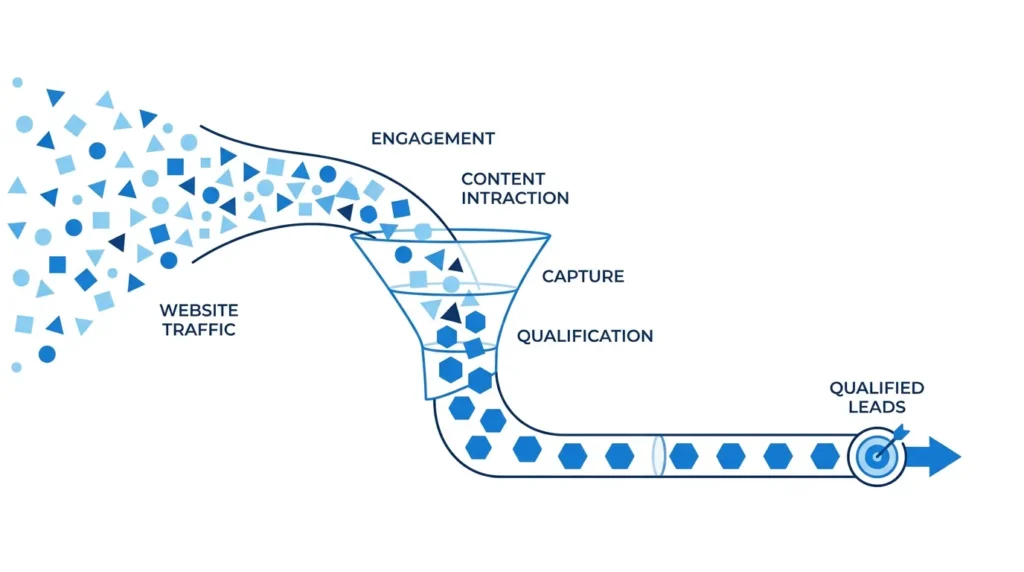
To keep it simple: online lead generation consists of four building blocks. You can improve them separately, but only together do they create scale.
1) Traffic to a conversion-focused landing page or intake
You need to connect one clear promise to one clear action. Think: “Request a demo” or “Schedule an intake”. Not five choices, no vague copy. In practice, we see that focusing on the promise and reducing friction leads to better conversion (Conversion Rate, CVR).
Practical checklist for your landing page:
One audience (or one clear segmentation per ad or campaign).
One value proposition above the fold.
One CTA (Call to Action): request a meeting or receive a proposal.
Proof that is relevant to that audience (case study, scope, approach, result context).
Form or calendar with as few required fields as possible, but enough to qualify.
Trade-off: fewer fields often increase volume, but sometimes lower quality. That’s why you build your qualification processes further down the funnel in a smart way.
2) Tracking that works, so you learn instead of guessing
If your tracking is messy, you optimize for noise. In my experience, the best route is: first define your conversions as events, then make campaigns smarter.
In Google Analytics 4 (GA4), this is now called “Key Events”. In GA4, you can set up key events based on valuable actions and use them as conversions inside your ad setup. Google explains this through “About key events” and how you can use them as a basis for conversions. (support.google.com)
For search insights, Google Search Console (GSC) is also worth gold. The Performance reports show clicks and impressions, with clear definitions of how clicks and impressions are counted in search results. (support.google.com)
What you should do concretely:
Define which actions count as a lead or as a step toward SQL.
Create GA4 key events for those actions, for example: “Form submitted”, “Meeting booked”, “Demo request validated”. (support.google.com)
Check your implementation with your site live and test data. No drama, but plenty of discipline.
Note: “clicks” are not automatically leads. Search data helps you support SEO and channel choices, but your lead definition comes from your conversion flow, not from traffic.
3) Qualification: from MQL to SQL with clear rules
Most teams stop too early at “lead received”. As if everyone who fills out a form is immediately an opportunity. In practice, that is rarely the case.
Your qualification needs at least three parts:
Fit: does the company match your offer? (industry, size, use case)
Intent: why are they looking now?
Timing: when do they want to solve this?
A practical approach that works well: use your form as the first filter, then follow up quickly (within 5 to 30 minutes if possible, otherwise the same business day). Responding too slowly is a silent killer for conversion to SQL.
That also requires one role split:
Marketing makes leads usable as MQL.
Sales decides whether an MQL becomes an SQL.
Why this works: you reduce the workload for sales. Sales only handles opportunities that genuinely have a chance. And marketing learns which sources are high quality.
4) Conversion Rate Optimization (CRO) and retention in the funnel
You optimize by measuring where people drop off and why. In many funnels, you see three classic pain points:
Landing page: the promise does not match the ad, or the audience feels “this is not for me”.
Form: too many fields or unclear what happens after submission.
Follow-up: no clear next step, or contact comes too slowly.
Your CRO plan does not need to be complex. Choose one variable per iteration. For example, first the CTA and the opening paragraph. Only then the form. That way, you avoid not knowing what worked.
Channels that actually generate leads in practice
You do not need to do every channel. We select channels based on your sales cycle, your margin, your audience and your ability to follow up.
SEO for lead generation: win on intent, not on traffic guesses
SEO is strong when people are already looking for a solution. In GSC, you can see which queries lead to impressions and clicks. GSC helps you prioritize what is already getting attention in search results. (support.google.com)
What works:
Create landing pages that match search intent, not internal themes.
Write content that answers the next question after “I want to know”. So: “how does it work”, “what does it cost”, “which requirements apply”.
Use your content to support follow-up, not as a replacement for a meeting.
Next step: choose 10 keywords or query clusters with relevance. Set up one landing page per cluster, with a CTA toward a meeting or quote.
Search Engine Advertising (SEA) and PPC: steer on conversion, not clicks
SEA and Pay-Per-Click (PPC) are often the fastest way to test volume. But you do need to define conversions properly. With GA4 key events, you can use valuable actions as conversions. (support.google.com)
What works in practice:
Segmentation: campaigns per audience or per offer.
Landing pages that align exactly with the ad.
Ad testing for messaging, not just headlines.
Steering on Cost Per Lead (CPL) and, above all, on quality by measuring how many leads become SQL.
Outbound where it makes sense, inbound where it is logical
Outbound is not “hard these days”, it is “discipline-intensive”. You need good targeting and your follow-up must be tight.
For cold email, a combination of relevance and rhythm works. Start with a short message, a concrete reason why you are reaching out, and a low-threshold CTA (for example a short question or a proposal for an intake). If you want to sharpen the structure, take a look at our approach. (Internal article: Cold Mailing: Effective Email Acquisition (2026).)
And yes, scripts for phone outreach help, as long as they stay human and you steer the conversation based on needs, not on a rehearsed monologue. (Internal article: Cold Telemarketing: scripts and techniques.)
Social media and retargeting: supportive, not the main engine
Social media can accelerate your top of funnel. But if you use it as your only engine for lead generation, you often get volume with mixed quality.
Practical role split:
Social: build recognition and trust.
Retargeting: bring people back to the meeting or form.
Sales follow-up: force conversion to SQL.
Trade-off: retargeting without good tracking gives you nice reports and poor results. Make sure your conversions are counted correctly.
From campaign to pipeline: how to build speed and quality
You can have the best ads, but if your follow-up is messy, your pipeline will still clog up.
Campaign planning and execution: make it repeatable
We see that teams that treat campaign execution as a process learn faster and make fewer mistakes. A simple way: connect each campaign to an intake flow, a scoring logic and a follow-up pace.
Reporting that gives your team the same truth every week
Important: automation should never change budgets on its own or make contractual or financial decisions without human approval. You want an assistant, not a driver.
B2B lead generation: from plan to SQL with channel mix and conversion
B2B is often longer, more complex and more sensitive to the right timing. That means your channel choice and qualification are even more important.
A good B2B approach starts with a plan you can execute and measure. This internal article lays out the logic, from plan and channels to conversion to SQL. (Internal article: B2B lead generation: plan, channels and conversion to SQL.)
Practical advice that often makes a difference:
ICP (Ideal Customer Profile) first, then ads or outreach. Otherwise you chase people who click, but do not buy.
Content for the evaluation phase: not only “what we do”, but also “how we approach it” and “why this works for companies like yours”.
Meeting moments with a clear process: who speaks with whom, what is discussed and what the prospect receives afterwards.
Data planning and optimization: measure what matters
You do not want to drown in metrics. You want to consistently measure three things: lead volume, lead quality and turnaround time.
Which KPIs work for online lead generation
CPL (Cost Per Lead): what does a lead cost based on your total channel costs?
CVR: how often does traffic lead to a lead step (form or meeting)?
Lead to SQL rate: what percentage of MQL becomes SQL?
Time to first contact: how quickly does your team respond?
If you run SEA, it is also wise to include ROAS (Return on Ad Spend). Just keep in mind: ROAS is not a replacement for lead quality. You can see a high ROAS with low SQL rates, depending on your targeting and landing page congruence.
Privacy and consent: prevent your marketing from sabotaging itself
Online lead generation is tied to tracking and the use of online communication. For that, you need a proper basis for consent where required.
The Information Commissioner’s Office (ICO) explains that you may need consent under e-privacy laws for marketing messages and for some kinds of cookies or tracking methods. (ico.org.uk)
Practical consequence: check your consent flow, your tracking settings and your way of processing data. This is not a “legal side issue”. It affects your measurability and your ability to carry campaigns through effectively.
What’s your next step? A 14-day sprint that really delivers
All right, enough theory. This is an approach we have applied with multiple teams. No magic, just structure.
Days 1 to 3, make it measurable
Define your lead steps and SQL definition in one document.
Set up GA4 key events for the actions that represent value. (support.google.com)
Check in Search Console whether your relevant pages are indexed and how they perform in clicks and impressions. (support.google.com)
Days 4 to 8, improve conversion
Choose one landing page or one ad set as the test base.
Create one variant with one clear change: CTA, promise or form.
Add a short follow-up message that makes the next step concrete.
Days 9 to 14, enforce quality
Implement MQL to SQL scoring based on fit, intent and timing.
Optimize for lead to SQL rate, not just lead volume.
If you do outbound, plan follow-ups with rhythm and a human touch, for example with a repeated short question or a proposal for an intake. (If you want to improve your email direction: Cold Mailing: Effective Email Acquisition (2026).)
Conclusion: online lead generation is a machine, not a mystery
If you do online lead generation well, you do not get random leads. You get a predictable system of traffic, conversion, qualification and follow-up that moves toward SQL.
Our advice in one sentence: build your funnel so lead quality becomes measurable, and then optimize for the step toward SQL. Everything before that is preparation. Everything after that is discipline.
And yes, at times it feels like playing chess with a clock. But once everyone on your team uses the same definitions and the same yardstick, it suddenly gets calmer. You know what works, you know why, and you know what the next move is.
Book your free strategy call — 30 min, no strings attached
Cookies on this site
We use analytics cookies to see how the site is used. They are only placed if you agree. Refusing costs you nothing — the site works exactly the same. Privacy statement