
 Written by
Daniel van Hek
Search Clicks·October 19, 2026
10 min read
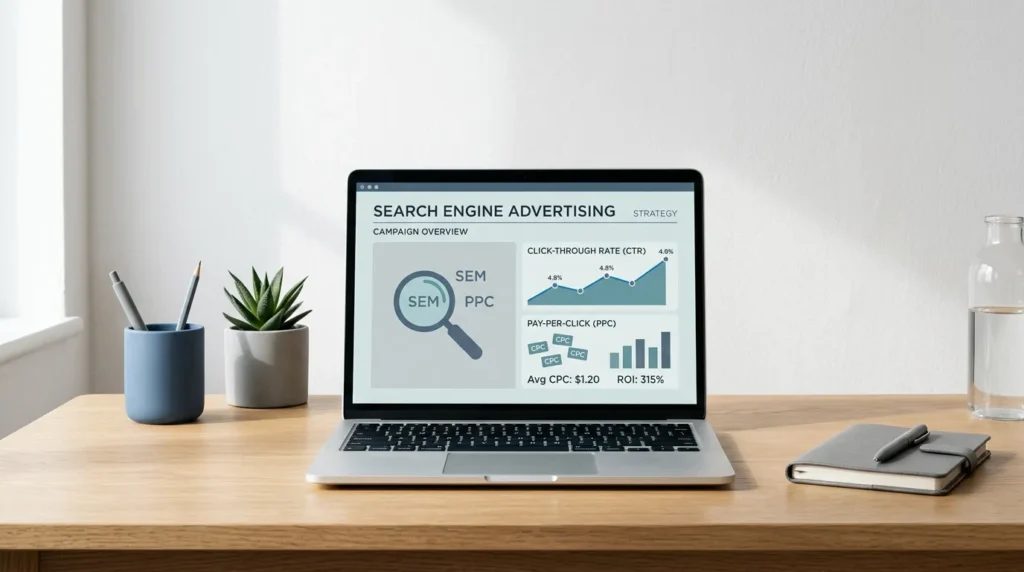
Grab your coffee. Let’s keep it simple: sea marketing (Search Engine Advertising) is paid search advertising that makes you visible at the right moment to people who already have commercial intent. Not “nice to know” traffic, but searchers actively looking for a solution.
What I keep seeing in practice is that SEA can often deliver results the fastest, provided you connect it properly to your website, your conversion process and your measurement. The pitfall is predictable too: many accounts start with budget and ads, and then forget that the real work only begins with search terms, landing pages and conversion tracking.
In this article, I’ll help you with a practical approach. You’ll learn which parts your account needs, which choices matter and what you can do next. We’ll keep it focused on online marketing and sales optimization, because that is where SEA makes the difference.
SEA marketing is Search Engine Advertising, where you show ads in search results based on search queries (keywords) and bids. You pay when someone clicks your ad, so you keep steering on the efficiency of your clicks and, above all, on what happens after that.
The strategy behind SEA is usually one of these three:
Now for the integration with your broader marketing mix. SEA rarely works well as a channel that stands apart from:
If you want to structure this like a professional, it helps to see SEA as a marketing tool. Not as a separate “ad project.” There is a marketing chain behind it: search intent to ad to landing page to tracking to decisions.
Want to get the basics of search advertising clear as well? Then read SEA: What Is Search Engine Advertising and How Does It Work?.
Be honest: your account probably has one problem — too much is mixed together. That makes optimization slow and reporting unreliable. So: build structure around intent and conversion goals.
A practical starting point:
Why this works: your ad copy and landing page can then keep following the same message as the search intent. That is good for relevance and for conversion.
Keyword match types help you control how closely a search query must match your keyword. In Google Ads, match types are generally explained as exact match, phrase match and broad match. (business.google.com)
What I do in practice:
Important: keyword match type does not automatically change your Quality Score, but it does influence which search queries you can get. (support.google.com) That is why “set it and forget it” almost never works with broad.
Ads attract attention. Landing pages earn it. You want the same promise to come back in your web copy, your structure and your CTA (Call to Action).
In other words:
This is not a creative exercise. It is conversion behavior. A mismatch creates drop-offs. And with SEA, you pay for those drop-offs.
Now for the part that is often approached the wrong way. Many teams only look at CTR (Click-Through Rate). But CTR is just the beginning. What you want to steer is what happens after the click, so conversions per keyword, per landing page and per search intent.
Google uses Quality Score to determine how relevant and useful your ad and landing page are for a search query. The components Google mentions include expected CTR and landing page experience. (support.google.com)
What this means for you:
Trade-off: if you filter too aggressively on intent, you get less volume. So you need to find a balance between precision and scale.
Broadly speaking, you can steer on cost per result. Note the definitions:
In practice, there are two workable approaches:
Be careful with a “single metric” obsession. A good campaign can have a temporarily higher CPA if the quality of the conversion improves. That is why you need to connect your KPI’s (Key Performance Indicator) to sales value, not just to web forms.
This is the area where many SEA teams stumble. You can optimize ads until you drop. But if your conversion measurement is incomplete, you are steering on a distorted picture.
Measure at least:
In privacy-first environments, standard measurement is less complete. Google has privacy-preserving measurement solutions for this, such as sitewide tagging, enhanced conversions and Consent Mode in combination with Google Analytics 4. (business.google.com)
What you should take from this in plain language:
Enhanced conversions is explained by Google as a best practice for improving conversion measurement, including hashed customer data and a consent framework in the EEA and the United Kingdom. (support.google.com)
If you do not have this in order yet, the next step is not “more budget.” The next step is: improve your measurement quality first, then optimize.
Tip from experience: have your sales team check once per quarter whether the definitions still match. It takes time, but it prevents you from optimizing for “forms” that nobody takes seriously.
Optimizing SEA is not a magic trick. It is a rhythm. You work in cycles based on data.
You start with a basic set of keywords, but you end with search term data. Build a process that checks irrelevant searches weekly and adds negative keywords where you see noise.
Why this works: broad can deliver extra variants. (business.google.com) That is valuable as long as you filter by intent and conversion result.
If a group of search terms has high CTR but low conversions, it is often due to:
Practical improvements that often have a fast effect:
Trade-off: if you make the form too short, you often get more unqualified requests. That is why you connect your CRO (Conversion Rate Optimization) to lead quality, not only to CVR (Conversion Rate).
If your campaign segments have different lead quality, treat them differently too. That sometimes means different campaigns or different landing pages for different segments.
You can approach this with a simple rule:
And yes, this is a bit boring. But boring is often the fastest route to predictability.
Sometimes you do not have room internally, or you need to build learnings faster. Then an SEA marketing agency can help, provided you use clear selection criteria. What matters to me is not just numbers, but also working method and measurement discipline.
If you want to approach this path with more control, check out Choosing an SEA Marketing Agency: Selection Criteria. Pay extra attention to:
No agency has to do everything itself, but you do want one clear owner for the chain from ad to pipeline.
If you want to sharpen your SEA marketing now, my advice is clear:
SEA works. But it works as a system, not as a standalone campaign. And once you set that up properly, optimization becomes a process your team can repeat without starting over every month.
If you want, you can tell me what you are measuring now (which conversions), what offer you are advertising and whether you mainly serve B2B or B2C. Then I’ll make a short, practical SEA improvement roadmap for your situation. (No vague advice list, but choices in the right order.)
Book a free strategy call and discover how many leads we can generate for your business. No obligations — just a concrete growth plan.
Book your free strategy call → Book your free strategy call — 30 min, no strings attached