

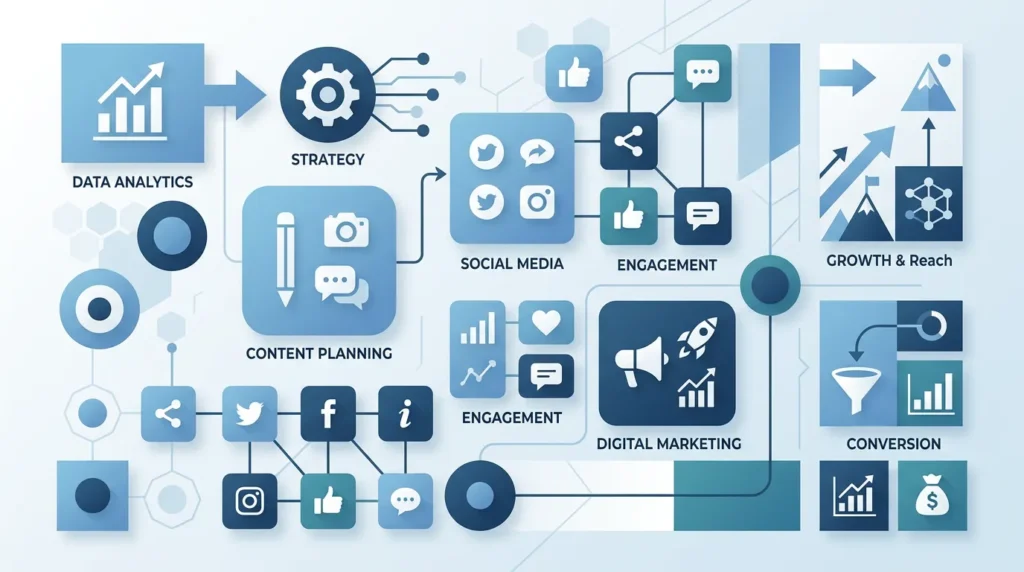
Grab your coffee, because I’m going to tell you something we keep seeing in practice over and over again. Social media marketing often sounds like “posting content and hoping it works”. But if you approach it properly, social media marketing is a sales engine on demand. Not because every post creates customers, but because we build reach, trust and conversion step by step, with clear KPI’s, smart content and targeted campaigns.
In this article, I’m speaking to you as a professional. We’ll explain what a social media marketing agency really does, which services you can expect, which models often work in terms of pricing and collaboration, and above all: how to choose an agency that delivers with measurable results in online marketing and online sales. No magic. Just a plan.
What exactly does a social media marketing agency do?
At its core, a social media marketing agency is a team that turns your social channels into a structured system. That system has three parts:
- Strategy: who do we want to reach, what do we want them to do, and what is the message per stage of the funnel?
- Creation and execution: content that makes sense, a realistic schedule, and campaigns driven by data.
- Measurement and adjustment: reporting on KPI’s, improvement cycles and conversion optimisations.
So it doesn’t just mean “making content”. It also means we understand how social media feeds through to your website, quotes and purchases. Sometimes directly, often indirectly. Think brand trust, retention and repeated exposure. And yes, in many projects it ultimately comes down to Lead Generation via online marketing and online sales activities, through contact forms, demo requests, or other commercial enquiries.
The E-E-A-T lens: why quality and trust matter
You can do a lot on social, but without trust it stays superficial. Google describes E-E-A-T (Experience, Expertise, Authoritativeness, Trustworthiness) as a quality signal in content evaluation. The basic idea is: show that you know what you’re talking about, and make it clear who is behind the information. (developers.google.cn)
In social media, that translates into things like:
- Experience-based content: why does something work in your practice, and what was the outcome?
- Making expertise visible: explanation, frameworks, cases (without unfounded claims).
- Reliable presentation: a consistent tone of voice, transparency, a clear contact route.
Dry humour included: social content that only shouts “we’re excited” eventually just becomes annoying. Content that explains and helps works longer. And usually it causes less internal team debate too.
Services you should expect from a social media marketing agency
Not every agency does everything. But a professional social media marketing agency can usually provide these services. We’ll also immediately show what you get out of them and how they’re executed in practice.
1) Social media strategy and channel selection
We always start with choices. Not because everything has to be done, but because your budget and attention are limited.
We map out:
- your target audience and their buying or decision-making behaviour
- the funnel stage per message (TOFU, MOFU, BOFU means in this context Top, Middle and Bottom of the Funnel)
- which channels fit your goal: reach, Community, or Lead Generation
If you work in B2B, this often moves toward content and campaigns that fit consideration and decision-making. Platforms like LinkedIn are often used for that, for example with Sponsored Content and lead formats depending on your setup. LinkedIn also describes the route from targeting to lead intake via ad formats. (business.linkedin.com)
2) Content plan, formats and editorial calendar
This is where the real difference between “posts” and marketing comes in. An agency with discipline usually delivers:
- content pillars (what we keep discussing again and again)
- formats (video, carousels, document posts, Q&A, stories from practice)
- a calendar that is realistic, with room for community and reactions
The goal is consistency in quality. Not volume for the sake of volume. In practice, we often saw that the content rhythm we could sustain had more impact than a spike in week 1 and silence in week 3.
3) Community management and engagement with purpose
Community management is more than replying. It’s about guiding conversations that create value. Think about:
- collecting questions for FAQ content
- spotting barriers to purchase
- using signals to fine-tune campaigns
At this level, we often work together with sales, so responses match your offer and your quote process.
4) Social advertising (paid social) and campaign setup
Many social agencies sell “ad management”. You need to understand that properly. Paid social only makes sense if the goal is clear, for example:
- website traffic that contributes to Lead Generation through conversion points
- targeted inflow to a landing page
- retargeting based on behaviour
A mature agency ties the ad to your measurement plan. Measurement does not just mean clicks, but also conversions. And conversions do not mean “every mouse click”. It means actions that have commercial meaning, such as a completed contact form or a demo request, so real Lead Generation.
An example of what to watch for in social advertising is the setup around audience and formats. LinkedIn, for example, describes different ad formats and how they fit into the lead intake route. (linkedin.com)
5) Reporting on KPI’s and optimisation
Reporting that you actually use usually includes:
- what we tried to achieve
- which KPI’s belong to that
- what worked, what didn’t, and why
- what we’ll do differently next week
Keep in mind: your KPI’s must fit your goal. If your goal is Lead Generation, we don’t just measure engagement. We measure conversion into a commercial action. That can be via CVR (Conversion Rate), and for campaigns also via ROAS (Return on Ad Spend), depending on your data maturity.
Be honest: social analytics without a conversion link is often just “nice numbers”. Useful, but not management information.
When is it smart to bring in a social media marketing agency?
Outsourcing is not automatically better. But sometimes it’s exactly what you need, because time, discipline and specialist execution are scarce.
Outsource if one of these situations applies
- You have good people, but nobody has room for consistency and campaign execution.
- You do social “on the side”, so it doesn’t make a structural contribution to online sales.
- You want to scale into paid social, but your tracking and conversion flow are not tight yet.
- You have internal content discussions that take weeks. An agency can standardise process and formats.
Don’t outsource if your goal stays vague
If you have no idea which commercial actions you want to stimulate, social quickly becomes a creative hobby. Of course, creativity is needed. But marketing without objectives is like coffee without flavour. You have it, but you won’t buy it again.
So ask early about the measurement plan and the lead flow. If you’re still not sure what that flow should look like, also take a look at this background on other parts of online marketing, such as:
- Choosing the best online marketing agency: here’s how to do it right
- SEO and SEA: the difference, the benefits and when to use both
Pricing models and what they mean in practice
There are roughly four pricing models you often see at social media marketing agencies. No model is perfect. It’s about whether the model fits your scope, pace and measurability.
1) Monthly fee with fixed scope
This model works well if the work is clear, such as content planning, x posts per week, community management, and fixed reporting.
Trade-off: if you need more later, that usually happens through add-ons.
2) Fee plus ad budget management
Then you pay an agency fee and an amount for campaigns (for paid social). In that scenario, ROAS (Return on Ad Spend) or a similar metric is essential, or at least you use conversion KPI’s to steer performance.
Trade-off: you need to be sharp on tracking and landing pages. If your landing page doesn’t convert, you can buy social smartly and still get poor results.
If you also use ad channels outside social, it can help to understand the basics of ads and management, for example in:
3) Project price for a strategy plus launch
Useful if you first want to get things in order. Think of a content strategy, format development, and setting up campaign structure.
Trade-off: after the project, you still need to keep pushing with execution and optimisation. Marketing doesn’t stop because a deck is finished.
4) Performance fee linked to commercial actions
Sometimes you’ll see a model where costs are partly linked to Lead Generation performance. In theory, that can be right, but only if everyone uses the same definition.
What you need to enforce:
- what counts as a “lead” in your agreement (for example, a completed form with minimum quality)
- how you prevent your agency from optimising only for quantity
- which KPI is leading, and what the definition of success is
Be honest: without quality criteria, performance pricing quickly becomes a discussion about definitions. And that discussion costs energy, while you’d rather be making content.
How do you choose the right social media marketing agency? Checklist for professionals
You can assess an agency without romance. Below is a checklist we use in audits and selection conversations. It gives you clarity faster than ten presentations.
1) Ask about their approach to goals and the funnel
A good agency doesn’t start with creative material. They start with objectives and funnel logic. Ask:
- Which TOFU/MOFU/BOFU messages do we create, and how do we translate that into content?
- Which commercial action do we measure as the primary success metric?
- How do we connect social to that action, via website and landing pages?
If you’re mainly looking for Lead Generation, it helps to also look more broadly at your online conversion chain. Think landing pages and campaign consistency. Short version: improve your conversion, and your social spend becomes less “expensive gambling”.
2) Check tracking and measurement plan, not just reporting
An agency can send pretty reports. But what do you want to see?
- which conversion points we measure (Lead Generation definitions)
- what role GA4 (Google Analytics 4) plays
- how events are passed on, via GTM (Google Tag Manager) if that’s in your setup
- how often we check data for errors, such as duplicate events
If this part is vague, it’s often a sign that optimisation later will run on “gut feeling”.
3) Pay attention to the quality of the content process
Ask how they work with feedback and approvals. Specifically:
- how many feedback rounds are standard in the process
- how input is turned into publishable content
- who writes, who edits, and who publishes
If the agency can’t explain its process, you’ll end up fighting the same battle again with every post.
4) Assess their expertise in social advertising and conversion
You don’t need to be an ad expert to assess this. Ask about their way of working:
- how do they launch campaigns (hypotheses and tests)
- which KPI’s do they optimise, for example CTR (Click-Through Rate) versus CVR (Conversion Rate)
- how do they optimise landing pages together with your team
- which limitations do they expect (for example budget pacing, creative fatigue)
Pro tip: good agencies don’t just say “we optimise”. They also say what they change. Creatives? targeting? bidding strategy? funnel inflow? That makes it testable.
5) Look at specialisation, not general claims
Do you have a niche? Then you probably want an agency that understands that logic. If, for example, you’re looking for online contractors to deliver more commercial results, there are specific routes. You can already read background content about online marketing for that situation, such as:
And if you do B2B, it helps to look at what works for business prospects. In that context, this page is relevant:
6) Check how they organise collaboration and communication
Marketing is teamwork. Ask about cadence:
- weekly or biweekly sprint calls
- who provides content input
- how quickly they respond to feedback
- what a monthly report looks like, and what the follow-up action list is
If the answer is “we send everything by email”, it often becomes reactive. You want a rhythm where we learn and improve.
The next step: how to turn your social into a measurable system
Okay. You probably don’t want theory. You want a next step you can take tomorrow. This is a practical route we often use as the start of a social collaboration.
Step 1: Define one primary commercial objective
Choose one. For example, Lead Generation through completed forms, or appointments via a booking flow. We also define what a marketing qualified lead (MQL) or sales qualified lead (SQL) means in your context. Note: the definitions have to fit your sales process. Otherwise you measure “something” and manage “something else”.
Step 2: Get your conversion chain in order
Social is inflow. Conversion happens on your website and landing pages. If there’s noise or delay there, your social budget will deliver less return.
Use this kind of background to improve your environment:
Step 3: Create a content plan with measurable variations
We start with content pillars and formats. But we make sure we create variations so we can learn. Don’t change everything at once, or you won’t know what had the effect.
Step 4: Start a test phase for paid social with clear KPI’s
If you use paid, we run a small test set with:
- a clear audience and message
- a landing page that supports the message
- measurement on CVR (Conversion Rate) and the commercial action
We monitor and optimise. But we don’t promise anything about “always better”. We work with hypotheses and iteration. That’s honest, and it works better than hope-based marketing.
Step 5: Consider automation for lead follow-up and reporting
Social is often a top-of-middelfunnel signal. Automation can help with quick follow-up, updating lead status in your CRM (Customer Relationship Management), and making your marketing reporting consistent.
If you want to dive deeper into this, this is a useful starting point:
Important: automation should never make autonomous budget changes or decisions without human approval. We use automation to improve speed and consistency, not to replace governance.
Step 6: Connect social with other channels where it makes sense
Social often works better when it’s part of a broader online plan. Think SEO (Search Engine Optimization) and Search Engine Advertising, or email marketing to turn interest into conversion.
Useful background:
- Email marketing strategy: from list to conversion
- SEO and SEA: the difference, the benefits and when to use both
Conclusion: choose a social media marketing agency based on execution and the measurement plan
If you take one thing away, let it be this. Choose a social media marketing agency that sees social as online sales optimisation, not as a content machine. You want strategy, creation, paid social where it fits, and above all: a measurement plan that supports commercially meaningful actions.
Our selection criteria are therefore simple:
- clear goals and funnel logic
- conversion and tracking that work correctly
- a content process that gives your internal team rhythm
- optimisation on KPI’s, not on “feeling”
And if you’re still unsure, you can also read more context on the approach of social marketing agencies in general via:
Then you’ll be ready for the conversation. You ask focused questions, you test the way of working, and you choose the agency that fits your online ambition most logically. Relaxed at the table, but professional in execution.
