

You hear the terms inbound and outbound everywhere. And yet I see in practice that teams often make the same mistake: they choose one camp, as if marketing and sales were one-way traffic. Let’s fix that.
In this article, we explain the difference between inbound marketing and outbound marketing. Then we translate that into a workable strategy for online marketing and lead generation. With clear choices, concrete examples of what works, and a next step you can already take tomorrow.
Because honestly, you don’t want a “pretty” funnel. You want a predictable system that delivers quality. Not just volume.
Inbound vs outbound: what’s the real difference?
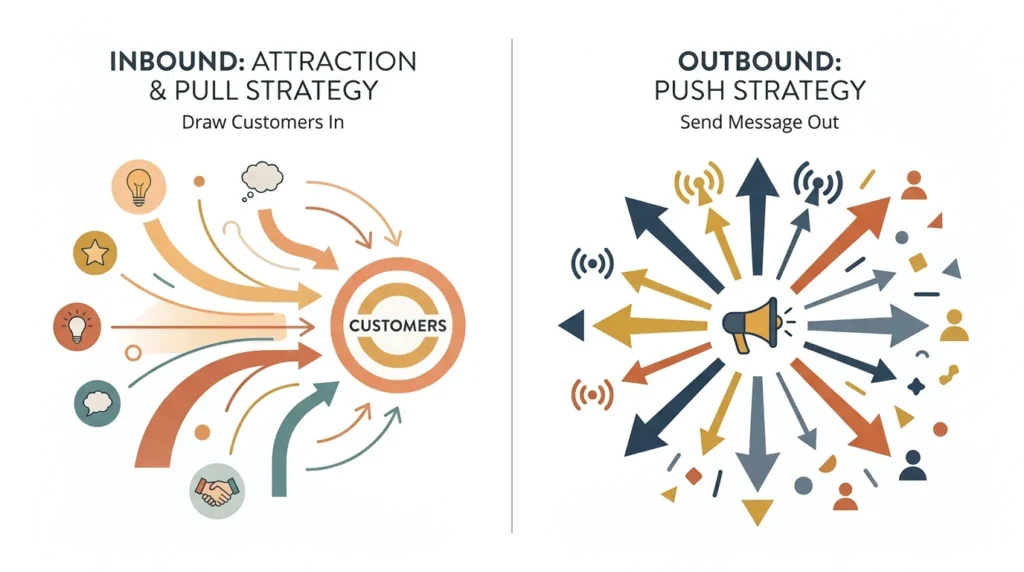
The difference is not in the channels. It’s in the initiative. Who draws attention to themselves, and who pushes a message into the market?
Inbound marketing: you attract, prospects come to you
Inbound marketing is an approach in which you create valuable information so people find you when they are already actively looking for a solution. You create content that matches questions, problems, and decisions. Think SEO copy, landing pages, whitepapers, webinars, and supporting email campaigns. HubSpot describes inbound as a method that attracts people through relevant content, rather than just “pushing”. (hubspot.com)
In practical terms, this means:
- You target the moment when someone is already in search mode.
- You build trust before the conversation.
- You optimize for traffic quality and conversions, not just reach.
Outbound marketing: you go to them, prospects are approached
Outbound marketing is a proactive approach. You take the initiative and approach people with a message, through channels such as cold outreach, paid interruptive advertising, and other forms where you do not wait until someone searches for you. TechTarget describes outbound as a strategy in which companies actively make contact with potential customers, often through methods such as cold calling or cold emailing, direct mail, and paid campaigns. (techtarget.com)
In practical terms, this means:
- You target people who are not yet looking for you.
- You start the conversation with relevance and a clear next step.
- You measure speed, response, and qualification, not just likes or views.
Why this difference matters
Because it directly affects your strategy, your message, and your metrics.
Inbound often works better when you are already building a brand or when you can build content assets that keep generating returns. Outbound often works better when you can sharply target specific accounts or segments, and when you are willing to iterate on pitch, timing, and follow-up.
What works when: the strategy behind smart choices
Here comes my “coffee with a bit of sharpness” part: the best companies use inbound and outbound together. Not because it sounds nice, but because the limitations of one are exactly the strengths of the other.
When inbound deserves priority
Choose inbound if one or more of these situations apply:
- You sell something people research first. Think complex services, B2B solutions, or journeys with multiple stakeholders.
- You can build a content library that answers real questions.
- You want a more stable system. You accept that results often come later, but you are looking for durability.
Inbound is strong at reducing friction. You lower the effort prospects need to trust you. That is exactly why SEO and content are so often at the foundation of a strong lead generation machine.
If you also want to understand how SEO and Search Engine Advertising (SEA) complement each other, feel free to read SEO and SEA: differences, benefits and when to use both.
When outbound deserves priority
Prioritize outbound if:
- You need pipeline fast, for example to hit a quarterly target or test a new proposition.
- You have a clear ICP (Ideal Customer Profile) and you know who the decision-maker is, or at least who you need to reach.
- Your offer is sharp enough to convert based on value and timing.
Outbound is less about “waiting” and more about “approaching”. But pay attention: outbound is not about bulk. It’s about relevance, cadence, and qualification. Otherwise you’ll mostly end up talking to people who do not care about your message.
Why the combination often wins
Inbound makes outbound warmer. Outbound makes inbound faster to scale. In practice, I especially see this when you:
- Use outbound to start conversations with specific accounts.
- Use those conversations to improve your inbound content (questions, objections, prospects’ language).
- Then update your SEO and landing pages based on what prospects actually say.
This is not theory. This is what your team will notice in conversion rates (CVR) and in the quality of Marketing Qualified Leads (MQL) moving toward Sales Qualified Leads (SQL).
The difference in execution: message, channels, measurement
You can use inbound and outbound on the same channels. Think email or advertising. The difference lies in the role the channel gets within your system.
Message: inbound educates, outbound persuades
Inbound content explains, helps people decide, and reduces doubt. Outbound messaging needs to land faster. You need to make it clear in the first lines:
- Who it is for (segment).
- Which problem it addresses (pain or context).
- What the next step is (CTA, Call to Action).
A simple rule of thumb that works well: inbound is “here is information”. Outbound is “this is why it is relevant to you, do you want us to make it concrete together?”
Channels: examples without noise
To keep it practical, this is how you can usually place channels:
- SEO and content are inbound building blocks.
- Search Engine Advertising (SEA) can support inbound (capturing intent) and complement outbound (push to target audiences), depending on your targeting and landing strategy.
- Cold outreach is typically outbound, unless it concerns people who have already signed up for a relevant value exchange.
If you use content and ads interchangeably, that is not wrong in itself. But make sure the intent and role are clear in your funnel design.
Measurement: different KPIs, different feedback loops
This is often where the hidden cost sits. Teams measure inbound as if it were outbound, or the other way around. That leads to the wrong optimizations.
For inbound, you often look at:
- Organic performance and CTR (Click-Through Rate) from your search results, via Google Search Console (GSC).
- Conversions on landing pages, with emphasis on CVR (Conversion Rate).
- The path from visit to contact, including lead qualification quality.
For outbound, you often look at:
- Response rates and meetings, plus lead scoring toward SQL.
- Speed to lead (how quickly follow-up happens).
- Impact on pipeline, not just on “opens”.
The KPI (Key Performance Indicator) you choose should support your definition of success. Otherwise you are measuring, but not steering.
Tracking and hygiene: you cannot optimize what you cannot see
We often see teams relying for too long on a tracking setup that does not fit their funnel. That is why it is smart to connect your event tracking through Google Tag Manager (GTM) and define your conversions clearly. Use Google Analytics 4 (GA4) to understand behavior, but let sales feedback flow back into your marketing learnings. That is where the “magic” in real results lives.
Combining inbound and outbound into an integrated lead generation machine
Okay, how do you build this without turning it into a spreadsheet novel? You need an integrated approach with one central logic: the same audience, the same core message, different moments.
Step 1: tighten your ICP and funnel definitions
Start with ICP (Ideal Customer Profile). Who is it, what context are they in, and what decision do they need to make? Then define clearly:
- What is a lead? (Only when someone shows real commercial interest and leaves contact details or makes a concrete request.)
- What is an MQL?
- What is an SQL?
- When does a conversation become a real opportunity for sales?
These definitions need marketing and sales to speak the same language. Otherwise each team will optimize based on its own intuition.
Step 2: choose inbound assets that can feed outbound
Create inbound content that can “support” your outbound messaging. Don’t think in pages for the sake of pages. Create assets that address a specific objection, such as:
- Comparable scenarios (without marketing fluff, just the problem and approach)
- A checklist or framework prospects can use themselves
- Case-style explanations focused on process and results (without empty claims)
That gives sales and outreach something concrete to refer to.
Step 3: design outbound with cadence and qualification
Outbound only works well when you see it as a series of micro-moments. Not as one message. You want a cadence that:
- Adds relevant context at each step (not just the same sentence again).
- Combines quick follow-up with respect for timing.
- Routes leads to the right next action (reply, meeting, nurture).
In practice, email is often the most scalable, provided you protect quality. If your email strategy is central, Email marketing strategy: from list to conversion will help.
And if you specifically want to make B2B email profitable and scalable, then B2B mailing: how to make it profitable and scalable fits well with your next iteration.
Step 4: automation with judgment (for efficiency, not magic)
Automation can help you follow up faster, categorize leads correctly, and make your campaigns more consistent. Use automation only if it demonstrably works better for efficiency or conversion quality. Typical examples in online marketing and sales optimization:
- Automatic enrollment into nurture as soon as someone requests an asset.
- Routing to sales when an SQL criterion is reached.
- Recognizing page interest to personalize outreach.
- Reporting that tracks marketing and sales together using the same definitions.
Watch the boundary: automation should not independently change budgets or make promises to prospects without human oversight. In marketing, control is about compliance and quality.
Step 5: test and learn by audience, not by channel
The best tests are audience tests. Not “does email work better than SEO?”. The real answer is usually: for audience X, channel Y with message Z works better.
Work in short iterations. Look at:
- CVR from landing to contact
- Conversion from contact to MQL to SQL
- Meeting rate and show rate toward sales
When you see where the flow gets stuck, you know exactly which part of your inbound and outbound setup to adjust.
Common mistakes with inbound and outbound, and how to avoid them
These are the pitfalls we see most often. And yes, I have made them myself too, back when I was too eager to “find what works”.
Mistake 1: you measure “activities” as if they were conversions
You can have lots of traffic or lots of sends without it producing real lead qualification. Keep the chain sharp: lead, MQL, SQL, meeting, opportunity, customer.
Mistake 2: one message for every moment
Inbound is not the same job as outbound. Keep the core message the same, but adapt the angle by stage. Inbound may explain more. Outbound needs to answer more of “why you, why now, what’s in it for me?”.
Mistake 3: no feedback loop with sales
Sales knows why deals do or do not close. If you do not feed those insights back into content and outreach, you keep optimizing on assumptions. That works for a while, until the market changes.
Mistake 4: starting outbound without warming assets
Outbound can be faster, but if prospects do not have a convincing path to build trust (content, proof, explanation), you lower the chance of conversion. So build the basics first, or make sure outbound points to the right information source.
Practical next step: choose your starting point for the next 14 days
If you do not yet have an integrated approach today, I would not change “everything” at once. You can get wins faster by tackling one bottleneck.
Use this simple plan for the next 14 days:
- Week 1, days 1 to 3: redefine your funnel and measurement definitions. Record what lead, MQL and SQL mean in your system.
- Week 1, days 4 to 7: choose 1 inbound asset that is already attracting attention (SEO or paid traffic to the same landing page). Improve the page based on real questions and objections.
- Week 2, days 8 to 10: build outbound messaging around one concrete problem from that asset. Make sure there is one clear CTA toward a meeting or next step.
- Week 2, days 11 to 14: set up your follow-up sequence and routing rules. At minimum, check speed and lead qualification quality.
If you want extra tactics for lead generation, take a look at Generating More Leads: 12 Practical Tactics (2026). And if your focus is B2B and you want to know how to reach business prospects, then Generating B2B leads: reaching business prospects is a logical addition.
Conclusion: inbound and outbound are not rivals
The difference between inbound and outbound is simple, but the application is where it gets interesting. Inbound attracts prospects with value and intent. Outbound takes the initiative with relevance and a clear next step. Together, they form a system that can deliver both speed and durability.
If you take one thing away: stop choosing based on gut feeling. Choose based on funnel, audience, and measurable flow from lead to MQL to SQL. Then inbound and outbound stops being a debate. Then it becomes a plan.
Do you want to translate this into your channel mix and team agreements? A good next step is also to clarify how you choose execution and support. If you are considering organizing that capacity with an agency, then Choosing the best online marketing agency: how to do it right is a good fit for your preparation.
And if you specifically work in the online construction contractor space, then Online marketing agency for online construction contractors: how you win can help you with a practical approach to lead generation and conversion.
