

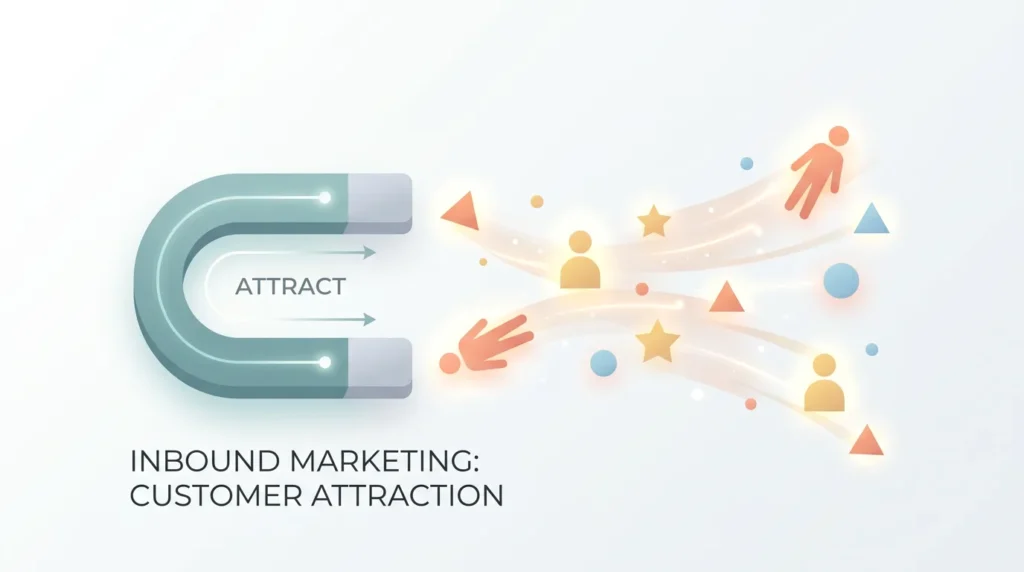
When you hear inbound marketing, you often think of “posting content” and you’re done. That’s not it. Inbound marketing is a method for drawing people toward you, then helping them choose, and then turning them into customers who build trust.
In practice, it works like a system. Not like a stand-alone campaign. You build a route from question to answer. And you measure where that route really delivers results. In this article, we give you a clear, practical blueprint, with choices you can apply tomorrow.
What is inbound marketing, and why does it work?
Inbound marketing is a form of marketing where you offer value before asking for action. The idea is simple: people have questions, problems and doubts. You help with content and experiences that make them smarter. Only then comes the commercial step.
Many teams describe inbound marketing with three phases: attract, engage and delight. The goal of attract is visibility and first interest. Engage is about the conversation and conversion. Delight is about retention, advocacy and satisfied customers. You see this setup reflected in the inbound methodology and the related flywheel thinking. (hubspot.com)
The strategy behind inbound marketing
Inbound is not “chasing free traffic”. It’s about timing and relevance.
- Timing: You show up at moments when your audience is trying to figure something out.
- Relevance: Your content matches the exact level of their question, from exploring to deciding.
- Continuity: You build a library and a conversation, not a one-off post.
Why it works (without magic)
There are two building blocks that make inbound credible:
- People search for solutions, not ads. Content helps them understand better what they need to do.
- Search engines reward helpful content. Google emphasizes in its guidelines that you should create content for people, “people-first”, and not for ranking manipulation. (developers.google.com)
Note: inbound is not a button you switch on. Expect a build-up phase. Especially if you’re starting with a small content base or a website that is not yet known as an “informative source”.
The inbound marketing model: attract, engage and delight
Let’s make the model practical. You can run inbound through all kinds of channels, but you do need to understand the logic per phase.
Attract: draw people in with valuable entry-level content
Attract content is often informative and broad enough to fit the first search. Your goal is not to sell right away, but to create recognition and trust.
Examples that usually work well:
- SEO articles for search intent (problem, approach, high-level comparison)
- Guides and checklists (useful to save)
- Webinars or short videos that make one topic truly clear
Practical tip: write based on concrete questions from sales, support and conversations with prospects. That’s often the fastest route to content that “really works”.
Engage: help people decide and make conversion possible
Engage means: you guide visitors from interest to lead or purchase. This is where content becomes more focused.
What works in engage:
- Supporting landing pages per use case, not one generic page
- Lead magnets that deliver value immediately (for example a template or calculator)
- E-mail nurture that answers questions at the right time
This is also where your measurement model comes into play. Without insight, you don’t know which questions your audience is really asking.
Delight: strengthen the relationship after purchase
Delight is where inbound often gets sloppy. Teams think: “The deal is closed, done.” But satisfied customers become returning customers and give your marketing material for new content.
Delight actions that are practical:
- Onboarding content that prevents customers from dropping off
- Case studies that not only show success, but also explain choices
- Community or events, starting small is fine
In the inbound flywheel idea, you see this as a cycle, not an endpoint. (hubspot.com)
From strategy to execution: what you should do first
You can make a beautiful inbound plan that ends up in a drawer. That’s why we give you a route you can follow step by step. No jargon, just choices.
Step 1: choose one audience and one problem as your starting point
Inbound works fastest when you define one segment sharply. Not everyone, not everything. Choose the audience sales talks to most often and where you can really deliver value.
Then make one “problem hypothesis” concrete, for example: “We solve X for Y, usually when Z.”
Step 2: build your content map based on search intent and phase
For the starting point, take 10 to 20 topics. Not 100. For each topic:
- Which phase does it fit? attract, engage or delight.
- What is the main question the reader has?
- What is the next step that feels logical?
You don’t have to gate everything. Gating is useful for lead capturing, but it also slows traffic down. Trade-off: more leads versus less reach. Choose consciously.
Step 3: create a measurement plan that guides your behaviour
If you want to do inbound marketing, you need to know what “good” means. We usually use a short KPI set, because otherwise nobody keeps track of it.
A usable KPI set:
- Attract: organic traffic on core topics, engagement on content (time on page, scroll, returning visitors)
- Engage: conversion to lead, e-mail response (opens are not everything, also look at clicks)
- Delight: retention or repeat purchase, pipeline contribution through upsell and referrals
Limitations, to be honest: measurement models are always estimates. Especially if you have many touchpoints and not everything can be traced directly back to one campaign.
Step 4: focus content on “helpful, reliable, people-first”
This is not a marketing slogan, it’s a practical quality standard. Google asks for content that genuinely helps people and is not primarily meant to influence search rankings. (developers.google.com)
In concrete terms, that means:
- Write from real questions and experiences.
- Explain trade-offs, even when your product is not always the answer.
- Make reading easy, avoid vague claims.
Which channels fit inbound marketing best, and what you can skip
Inbound marketing is channel-agnostic. But not every channel delivers leads of the same quality. We therefore choose based on intent and production effort.
SEO as the backbone, as long as your content is trustworthy
SEO is often the core of attract. You build a durable library. But you only get durability if the content is strong and stays consistent.
If you want to know how to tackle this in practice, also read SEO in practice: strategy, execution and growth.
Content marketing for questions, not for “views”
Content marketing is a broader term than inbound, but they overlap. The Content Marketing Institute describes content marketing as an approach in which you offer valuable information to help and move your audience. (contentmarketinginstitute.com)
In inbound, you translate that into the buyer journey and your phase: attract content answers exploration questions, engage content supports choice, delight content helps with success after purchase.
E-mail for engage and nurture
If you’re doing inbound, e-mail is usually your fastest lever for conversion. Not because everyone thinks e-mail is “magic”, but because e-mail lets you time your message.
If you want a complete plan, look at Email Marketing: Complete Strategy Guide (B2B and B2C).
Marketing automation for consistency
Automation ensures you deliver the same quality experience, without the manual work continuing to pile up.
A practical route is to connect flows to behaviour: download, sign-up, website page, or e-mail click. You can then follow up logically without your team having to manually handle every lead.
Read more about this in Marketing Automation: efficiency and scale through smart flows.
A brief note on “AI search engines” and GEO
AI and new search formats are changing how people find information. That’s why you see teams thinking about Generative Engine Optimization (GEO). If you’re curious about that, you already have a starting point in GEO (Generative Engine Optimization) explained, practically and GEO (Generative Engine Optimization): hub for AI search engines.
Practical nuance: this is still developing. Use GEO as an extra layer, not as a replacement for your inbound basics: good content, clear structure and a clear conversion path.
When paid channels make sense in an inbound mix
You don’t have to keep inbound “pure”. But paid channels should support inbound, not drown it out.
A realistic combination:
- Use paid ads to get quick data on which topics resonate.
- Then invest in SEO and nurturing on the best-performing topics.
If you’re also using paid, it helps to understand the basics. See Google Ads explained: strategy and practical steps.
Lead generation with inbound marketing: formats that perform
Lead generation is where inbound teams often stumble. Not because the concept is wrong, but because they create a mismatch between content and conversion.
Build lead magnets that actually “do” something
A lead magnet works better when it solves a task. Think of:
- Templates (fillable in 15 to 30 minutes)
- Checklists with clear criteria
- Calculation modules or calculators
Trade-off: the more specific and valuable it is, the fewer people will request it. That’s not a problem. You want fewer leads, but with better fit.
Work with topic clusters and internal logic
You want Google and visitors to understand where your expertise lies. That’s why it helps to build clusters around one main topic.
Practically:
- 1 pillar content (broad, complete)
- 5 to 10 supporting articles (specific, focused on subquestions)
- clear internal links between articles (so people don’t get lost)
Nurture flows that don’t shout
Nurture is not a spam machine. You want a conversation that moves with the phase. A simple flow often works better than a complicated setup with 40 variants.
Example of a logical approach per lead type:
- Download e-book: send 2 to 3 follow-up e-mails with deeper insight
- Visit pricing page: send a short “what this means for you” story
- Webinar sign-up: reminder, then recap and relevant case
You measure each step, and you optimise for behaviour, not for hoping.
Common inbound marketing mistakes (and how we prevent them)
We see a few patterns returning among teams that want to scale inbound. Luckily, you can get rid of them relatively quickly.
Mistake 1: creating content without a conversion path
You publish an article, but there is no logical next step. Visitors then can’t move forward. So always add a “next question”, for example to a checklist, template or deeper dive.
Mistake 2: everything for everyone
If your audience is not sharply defined, your content becomes generic. Generic content competes against everyone. So choose your segment and your problem hypothesis as your starting point.
Mistake 3: too much top-of-funnel, too little engage
Attract is important, but without engage you can’t convert. Make sure you have at least a few pieces of content that help people decide directly.
Mistake 4: your measurement plan is too vague
If you only look at traffic, you miss the real win. You want insight into lead quality, conversion to sales and the role of content in the journey.
How to speed this up with help from specialists
Sometimes you want speed and specialist execution. In that case, outsourcing is fine, as long as you keep control over quality and strategy.
When choosing, pay attention to process and responsibility, not just presentations. A good place to start is Choosing a marketing agency: what you need to watch for.
And if you’re specifically thinking about SEO, it helps to know when you need a specialist. Then read Hiring an SEO Specialist: What You Need to Pay Attention To.
If you notice that inbound is a lot of work and your team doesn’t yet have the right discipline, you can also look at SEO in 2026: practical guide for growth with focus.
Conclusion: your next step with inbound marketing
Inbound marketing comes down to one core idea: you attract customers with value, you guide them with relevant information, and then you make sure they succeed. That is the method behind attract, engage and delight. (blog.hubspot.com)
If you want to get started now, our most practical next step is:
- Choose one audience and one problem hypothesis.
- Create a content map with 10 to 20 topics spread across attract and engage.
- Set up a simple measurement plan with KPIs per phase.
- Publish the first set and build nurture for the people already showing interest.
Dry truth, with a wink: inbound marketing is not a “trick”. It’s work. But work that pays off, because every publication adds to your knowledge base and conversion engine.
