
 Written by
Daniel van Hek
Search Clicks·August 6, 2026
10 min read
Written by
Daniel van Hek
Search Clicks·August 6, 2026
10 min read
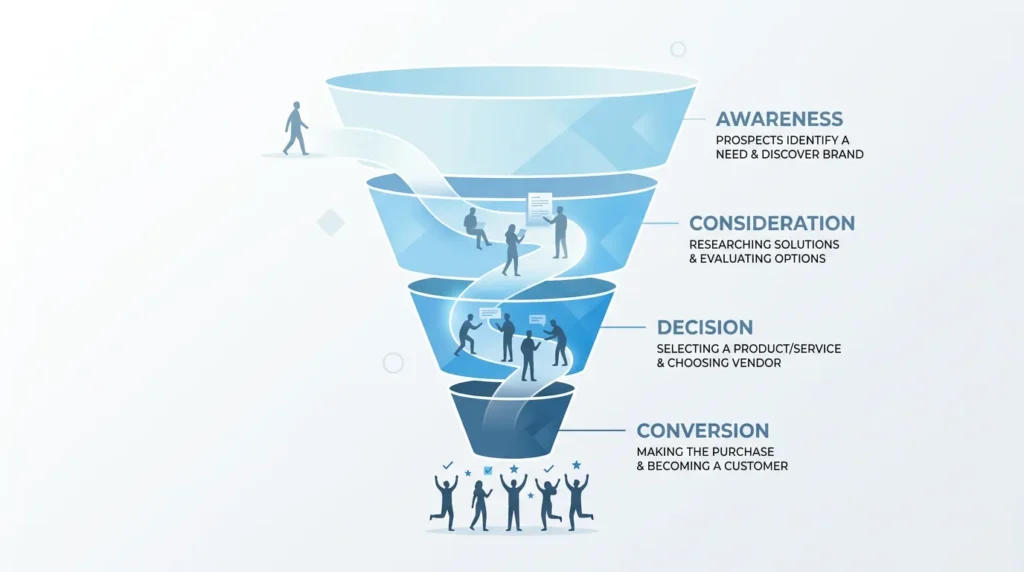
Imagine this: you get new visitors every week, but you notice they’re not taking the next step. No panic. That’s exactly when an inbound marketing strategy really proves its value. Not with “more content,” but with the right content at the right time, for the right audience, with a measurement plan that makes sense. Because online marketing is not a creative casino. It’s a system.
In this guide, we take you from awareness to conversion. You’ll get a practical approach to buyer personas, content mapping, landing pages, lead qualification and measurement with Google Analytics 4 and Google Search Console. We keep it concrete, including what works, why it works and what your next step is.
An inbound marketing strategy comes down to one idea: you attract potential customers with useful information. Not by shouting, but by helping. Many inbound methods describe this as a series of phases in which you attract people, start a conversation and help them move toward a purchase or contact. In practice, we turn that into a realistic journey for your market and sales process. A well-known model is Attract, Engage and Delight, with content becoming more relevant as intent increases. (hubspot.com)
One thing to keep in mind: inbound doesn’t work “automatically.” If your content doesn’t match intent, if your landing pages don’t convince, or if your measurement plan is off, you’ll get traffic without commercial output. (Traffic without output looks nice in the stats, but it’s bad for your team’s calendar.)
Most teams create buyer personas as a PDF full of keywords. We do it differently. For us, a buyer persona is a decision tool that makes content and conversion logical.
Use three sources, in this order:
Practical tip: if you can’t name an objection in your personas, your persona is probably too generic. Make that objection explicit. That’s where your content strategy starts.
TOFU, MOFU and BOFU stand for Top, Middle and Bottom of the Funnel respectively. We use these as broad frameworks. Then we connect them to intent: where is someone in their decision-making?
In TOFU content, you don’t want to sell perfect solutions. You want to create understanding. Think about topics that connect with common challenges and questions. Examples of the type of content that usually works:
Why this works: you capture people who are still exploring. They’re not ready for a demo. But they are looking for information.
MOFU content is where you really start “helping them choose.” Be more specific here:
Why this works: you reduce uncertainty. In this stage, objections become dominant.
In BOFU content, you want one clear next step. No menu with ten forms. Think about:
Why this works: you match your message to the intent. That makes the CTA feel logical, not random.
When your content mapping is in order, your website becomes a roadmap. And yes, it suddenly feels less “marketing” and more “helpful.” Lovely.
Inbound Marketing: Attract Customers with Valuable Content
You can have the best content in the world. If your landing page is off, you’ll lose conversions. And if your lead is not properly qualified, your sales team will waste time.
An important distinction: a lead is a person or organization with possible commercial interest, which we were able to capture through online marketing or online sales activities. After that, you want to qualify.
Why this is crucial: if you don’t define MQL and SQL, you’ll optimize for the wrong goal. Then you may get lots of form submissions, but few conversations that actually matter. That is not “failed marketing,” it’s a measurement and qualification problem.
Nurturing is not spamming. It’s staying relevant based on behavior. In practice, what often works:
You don’t need to build an extra campaign for everything. What you mainly need is a consistent path.
If your inbound marketing strategy isn’t measurable, you’re steering by gut feeling. That can work on Tuesday. Not on a quarterly basis.
In Google Analytics 4, valuable events are marked as key events. This fits the idea that you measure actions that are commercially relevant. Google explains that Analytics uses events for user behavior, and that you can mark events as key events to show them as important in reports. (developers.google.com)
Practically, this means:
Note: if you create too many key events, your dashboard becomes unreadable. We choose deliberately. Fewer metrics, better decisions.
In Google Search Console, you’ll find performance reports that show how often users saw your site in Search, and whether they clicked through. Google says Search Console includes different reports for performance and deeper insights. (support.google.com)
Use it like this:
Extra check: Google also has guidelines for helpful and reliable content, which you can use as a self-check when improving existing pages. (developers.google.com)
You need KPIs, but only if they measure behavior directly. Think about:
If your KPIs don’t explain why someone moves to the next step, then it’s just a dashboard for your ego. And trust me, that drains energy.
Okay, let’s turn this into action. Not big ideas, but a sequence you can start today.
No magic. Just a system that learns. And yes, that feels slower than “more posts.” But it delivers a more stable result in lead quality and conversion.
An inbound marketing strategy works when you bring buyer personas, content mapping and conversion design together. You attract visitors with value. You help them choose with relevant information. And you make the next step easy, logical and measurable.
Our recommendation is simple: start with one persona and one complete route from TOFU to BOFU. Set up your tracking with key events in Google Analytics 4. Use Google Search Console to improve pages that already deserve search traffic. (support.google.com)
Then scale. Not by shouting louder, but by organizing better. Because in inbound marketing, the person who takes the customer’s decision process most seriously wins. And that’s you, if you execute it step by step.
Book a free strategy call and discover how many leads we can generate for your business. No obligations — just a concrete growth plan.
Book your free strategy call → Book your free strategy call — 30 min, no strings attached