
 Written by
Daniel van Hek
Search Clicks·August 9, 2026
12 min read
Written by
Daniel van Hek
Search Clicks·August 9, 2026
12 min read
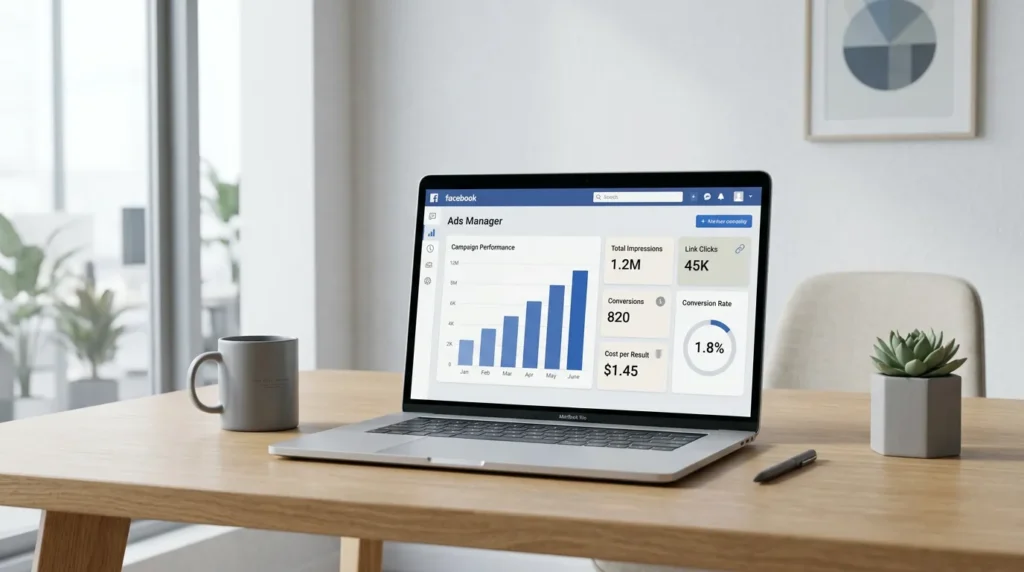
Just imagine running an ad campaign, but not really knowing why it works. No drama, that happens to a lot of teams. Often the problem isn’t the creative or the budget. It’s the mix of audience selection, conversion tracking, and optimization on the right signals.
With facebook ads, you can steer very precisely on reach, engagement, and especially on commercial actions such as appointments and purchases. In this article, we keep it practical. We’ll walk through strategy, setup, tracking, budget control, and optimization together. So you don’t get “more clicks”, but more lead generation that fits your commercial goal.
Facebook ads are paid ads within Meta, designed to reach and activate people through different goals, such as traffic to your website, leads via forms, and conversions on your landing page. The core is simple: you choose a goal, you provide a signal for optimization, and you use reporting to make adjustments.
You can’t just “buy traffic” and hope it sorts itself out. If you optimize for the wrong goal, you’re also optimizing for behavior that doesn’t fit your profit engine. That’s why we always start with the question: which action means commercial success for us?
Your KPI set should steer your campaign, not just explain it. We use at least these layers:
Note that the order matters. If your CVR drops, you can have a high CTR, but your campaign is still expensive. And yes, that’s exactly why we treat tracking and landing page together.
You can roll out facebook ads with all kinds of targeting options. But the best results usually come from one clear direction: a sharp ICP and a funnel that connects logically to your offer.
If your ICP is still vague, your budget becomes a kind of popularity test. Everyone gets a chance, nobody wins convincingly. It feels fair, but commercially it’s expensive.
Work with three layers, not twelve random ad sets:
In practice, we build campaigns that strengthen one another. TOFU creates data and reach. MOFU makes that data commercially useful. BOFU delivers the action. That’s not “magic”. It’s simply patience plus smart segmentation.
For many companies, this structure works well:
Trade-off: retargeting can be very profitable, but if you retarget too narrowly, you get learning cycles that are too small. Then your CPC or CPA rises unnecessarily.
Creative is often the first thing teams start tinkering with. Fine. But we want your creative to support a decision:
A practical rule: make sure creative fits the funnel. TOFU doesn’t need a hard sales pitch. BOFU does. If you mix that up, you get CTR but poor CVR, and then your campaign runs on cost instead of intent.
If you run facebook ads for lead generation, tracking is not a “technical side issue”. It’s the engine of optimization. If your conversion signals are messy, you optimize on noise.
Meta talks about using the Conversions API to measure conversions and better support ad performance, with less influence from browser loading errors, connectivity, and ad blockers. That comes from Meta’s documentation about Conversions API. (facebook.com)
In practical terms, this means you measure more reliably, which lets your campaigns optimize more consistently. Not every setup is identical, but the idea is clear: fewer drop-offs in your event data.
In practice, many teams use both: client-side events via Meta Pixel and server-side events via Conversions API. Meta says Conversions API can help, and that there is a deduplication mechanism so you don’t count twice. (facebook.com)
Why does this matter? Because duplicate events can distort your reporting and optimization. There are technical guidelines and examples around event deduplication when combining both signals. (github.com)
Practical tip: work with an implementation that your development team or tracking partner can validate with event matching and event diagnostics in your event setup. If you can’t check this, slow down first, then scale.
Tracking goes hand in hand with privacy requirements. Make sure your privacy policy clearly explains which data you collect and why, and that you’ve set up the right consent settings and consent flow. Whether you use only Pixel or also Conversions API, your responsibility remains. (This is not legal advice, but a practical quality check.)
Okay, we’ve got ICP, funnel, and tracking. Now we build the campaign in a way your team can actually manage without opening ten tabs every day.
We usually recommend:
Trade-off: more structure takes setup work. But it delivers lower “explanation costs”. You see faster where your wins are.
Budget control is not an exact science. We work with a practical rhythm:
For many companies, this pattern works:
And yes, sometimes it’s smarter to start with form leads and later switch to site conversions. Not because it’s always better, but because in the early phase you can measure conversions faster. After that, we optimize for the right step toward CRM.
If your landing page doesn’t match well, then you’re advertising to send people toward disappointment. Your CTR may look fine. Your CPA tells the truth.
Want to tackle this practically? Also check out Build a Website: from plan to conversion, step by step. It helps you design your page around intent instead of around your own internal opinions.
You don’t have to do everything right at once. But you do need a plan. Below is an approach we often use in practice for facebook ads for lead generation.
Next step: set up a simple dashboard view in your analytics or reporting, so you’re not making decisions “by feel”.
Next step: rewrite BOFU creative and landing page based on objections you see in sales conversations. That’s often the fastest win.
If you want to structure and scale your full lead process, this guide often fits well: Generating Leads: Complete Guide to B2B Lead Generation.
Next step: run one experiment at a time. No 12 changes on the same day. That’s how you rob yourself of real insights.
If facebook ads are delivering lead generation, the question comes up quickly: how do we make the process scalable without driving your team crazy with manual work?
Automation within marketing and sales means we build workflow steps that add value immediately. For example:
If you want more structure here, take a look at Automation: how to make processes smart and scalable and Automating in marketing and sales: how to approach it smartly.
It may sound like a side issue, but it’s directly relevant. If leads are followed up slowly or sloppily, lead quality drops. Then your marketing seems worse. When in reality it’s your response process. With automation, you can shorten response time and improve routing, which better supports conversion to opportunity and ultimately to customer.
Sometimes internal capacity is simply too limited. If you then choose a Full Service Marketing Bureau or a B2B Marketing Bureau, pay attention to 3 things:
For orientation: Full Service Marketing Bureau: everything under one roof (2026) and B2B Marketing Bureau: expertise, services and selection criteria.
Extra context can help too. For example, if you want your funnel and content to better align with conversion, then this fits: Inbound Marketing Strategy: From Awareness to Conversion.
Dry truth, with coffee on the side: facebook ads usually punishes chaos with higher costs. But it also promises peace once you work with one consistent conversion definition and tracking.
If you want to do one thing tomorrow, make it measurable. Start by locking down your conversion definition and the reliability of your tracking. Concretely:
If you do this tightly, you’ll get something your team will be happy about: predictable insights. No guesswork. Just marketing and sales optimization you can repeat, improve, and eventually scale.
And if you want us to translate this to your situation, start with one question: which action really counts as a valuable lead for you, and how quickly does sales follow up on it?
Book a free strategy call and discover how many leads we can generate for your business. No obligations — just a concrete growth plan.
Book your free strategy call → Book your free strategy call — 30 min, no strings attached