
 Written by
Daniel van Hek
Search Clicks·August 4, 2026
10 min read
Written by
Daniel van Hek
Search Clicks·August 4, 2026
10 min read
Imagine getting a stack of business cards today. Nice, but what can you actually do with it? That is exactly the difference between “leads” and usable leads. With lead generation, it is not about as many fillable forms as possible. It is about the right people, at the right moment, with an offer that makes sense. And then, with a process that seriously increases the chance of conversion.
In this guide, we take you through a B2B lead generation approach that we often see working in practice. Warm, direct and above all: actionable. No magic tricks. Just a strategy you can measure, improve and scale.
Let’s start with clarity. Lead generation means: you get potential customers to take action so you can approach them for a conversation or next step. That can be through inbound channels (organic or content), through outbound (targeted outreach), or through paid (ads). But in all cases, the rule is the same: you need to be able to explain why that lead is likely to fit your solution.
So what do we avoid?
Google describes the principle behind these kinds of choices mainly as “helpful, reliable, people-first content” and aligns content with what people need. That ties directly into the E-E-A-T thinking behind quality content (Experience, Expertise, Authoritativeness, Trustworthiness). (developers.google.com)
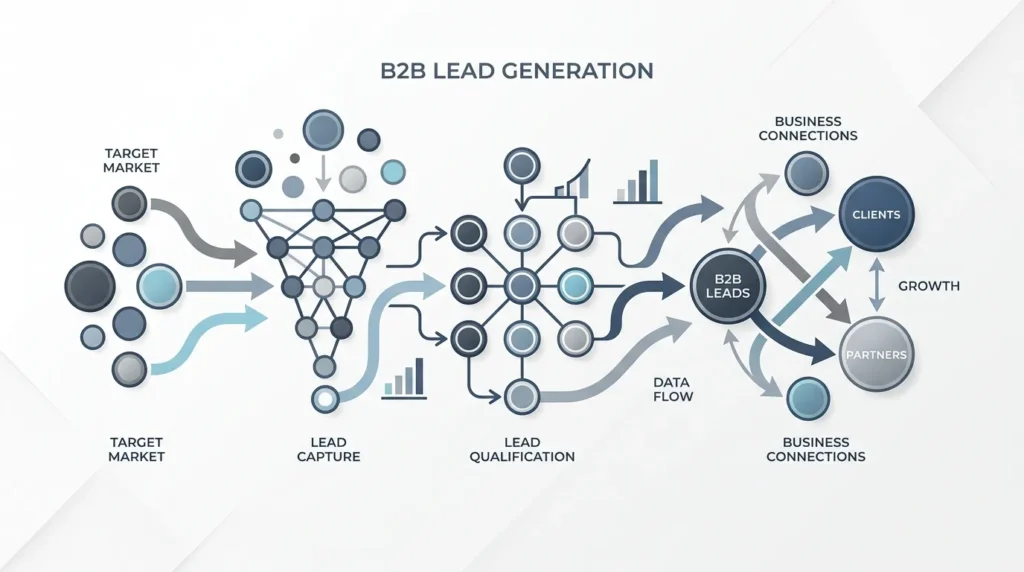
If we are honest, lead generation is often not a channel problem. It is usually a chain problem. Getting attention often still works. But the next steps drop off, or the lead flow is messy, or your follow-up takes too long.
That is why we always think in these steps:
Many teams see lead scoring or qualification as a technique. We see it as product quality: you help salespeople and you help prospects. That is why it is smart to work with a qualification method you can explain, for example based on aspects such as need, fit and timing. Methods like BANT or MEDDIC have existed for a long time and are often used as reference points for conversations and prioritisation. (hubspot.com)
In addition, many marketing teams use “lead scoring” to prioritise and route leads. The idea is simple: you translate signals and criteria into a score so your team knows who deserves attention first. (knowledge.hubspot.com)
Note: lead scoring is never perfect. It is a tool. Sometimes you get a high score from someone who is not ready yet. Sometimes the score is low but the fit is surprisingly strong. That is why a feedback loop with Sales remains essential.
You do not need to do everything at once. Choose 2 to 3 channels that match your sales cycle, your margins and your team capacity. Below are the channels, plus what really matters in practice.
Inbound works well if you want to build demand over several weeks to months. The benefit is often: better intent and lower acquisition costs over time. The downside is: you need to publish consistently and your content has to genuinely match what your audience is searching for.
A useful angle is this: create content that supports a specific buying step. For example, a technical comparison, an implementation plan, or a “how do we choose” guide. If you do that, you make it easier for prospects to trust you. That is exactly where E-E-A-T helps, especially “Experience” and “Trustworthiness”. (developers.google.com)
If you want to roll out inbound further in your organisation, then this hub link fits well: Inbound Marketing: Attract Customers with Valuable Content.
Paid can speed up your pipeline. But it also costs money to do it badly. That is why paid works best when you connect it to a clear route:
For LinkedIn-like environments, we see that “Lead Gen Forms” are often used to reduce friction. The idea is that users leave their details more quickly, with less typing on mobile. LinkedIn also explains that you can work with custom questions and that there are limits and options for fields. (linkedin.com)
Trade-off: faster forms can lead to more volume, but not automatically to better fit. So we recommend always steering on qualifying questions. And we recommend using Sales feedback to adjust your targeting and questions.
Outbound is not spam. Outbound is an appointment strategy. You approach people who are likely to be able to help you. What works in practice:
The pitfall: using outbound without an inbound signal. Then you do not know what your market finds important. That is why many teams combine outbound with content. Content makes your outbound less “cold”.
When you generate leads, you want two things at once:
Lead scoring can help, because you apply criteria and can prioritise records. In tools and knowledge resources, this is often explained as evaluating records against criteria and assigning values to a score property. (knowledge.hubspot.com)
A practical approach we often recommend:
Ask Sales: “when do you say yes to a lead?” and “when do you say no?” Turn those answers into 6 to 10 criteria. For example:
We see that teams often have one MQL idea for everything. We prefer two routes:
This lowers pressure on Sales and prevents you from producing “bad follow-up”. And it makes your marketing more serious. Because it feels less like you are only collecting details.
Clicks tell you that you got attention. They do not tell you whether your lead has value. That is why you at least look at:
Important: attribution is never perfect. Treat this as direction, not exact truth.
You can do targeting extremely well. If your landing page frustrates people, your conversion goes down. Conversion optimisation is not art. It is a set of improvements you implement one by one.
Here is what often makes the difference in practice.
Prospects want three things at the same time:
When your page delivers that, people take action faster. And when your form includes qualification, you get less junk and more conversations.
Speaking of forms, LinkedIn explains that Lead Gen Forms support, among other things, custom questions and fields, with a focus on the user experience. (linkedin.com) This can be useful for certain campaigns, but even there the key point remains: what you ask must fit your qualification needs.
Okay, enough theory. Let’s make it concrete. This is a plan we use to put structure in place within 30 days and learn quickly.
Be honest about what you can expect in 30 days. The goal is not that every experiment immediately “breaks through”. The goal is that you learn the system and speed it up.
If we may leave you with one message, it is this: lead generation works when you see it as a chain, from positioning to qualification and follow-up. Then you can improve where it is stuck. And then you build predictable pipeline instead of random spikes.
Our advice for the next step is simple. Pull up your current flow. Answer three questions in 15 minutes:
After that, you can adjust in a focused way. No major reorganisation. Just better decisions. And yes, that feels less exciting than “a new campaign”. But it usually does deliver results. Growth can be that boring, fortunately.
Book a free strategy call and discover how many leads we can generate for your business. No obligations — just a concrete growth plan.
Book your free strategy call → Book your free strategy call — 30 min, no strings attached