

You’re looking for an internet marketing agency. That makes sense. It just isn’t smart to buy “marketing” at random without knowing what you actually need. We’ve seen it often in practice: one organisation thinks of ads, another of SEO, and both end up missing the core question: who do you want to reach, with which offer, via which route to an appointment or purchase, and how do you measure that properly?
In this article, I’ll walk you through how internet marketing agencies work, which services and specialisms exist, and, above all, when each choice makes sense. No sales talk. Just a practical approach, including what your next step is once you’ve read this.
What does an internet marketing agency really do, and where is the value?
An internet marketing agency helps you optimise online marketing and online sales. That sounds broad, but in practice the value is usually very concrete:
- Strategy that makes sense, from audience and message to channel choice and measurement plan.
- Execution that keeps moving, from landing page to ad, from tracking to follow-up.
- Data-based optimisation, so you’re not steering on gut feeling.
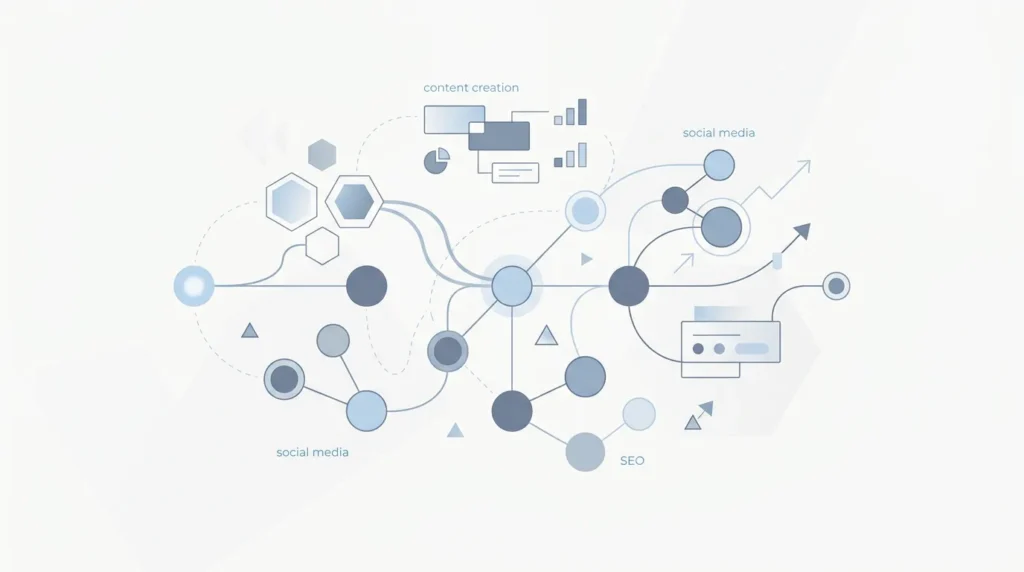
The reason this matters is simple. Online marketing is not a standalone tactic. It’s a system. The moment one part starts to fail, the whole result changes. Think traffic, but also conversions (what happens on your page), and follow-up (how quickly and how relevantly you respond to enquiries).
A good partner therefore won’t just show you campaigns. They’ll show you how the goal, the route, and the measurement fit together.
The key question to ask every agency
Don’t ask “what does it cost?” first. Ask:
- Which conversion actions matter most for us? (for example appointment request, demo request, quote request)
- How do you measure those actions? (tracking, definitions, reporting)
- What do you do if a channel underperforms? How do we decide then, and based on what?
If they give you a clear answer here, you’re usually in good hands. If they stay vague or mostly talk about “branding” without measurable actions, it quickly becomes an expensive hobby.
Services you’ll almost always come across, from strategy to conversion
Many internet marketing agencies offer a mix. But they differ in focus. Here are the most common services, the purpose they’re meant for, and what you can practically expect from them.
1) Search Engine Optimization, SEO
SEO, Search Engine Optimization, focuses on visibility in search results based on relevance and quality. It usually works well when you:
- want structural growth on terms that match your offer
- are willing to invest in content, technical foundations and authority
- think in a conversion-focused way (not just traffic, but enquiries or purchases)
SEO is not a button you can turn on within weeks. The pace depends on competition and your current position. But once it’s in place, it’s often more cost-efficient than relying purely on ads.
A strong SEO team connects SEO to your commercial reality, so to landing pages, internal links, and measurable conversions.
2) Search Engine Advertising, SEA
SEA, Search Engine Advertising, is about ads in search engines. The advantage is speed. You can often get relevant visitors faster than with SEO.
SEA is usually a good choice when:
- you want to act directly on commercial search intent
- you want to test quickly which keywords and messages work
- you have budget to learn, optimise and scale
Important: SEA without proper conversion measurement is like cycling without brakes. You see traffic, but you don’t know whether it’s actually generating real enquiries. SEA should therefore go hand in hand with conversion tracking and a landing page that works.
In Google Ads, for example, the conversion ratio is linked to conversion tracking and conversions per ad interaction, as a measure of how effectively your ads turn traffic into conversions. (support.google.com)
3) Analytics and tracking, especially GA4
In online marketing, measurement is not an afterthought. It’s your steering wheel. Many choices depend on what you measure and how you define it.
GA4, Google Analytics 4, is often used to measure conversions and key events. Google explains how you measure conversions with events and how this can help you track actions that come from organic or other channels. (support.google.com)
There’s also GSC, Google Search Console, which helps you gain insight into search performance and optimise your site for Google Search. Google explicitly positions Search Console as a tool for monitoring website performance and making informed decisions for search results. (support.google.com)
4) CRO, Conversion Rate Optimization
CRO, Conversion Rate Optimization, is about improving conversions on your pages. This is often the most underestimated lever. You can get a lot out of ads, but if your landing page doesn’t convince or isn’t logical, your budget disappears.
Good CRO works with hypotheses. For example:
- Does the offer match the promise in your ad or search result?
- Is the CTA, Call to Action, clear and in the right place?
- Can people quickly see whether it’s for them, and what the next step is?
5) Lead generation and follow-up
Lead Generation here means: attracting potential customers through online marketing and online sales activities. A lead is therefore not “visitors touching the system.” A lead is a person or company showing recognisable commercial interest, for example by submitting an enquiry or starting a contact moment.
An internet marketing agency can help with this through:
- landing pages and forms
- ads and SEO that lead to an appointment route
- lead qualification and CRM follow-up
- optimising response time and conversion to an appointment
Why does this matter? Because many teams do buy traffic, but make the follow-up too late or too generic. Then you get a lot of “interest” but very few appointments. And you won’t always see that gap in dashboards unless you measure the pipeline path properly.
6) Automation, but responsibly
Automation here means: software, AI, workflows, integrations or automated processes to optimise online marketing and sales.
Examples in a marketing and sales context:
- automatic lead routing in your CRM, based on topic or region
- automated follow-up emails or reminders, within predefined rules
- campaign reporting, so your team can adjust faster
Watch the boundary: automated systems should not make budget changes or contractual commitments without human approval. This is also a practical mistake we see in projects, because nobody wants to discover that “the machine” has independently made the wrong calls.
Which specialism makes sense when? Practical decision rules
Okay, now for the real work. You want to know: “which type of internet marketing agency suits us?” Let’s make that practical with decision rules.
When you mainly need SEO
SEO is often logical when:
- you have an offer that can be searched for (services, topics, use cases)
- you can create or improve enough landing pages
- your team is willing to keep improving content and pages continuously
Our starting point is simple: SEO takes patience, but it can become scalable. The trade-off is that you don’t just have to sell in the short term, but build value in the long term.
When SEA is the best start
SEA usually works well when:
- you want to make quick use of market opportunities, for example around seasonal peaks
- you want to test new propositions
- you already have landing pages that can carry conversion
The trade-off is that SEA requires budget and optimisation discipline. You need to keep an eye on CTR, Click-Through Rate, conversion KPIs and cost per action.
When CRO is the biggest lever
CRO is often the priority if you already have traffic or are already spending on ads, but the revenue path is stalling.
Typical signals:
- lots of clicks, but few enquiries
- forms are started, but not completed
- visitors don’t understand within 10 seconds what you offer
The advantage of CRO is that it often delivers impact faster than SEO, provided you have enough traffic to test.
When you need “Full Service”
If your internal capacity is limited, or if you don’t have a complete measurement plan and consistent execution, then a full service marketing agency is often a logical choice. They can bring together strategy, creative, implementation, tracking and optimisation.
An example of how you can approach this can be found in Full Service Marketing Bureau: Everything Under One Roof. Use pages like this mainly as a starting point for the type of service, not as a replacement for your own selection process.
How to choose the right internet marketing agency, without surprises
This is the part where your energy is better spent than on endless quote work. Choose based on the system, not on pretty promises.
1) Their measurement plan, or your measurement plan
Ask how they define and measure conversions. In Google Ads, for example, conversion ratio is linked to conversion tracking. (support.google.com) And in analytics you can measure conversions via events in GA4. (support.google.com)
You therefore want a concrete answer to:
- Which actions count as conversions?
- How do they prevent conversions from being counted twice?
- How do they connect marketing actions to sales follow-up?
2) Their approach to privacy and consent
Online marketing runs on data, and data runs on rules. In Europe, there are requirements around consent when that is needed. The European Commission, for example, describes when consent is valid and emphasises conditions such as explicit consent through a positive action. (commission.europa.eu)
There is also the IAB Europe Transparency and Consent Framework, developed to support transparency and choice in line with GDPR and ePrivacy. (iabeurope.eu)
What you should ask an internet marketing agency in practical terms:
- How do they make sure tracking only runs where consent is required?
- What role does a CMP, Consent Management Platform, play, and which data is or isn’t processed?
- How do they guide you through implementation in your environment?
The goal is not to read legal text. The goal is for your measurability not to collapse, while still acting correctly.
3) Their optimisation cycle, not their calendar
An agency can send a “monthly report”. But what you want is a decision cycle. For example:
- Measure: we see where leads drop off.
- Diagnose: is it the intent, page, offer or follow-up?
- Test: we change one variable.
- Evaluate: we look at conversion, not just clicks.
If they can explain this with examples from similar projects, that’s a good sign.
4) Their input-output ratio
You want to know how much work sits with you. Think about:
- supplying content (copy, proposition, proof)
- product knowledge and sales material
- quick feedback on landing pages and forms
If the agency wants to do everything, but you provide nothing, frictions will arise later. And if you have to do everything while they deliver very little, you’re paying for “management”. You want balance.
Our practical 30 to 60 day plan for the first phase
Suppose you decide today to work with an internet marketing agency. This is how we like to start, because it quickly shows what works.
Step 1, week 1 to 2: sharpen goals and conversion actions
Record:
- Which conversion actions count as success
- What a Marketing Qualified Lead is and what a Sales Qualified Lead is, and how they get that label
- Which reporting you want to see as a KPI, Key Performance Indicator
Trade-off: this is boring work. But it prevents later arguments about “what we actually measured”.
Step 2, week 2 to 3: check tracking and measurability
We check:
- GA4 events and conversion settings, so key events are correct (support.google.com)
- Search Console basics, so SEO insights are usable (support.google.com)
- Ad conversion measurement in SEA, linked to conversion tracking (support.google.com)
- Privacy and consent, so your tracking doesn’t create gaps because of bad implementation (commission.europa.eu)
Step 3, week 3 to 5: quick wins on landing page and offer
We choose a maximum of two landing pages or funnel components to improve. For example:
- make the CTA and form simpler
- add proof and context, so the visitor feels “yes” faster
- align the page message with the ad or search intent
Step 4, week 5 to 8: optimise based on conversion behaviour
Only then do you adjust campaigns, content or targeting based on what you see. We steer on conversion behaviour, so not only on CTR. Clicks are nice, but conversions are the real currency.
If SEA is part of it, you also look at CTR and conversion ratio, because in Google Ads the conversion ratio has a direct link to conversions per ad interaction. (support.google.com)
Conclusion: choosing an internet marketing agency should feel like having control
When you choose an internet marketing agency, you want the company to make your team stronger. Not just with campaigns, but with a system: strategy, execution, measurement and optimisation. Once that chain works, online marketing becomes less about guessing and more about steering.
Take the smart route: start with conversion actions and a measurement plan, check tracking and privacy, and then begin targeted improvements to landing pages and funnel steps. That pace gives you clarity within 30 to 60 days.
And one more thing, with a wink: if someone only tells you how much “reach” they can deliver, but can’t explain how you measure and follow up on real enquiries, then that isn’t internet marketing. That’s mostly a hobby with KPIs in another language.
