
 Written by
Daniel van Hek
Search Clicks·August 19, 2026
11 min read
Written by
Daniel van Hek
Search Clicks·August 19, 2026
11 min read
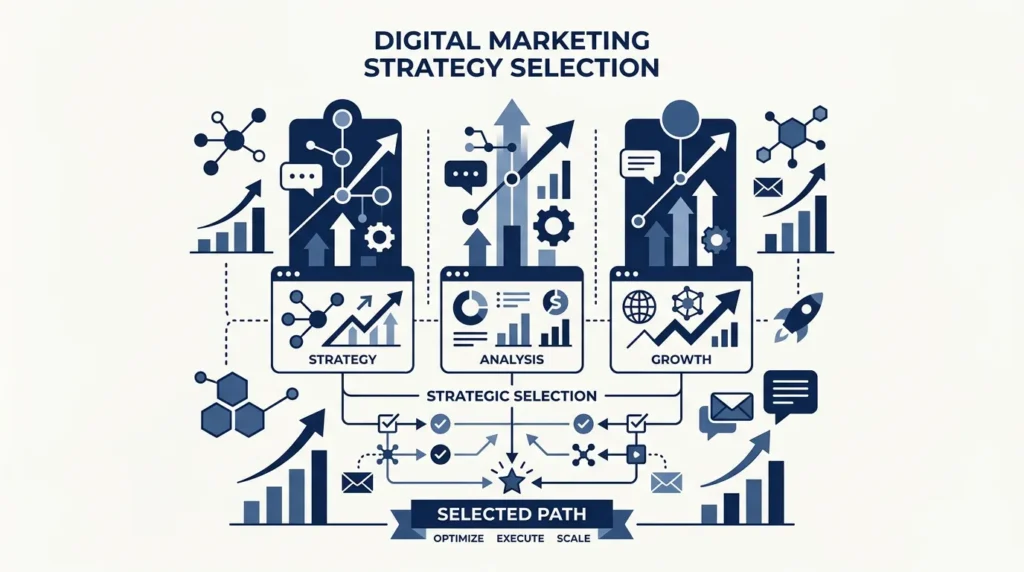
If you’re looking for the best online marketing agency, you often first think of a team that is “good at marketing.” Fair enough. But in practice, you want something different. You want a system that turns online demand into real commercial results: leads, appointments, and customers. That system should also be controllable, measurable, and adjustable.
That’s why we never look at an agency only in terms of creativity or pretty reports. We look at the way they move from strategy to execution, and how they demonstrably learn from data. In other words: we’re looking for someone who masters the process, not just the campaign.
Quick reality check, without killing your enthusiasm. There’s no such thing as one objective “best” agency for every situation. The best agency fits your goals, your market, your sales process, and your budget room. That’s why this guide is practical and to the point.
Here’s the checklist we use in practice. You can use it during conversations, in proposals, and for a trial assignment. Each criterion below has one goal: prevent you from later paying for work you can’t steer.
A serious online marketing agency starts with tracking and definitions. Not as a formality, but to know what “success” means. Think of goals and conversions in Google Analytics 4 (Google Analytics 4) and connections with Google Search Console. Search Console is there to monitor, maintain, and fix issues with your visibility in Google Search. (support.google.com)
In GA4, the idea behind conversions and (in e-commerce scenarios) ecommerce events is also important, so you don’t compare apples with pears. (support.google.com)
Test question for you: “Which conversions do you define, why, and how do you make sure sales and marketing use the same definition?”
Watch the word “targeting.” Everyone uses it. What you need is something concrete enough to base campaigns on: an ICP, or Ideal Customer Profile. A good agency explains which characteristics make your target audience someone who actually has a chance of becoming a customer.
What we look for:
This isn’t academic. A strong ICP reduces friction, because you waste less on people who were going to drop off anyway.
You often see discussions about SEO and E-E-A-T. What Google says is that the concept appears in quality guidelines. E-E-A-T is tied to information quality, including experience, expertise, authoritativeness, and trustworthiness. (developers.google.com)
In practical terms, this means for you:
Important nuance: E-E-A-T is not a magic button. It’s a set of signals around content and context. We use it as a quality filter in content planning.
For SEA, or Search Engine Advertising, and PPC, or Pay-Per-Click, everything revolves around conversions and costs. But watch the definitions.
In advertising, we often talk about:
Google Ads offers strategies that predict based on conversion values, with Google working from conversion tracking and conversion values as you report them. (support.google.com)
In addition, Google Ads also provides information about changing and setting bid strategies around CPA and ROAS, including how labels and settings can change. (support.google.com)
Test question: “Which conversion do you use for optimization, and how do you make sure that value really matches what sales sells?”
You can buy or earn a lot of traffic. Without strong landing pages, it stays guesswork. A good agency approaches CRO, or Conversion Rate Optimization, logically:
Note: “testing” can also be fake, such as changing something every week without a hypothesis or measurement plan. Ask how they prioritize.
In this guide, Lead Generation means exclusively: generating potential customers for companies through online marketing and online sales. A lead is someone with a real commercial interest, for example through a request, an appointment, or an intake you can follow up on.
That’s why you check how they handle the difference between:
If an agency says “leads” and means “website visitors,” then they’re not leads. Then it’s marketing traffic. That may sound dry, but it will save you a lot of discussion later.
We like reporting you can actually use. Not reporting you can only read. Ask about the rhythm:
And above all: how do they make sure you don’t have to start over every time? An agency that is mature keeps track of learnings and translates them into the next sprint.
If they talk about automation, check whether they mean online marketing and sales optimization, for example lead capture, lead qualification, follow-up, updating CRM, and campaign optimization. In your world, automation should help you, not gamble.
And extra important: automated systems should not make unauthorized budget changes or contractual commitments without human approval. That’s not just “best practice”; it’s a maturity line.
So ask: “Which automation do you use, which triggers do you use, and who approves decisions before any money or appointments are affected?”
Alright, you have criteria. Now you want to know how to turn them into choices. Here’s a conversation template we like to use. It forces concrete answers.
Tell them:
Then agencies can immediately show whether they understand it.
A good agency gives you a plan you can test. Not a perfect story. But a plan with:
This last part is gold. It shows whether they really learn or just execute.
We recommend a trial assignment with a clear output. Think of:
The trial should end with decisions. Not just slides.
It sounds human, but it’s business. How quickly do they respond? Are their answers concrete? Do they explain trade-offs?
An agency that’s good will also dare to say “no” or slow down an approach if the data isn’t there yet. That’s often a sign of professionalism, not a lack of ambition.
Let’s keep it simple. The best agency approach is often channel mix plus pace. Below is a practical roadmap that often works well.
Why this order works: you don’t just want traffic, you want insight. SEA can give faster feedback, while SEO builds knowledge for later.
Often the bottleneck isn’t “reach.” It’s the step from visit to commercial intent.
The trade-off you need to accept: lower costs often go together with stricter selection. That’s good, as long as deal quality goes up or stays the same.
Some agencies are fully integrated and handle strategy, execution, and optimization end to end. If that’s what you want, also look at this piece about a Full Service Marketing Bureau: Everything Under One Roof. Use it mainly as a framework to check whether responsibility for measurability, content, and conversion is truly placed with one team, and not fragmented.
You can’t “tick off” E-E-A-T with one sentence. But you can assess whether an agency is trustworthy. According to Google’s own material on quality and E-E-A-T, it’s about experience, expertise, authoritativeness, and trustworthiness as part of quality assessment. (developers.google.com)
In selection, that means for you:
And again, a friendly reminder. Be careful with any agency that “guarantees” you’ll rank higher or that revenue will rise immediately. That kind of claim is not professional and doesn’t fit how online marketing really works.
If you want to move forward today, do this. No long preparation. Just clear actions.
Then you have a choice you can justify to your team and your management. And honestly, it also saves you a lot of coffee with “we’ll take another look.”
Conclusion: The best online marketing agency is the agency that understands your online sales process, makes it measurable, and continuously optimizes it based on conversion and lead quality. Use the criteria in this guide, turn conversations into a trial assignment, and choose based on execution plus learning ability. That’s the fastest route to online growth you can truly control.
Book a free strategy call and discover how many leads we can generate for your business. No obligations — just a concrete growth plan.
Book your free strategy call → Book your free strategy call — 30 min, no strings attached