
 Written by
Daniel van Hek
Search Clicks·August 22, 2026
9 min read
Written by
Daniel van Hek
Search Clicks·August 22, 2026
9 min read
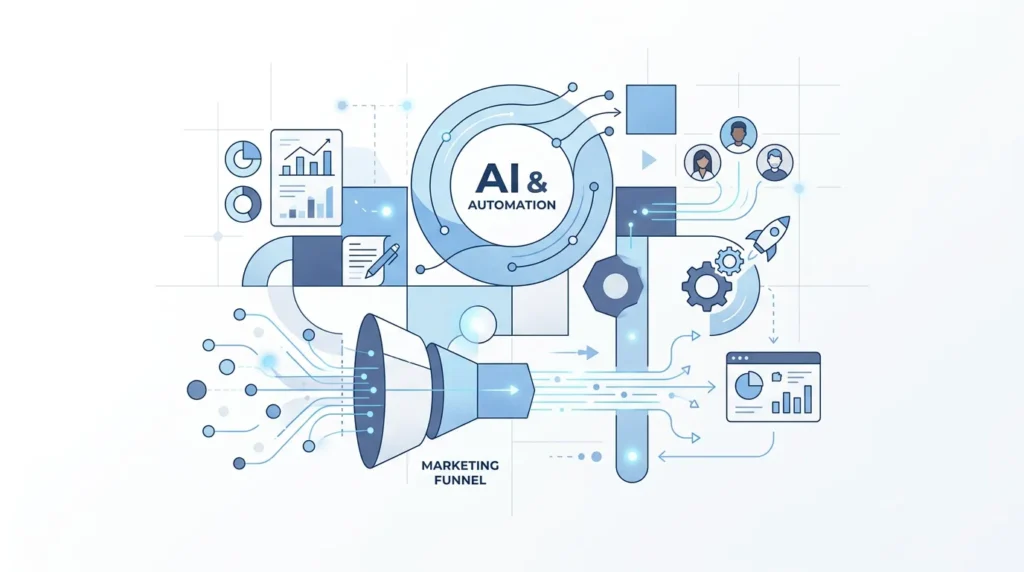
Imagine your team not repeating the same actions every week. Not because we are getting lazy, but because we want to work smarter. AI automation can do exactly that, if you approach it as a marketing and sales system, not as a gadget.
In practice, we see that most of the gain does not come from “cool AI”, but from two things you can control: faster follow-up and better decisions based on data. AI can speed up both. But only if you set up your measurement plan and your process properly.
In this article, we help you step by step with an approach that works for online marketing and lead generation, including chatbots, predictive analytics, and personalization. We keep it concrete, with trade-offs and a clear next step.
Let’s start with the core. In marketing and sales, everything revolves around the chain from attention to contact, and from contact to an appointment or sale. AI automation usually helps at one of these stages:
Why does this work? Because your marketing and sales spend less time on manual work and get more time for decisions. And decisions improve when you make clear what you mean by “quality” (not just volume).
Alright, use cases. Not 25 ideas. Just the 6 we see most often as real impact. Including what can go wrong.
A chatbot is only useful when it gathers information your sales team can use. Think: industry, desired solution, budget range (if you are allowed to ask), timing, and the main success factor.
What you build: a conversation that asks questions and structures the answers into fields in your Customer Relationship Management (CRM).
Why it works: you shorten the time between interest and contact, and you make the lead more usable. On top of that, you can automate routing based on intent.
Trade-off: if your questions are too aggressive or you store the fields in a messy way, you frustrate your visitor. And then you get less quality.
You already know when someone is giving off “signals”: downloads, contact requests, multiple page visits, or visits to a pricing or case page. AI can combine that with historical data and decide faster which follow-up makes the most sense.
What you automate: e-mail and message sequences, with logic such as: “No reply within X hours, send a short check-in with relevant material”.
Why it works: speed and relevance increase the chance that a contact moves along in the funnel.
Trade-off: too much automation sounds efficient, but sometimes feels generic. That is why you need content templates with dynamic variables, and you need a way to quickly add a “human in the loop” when intent is high.
Lead scoring is often poorly implemented: one model, one score, and done. We prefer a different approach. AI predictive models can assign a score for “chance of booking an appointment” or “chance of qualification”.
What you need: historical progression in your CRM, definitions of a Marketing Qualified Lead (MQL) and Sales Qualified Lead (SQL), and a measurable conversion action.
Why it works: you do not optimize on clicks alone, but on the likelihood of a sales-worthy outcome.
Trade-off: models learn from the past. If your offer or market changes, you need to adjust.
Personalization works when you connect it to intent. So not “we know who you are”. Rather “you asked for X, so you get Y”.
What you personalize: landing page content based on ad or search intent, dynamic FAQs, and adapted examples.
Why it works: you reduce friction. Visitors see relevance faster, so they keep going.
Trade-off: too many variants create chaos in testing. Keep it limited and test with purpose.
This is less sexy, but the gain is big. AI can help spot deviations faster and provide summaries for your team.
What you automate: weekly checks on key event volumes, conversion-path deviations, and channel performance based on the KPI’s you set.
Why it works: you detect problems earlier, so you do not only notice afterward that things went wrong.
Trade-off: if your tracking is wrong, AI will report it beautifully and incorrectly.
The “secret sauce” is often not the AI model. It is the data flow. AI only works well when CRM data, website events, and ad conversions are consistent.
What you set up: a clear event catalog and a standard for lead fields. You avoid different teams using different definitions.
Why it works: you make optimization measurable and repeatable.
Trade-off: this takes discipline. Better to run a few fewer pilots than create data chaos.
We say it often, with a smile, but it is true: AI can only steer on what you measure. That is why our approach usually starts with a measurement plan for online marketing and sales optimization.
In Google Analytics 4 (GA4), you work with events and set key events for what matters to you. Google explains that GA4 uses an event-based measurement model and that events must be set up correctly. (developers.google.com)
In practice: first define:
You want to avoid optimizing for “almost success”. Google also explains that your attribution settings can affect conversions and key events. (support.google.com)
In practice: create one source of truth for your team:
We use a simple system: an event contract is a list with event name, definition, trigger, and required parameters. You want your team not to get creative with names.
Why: AI automation becomes inconsistent quickly if definitions shift.
We want you to use AI safely. Not because we are afraid, but because online marketing and sales affect real people, real budgets, and real customer relationships.
A useful framework is the NIST Artificial Intelligence Risk Management Framework (AI RMF 1.0), with principles for managing AI risks, intended as a voluntary guideline. (nist.gov)
Use this as a way of thinking about how you deploy AI automation. Concretely, for marketing and sales it means:
Trade-off: governance takes time. But it prevents you from rolling out a beautiful automation that you later have to roll back, with reputational damage as a side effect.
Let’s make this practical. Below is a roadmap you can start with an existing marketing and sales process.
We usually choose one of these:
Why one? Because otherwise you will not know what caused the effect. AI automation needs test discipline.
Your KPI’s need to be linked to your definitions of lead quality and business outcome. Examples:
And yes, sometimes there is no “magic” effect. That is information too. Then the cause is usually tracking, definitions, or content.
If you organize this properly, AI automation becomes part of a larger system. Think about flows for lead capture, lead qualification, and campaign optimization.
A useful parallel is an approach around Marketing Automation: Efficiency and Growth Through Smart Flows. The idea there lines up with our approach: create flows that are repeatable, and let AI only do what makes your process smarter.
If we were tackling this together, we would start tomorrow with one short sprint. No long roadmap workshop. No presentation without decisions.
Only then do you “roll out” AI automation. Otherwise, you get a prototype that looks good, but does not become more reliable in the real funnel.
AI automation can speed up your online marketing and sales, provided you connect it to lead quality, fast follow-up, and a measurement plan that is correct. The best results usually do not come from a complex AI stack, but from simple automations with clear definitions and governance.
If you want to win with AI, make sure you have three things: a consistent measurement contract, a workflow that supports human management, and short iterations based on KPI’s. Then AI automation shifts from experiment to operational advantage.
Book a free strategy call and discover how many leads we can generate for your business. No obligations — just a concrete growth plan.
Book your free strategy call → Book your free strategy call — 30 min, no strings attached