

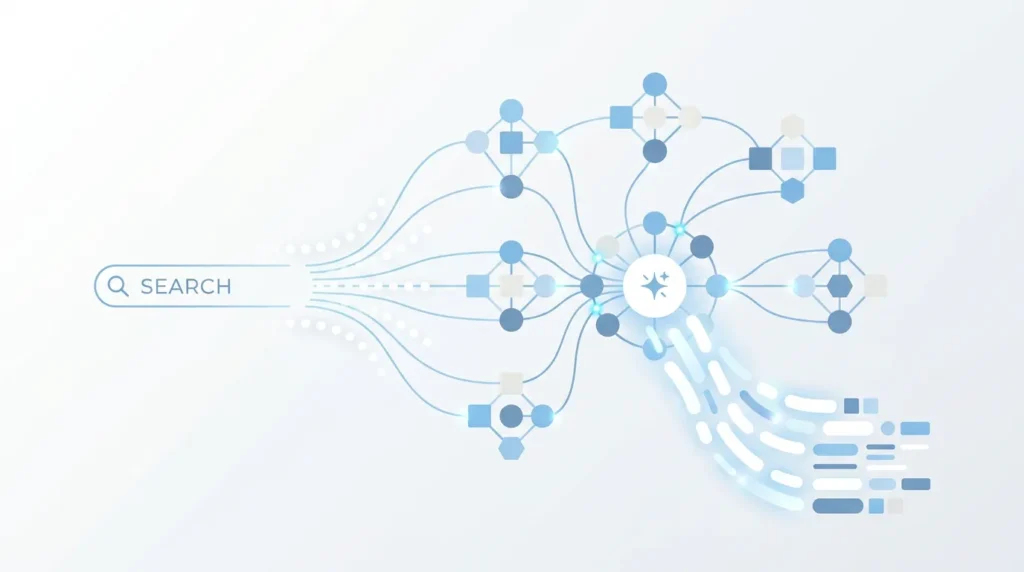
Grab your coffee. Because if you still rely entirely on “classic” search results today, you’re probably missing the next wave in online demand. An AI search engine doesn’t just pull up links and snippets. It generates answers, summarizes sources, and shapes user behavior. That has a direct impact on SEO, Search Engine Advertising, and conversions on your landing pages.
In this article, we’ll walk you through what AI search engines do, why people use them, and, most importantly, what you need to adjust in practice to keep getting found by the right people. No hype. Just a workable plan.
What is an AI search engine, in plain language?
An AI search engine combines two things:
- Search: the system scans web pages or uses a knowledge layer.
- Generate: the system writes an answer that flows logically, often with references to sources.
The result feels less like “search and click” and more like “ask a question and get an answer”. OpenAI describes this explicitly in ChatGPT search: web search is part of how answers are assembled. (openai.com)
Google has also introduced generative experiences in Search, such as Search Generative Experience (SGE), later developed further toward AI Overviews. (blog.google)
Why you need to understand this
Because the click path is changing. If the user already gets a useful answer based on your source mention, they may click through less often. That sounds bad, but it doesn’t have to be. It mainly changes your KPIs. You’re not only steering on traffic, but on the quality of the question that comes in and on how quickly your answer makes the conversation worth having.
How AI-driven search results change search behavior
In practice, we see three patterns. These are not laws, but typical trends that affect your conversions.
1) From short queries to intent queries
People ask longer questions more often. Not because they suddenly got smarter, but because they want less hassle. Instead of “best solution”, you now more often see “which solution fits situation X and Y”. That fits generative search experiences designed to speed up the answer journey. Google describes these kinds of “information journeys” in the context of generative search experiences. (services.google.com)
2) From click to evaluation
The user evaluates earlier. If you stand out with clear, credible, and coherent information, you’re more likely to be “pulled through” into an answer or shortlist, even if the click doesn’t always happen right away.
3) From one moment to multiple micro-moments
An AI answer is often a starting point. Users ask follow-up questions. If your content structure doesn’t help with that follow-up question, you lose the second step: the moment when someone really needs your page.
What you need to do commercially
You’re not only optimizing for rankings. You’re optimizing for “the question you solve”. That means your content needs to answer in the way the user frames the question in AI, and your landing page has to show within 10 to 20 seconds that you understand their situation.
AI search engine in practice: what your site needs to do differently
Okay, enough theory. Let’s get into what you can adjust now. We’ll build this in three layers: content, technical findability, and conversion.
Layer 1: content that is easy to answer with
An AI search environment often tries to combine information into one coherent answer. You can use that to your advantage.
What usually works:
- Clear problem and context sections: don’t just write about your product, but about the situation in which someone needs you.
- FAQs that actually add new answers: not “What is it?”, but “When do you choose option A vs B?”, “What input do you need?”, “What are the pitfalls?”
- Step-by-step plans and decision criteria: AI can more easily summarize what is already written as a process or checklist.
- Consistent terms: use the same words as in your sales conversations. That lowers the chance of misinterpretation.
Why this works: you give the system text fragments that fit neatly into an answer semantically. You make it less of a puzzle for AI.
Trade-off: too much “content for AI” without a human story makes your text flat. That’s why we always steer on readability and sales logic. AI wants structure. Your lead wants trust.
If you want to extend that generative angle more broadly, this aligns well with GEO (Generative Engine Optimization): The Future of Search Engines. See it as a roadmap, not a replacement for SEO.
Layer 2: technical findability still matters
Even though generative systems work differently, Google and other “search-like” environments still rely on indexing and accessibility.
These are the checks we do by default:
- Indexability: can the page be indexed, and is the content not accidentally blocked?
- Internal links: does your main topic cluster point to the pages that should support the answers?
- URL structure and canonicals: prevent variants from pushing each other down.
- Fast, clear page structure: H2s that actually describe the content. AI more easily picks up what is semantically correct.
Realistic expectation: you don’t need to rebuild everything. But you do need to make sure your best pages are the most logical places to reference.
Layer 3: optimize conversion for AI-driven visitors
If your traffic changes, your funnel changes too. That’s why we treat conversion as a separate project.
What we adjust on landing pages:
- Above the fold: within 2 sentences, it should say who you are and in what situation you help.
- Proof where doubt appears: use cases, approach, and concrete deliverables, not only at the bottom.
- Form or appointment, with minimal friction: ask only for what you really need to plan a good next step.
- Common objections: pricing structure, lead time, implementation, and what you need from the client.
Important: make a distinction between traffic and a real lead. A lead means a person or company with commercial interest and often identifiable contact details, obtained through a signup or request. Website visits and clicks are therefore not automatically leads.
SEO and SEA under AI search engines: what’s your best route?
This is where it gets interesting. AI search engines are changing the inflow. But SEO and Search Engine Advertising remain the push you need to get the right people to the right page.
SEO: aim for answer intent and topic clusters
In classic SEO, you often steer on keywords. In an AI search context, you more often steer on question types. That means:
- Create pages that answer decision questions.
- Work with topic clusters: one primary page with context, plus supporting pages per sub-question.
- Optimize for clarity. Think in terms of “explanation”, not only “optimization”.
Next step (SEO): take the pages that are already ranking well for relevant intent. Don’t leave them on their own. Add supporting sections and internal links based on the questions your sales team actually hears.
SEA: use ads to lower the barrier
AI answer systems can reduce clicks. With SEA, you can still be present at the moment the user is ready to act.
Practical advice:
- Make campaigns match the intent you see: informational questions versus “I want to compare quotes”.
- Use landing pages that differ by intent. One generic landing page for everything is often the fastest way to kill your conversion rate.
- Measure not only Click-Through Rate (CTR), but also conversions into a lead and the quality of that lead.
Here we consistently define the key metrics. If someone fills in a form and that leads to a commercial next step, it counts as a lead. If you also want to safeguard quality afterward, work with Marketing Qualified Lead and Sales Qualified Lead, depending on your qualification rules.
Attribution and measurement, without driving yourself crazy
AI search engines can influence behavior before the click. That means your analytics will never be “perfect”. But you can still get workable insights.
Our minimum setup is:
- Google Analytics 4 (GA4) for on-site behavior.
- Google Search Console (GSC) for search insights.
- Google Tag Manager (GTM) for consistent event tracking on landing pages.
Next step (measurement): list your conversion events. Set up your reporting so you always distinguish between “visit” and “lead”. Also, for each landing page, clearly map the main question and the associated ad or search intent cluster in your analysis.
What you can do tomorrow: an actionable 30-day plan
If we need to kick off this journey fast, we do it in short iterations. No big transformation in one weekend. But yes, with pace and controlled risk.
Days 1 to 7: diagnosis
- Map your top-10 landing pages. Which ones generate leads, and which ones mainly generate traffic?
- Pull your sales conversations or CRM notes. Collect the most common questions and objections.
- Make a shortlist of 5 pages that best serve “answer intent”, and 5 pages with the most potential to improve.
Days 8 to 14: content and structure
- Refine the context section for each page. Who does it help, in what situation, and with which approach.
- Add 3 to 6 decision questions in the form of subheadings (H2 or H3).
- Set up internal links to supporting pages. Make the “answer journey” logical.
Days 15 to 21: conversion
- Rebuild above the fold: problem, solution, and proof in short sentences.
- Optimize the form or CTA for your sales process (for example appointment, request, or demo).
- Check speed, readability, and mobile performance.
Days 22 to 30: align SEO and SEA
- Restructure your SEO content clusters around intents, not around isolated keywords.
- Adjust SEA campaigns to landing page intent. Move budget where conversion quality is better, not where CTR is only high.
- Report per landing page: lead rate and lead quality as separate assessments.
Note: this plan works best if you use a clear lead definition and have enough data. Otherwise, it’s hard to see the real impact. And yes, we know that sounds like “it’s your tracking”, but without reliable measurement you can only guess.
Conclusion: AI search engine does not mean “write off SEO”
An AI search engine changes the way people consume answers. They move faster, ask different questions, and sometimes click through less. That’s not a disaster. It’s a shift in how you earn attention.
If you:
- create content that directly solves decision questions,
- keep your site technically clean so information remains easy to find,
- and measure and improve your conversion based on lead quality,
then we stay commercially relevant, even in a world where answers are sometimes already summarized on the search page.
Our advice for the next step is simple: choose one content cluster, improve the landing pages for lead quality, and align SEO and SEA to that. That way, you quickly learn where your biggest gains are. And your coffee still tastes great, even if your competitors are still chasing “more clicks”.
